


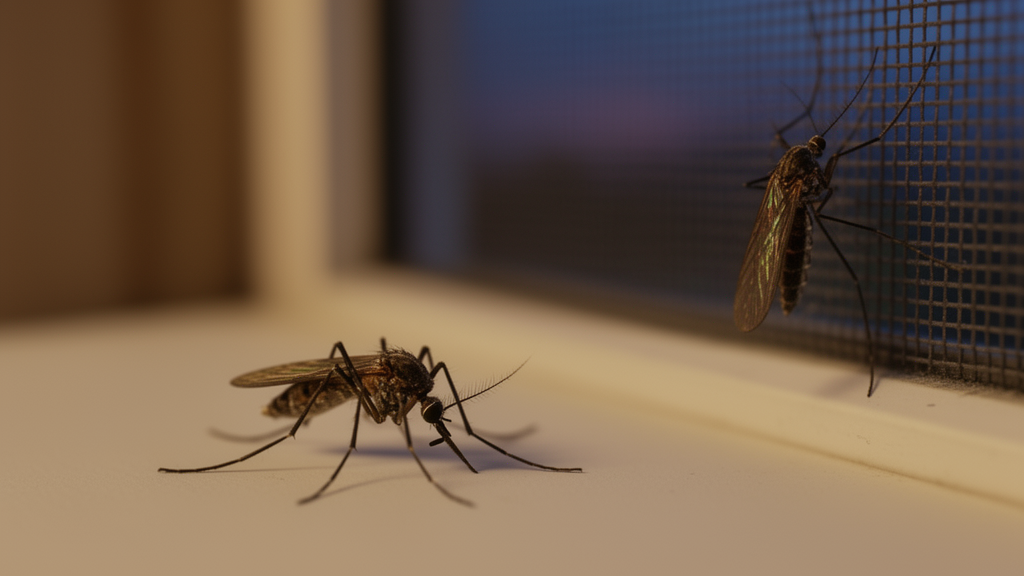
Malaria control depends on a deceptively simple idea: put an insecticide between a mosquito and a human being, and the mosquito dies before it can transmit the parasite. For decades, that idea has been undermined by resistance, the slow evolutionary process by which mosquito populations survive doses of chemicals that once killed them outright. A new study of the major African malaria vector Anopheles coluzzii adds a troubling and fascinating dimension to this picture. It shows that resistance is not merely a matter of surviving a toxic encounter. Instead, the resistance status of a mosquito appears to predetermine how it behaves when it meets an insecticide again, and even how successfully it reproduces afterward. The findings, published in PLOS One by Ehimwenma Aghahowa and colleagues, suggest that resistance monitoring programs that measure only mortality may be missing half the story.
The research team exposed laboratory populations of Anopheles coluzzii to three of the most important compounds used in vector control: the pyrethroids lambda-cyhalothrin at 0.05 percent and permethrin at 0.75 percent, and the organochlorine DDT at 4 percent. These are standard diagnostic concentrations used in World Health Organization-style susceptibility testing, which makes the results directly comparable with routine surveillance data collected across malaria-endemic regions. Male and female mosquitoes aged three to five days were tested in eight replicates, with 25 mosquitoes of each sex per insecticide per replicate, for a total of 2,000 mosquitoes in the susceptibility phase of the study. That scale matters, because behavioral ecology is notoriously variable, and small samples can easily generate artifacts that vanish on replication.
The experimental design was elegantly simple. Mosquitoes that survived exposure to the insecticides were classified as resistant cohorts, separated by sex into holding buckets, provided with sugar, and allowed an hour to acclimatize. The researchers then used a set of square-shaped containers connected by a pipe into an H-shaped apparatus. One chamber held insecticide-treated paper, abbreviated WITP, while the other held untreated paper, WOITP. Resistant mosquitoes, 15 per replicate in triplicate for each insecticide, were released into this arena and could choose where to fly, rest, land, and attempt to feed. The same assay was run with unexposed mosquitoes as a comparison. The team recorded flight efficiency, resting efficiency, repellency, landing, and biting behavior, translating each into quantitative scores across the observation period.
The behavioral results were strikingly asymmetric. Among resistant mosquitoes exposed to treated paper, flight efficiency rose dramatically, with mean scores climbing from 3.00 to 30.5 over the course of the assay. In the untreated chamber, by contrast, flight efficiency collapsed, with means falling from 2.00 to 0.50. Both trends were highly significant, with p-values below 0.0001. In plain terms, resistant mosquitoes that encountered the insecticide became hyperactive, darting around the treated environment rather than settling in it. This kind of locomotor stimulation is a well-documented consequence of sublethal pyrethroid and DDT exposure, but seeing it quantified against a matched untreated control makes the pattern unusually clear.
Resting behavior told the mirror-image story. In the treated chamber, resting efficiency plummeted from a mean of 12.50 to 0.00, while in the untreated chamber it climbed from 11.50 to 13.50, again with p-values below 0.0001. Repellency scores followed a similar trajectory in the treated environment, falling from 14.00 to 0.00, although responses in the untreated chamber did not follow a regular pattern. Landing and biting behavior likewise lacked a consistent trend across treatments. The overall picture is one of avoidance: resistant mosquitoes exposed to insecticide-treated surfaces abandon resting positions, take flight, and effectively vacate the treated zone. From an evolutionary standpoint, this is exactly what one would expect selection to favor. A mosquito that rests on a treated wall dies; a mosquito that detects the chemical and leaves survives to reproduce.
That adaptive logic, however, is precisely what makes the finding alarming for public health. Behavioral resistance of this kind can erode the effectiveness of insecticide-treated bed nets and indoor residual spraying without ever showing up in a standard susceptibility test. A net treated with a pyrethroid still kills susceptible mosquitoes that land on it, but a population that has evolved both physiological tolerance and irritant avoidance may simply feed outdoors, earlier in the evening, or on livestock, shifting the entire transmission dynamic. The study’s demonstration that resistance status predetermines these behavioral responses means that surveillance programs could, in principle, predict which populations are likely to evade control measures before those failures become visible as rising case numbers.
The reproductive findings add a second, less obvious layer of concern. The researchers crossed exposed and unexposed males and females in all combinations and assessed oviposition fitness, the ability of females to produce and lay eggs. Unexposed female mosquitoes took the largest blood meals, with a mean of 11.5, which matters because blood feeding drives both egg production and parasite transmission. The highest oviposition success was recorded in crosses between unexposed males and unexposed females, with a mean of 0.33. Every other cross, involving at least one insecticide-exposed parent, produced no eggs at all, with a mean of 0.00. Insecticide exposure, in other words, imposed a form of reproductive impairment that persisted even in mosquitoes that had survived the chemical encounter.
This sublethal reproductive cost has implications that cut in two directions. On one hand, it suggests that insecticide exposure carries a fitness penalty for resistant mosquitoes, which could theoretically slow the spread of resistance genes if exposed individuals contribute fewer offspring to the next generation. On the other hand, the complete absence of oviposition in crosses involving exposed parents hints at physiological damage, perhaps to sperm viability, egg maturation, or mating behavior, that standard resistance metrics never capture. If resistant females avoid treated surfaces and then fail to reproduce after incidental exposure, the population dynamics of resistance become far more complex than simple selection models assume. Understanding these trade-offs could inform strategies that deliberately exploit them, such as deploying compounds that maximize behavioral disruption and sterility in resistant populations rather than relying on outright kill.
The study also highlights a methodological gap in how the entomological community tracks resistance. Standard tube and cone bioassays measure knockdown and mortality over 24 hours, a binary outcome that says nothing about what a surviving mosquito does next. The H-tube behavioral arena used here, by contrast, converts flight, resting, repellency, landing, and biting into measurable endpoints that can be tracked alongside mortality. Incorporating such behavioral assays into routine monitoring would give control programs a leading indicator of operational failure, allowing them to rotate insecticide classes, deploy synergists like piperonyl butoxide, or introduce new-generation nets before avoidance behavior becomes entrenched. The authors argue explicitly that behavioral endpoints deserve a place in resistance monitoring programs, and the data they present make a strong case.
There are, of course, caveats worth keeping in mind. The work was conducted on a single vector species under controlled laboratory conditions, with relatively small cohorts of 15 mosquitoes per replicate in the behavioral assays, and the mechanisms linking exposure to oviposition failure remain to be identified. Field populations face a mosaic of insecticide pressures, environmental stresses, and parasite infections that no laboratory arena can fully reproduce. Yet the core message survives these limitations intact: resistance is a package deal, bundling physiological survival with altered behavior and diminished reproduction. As malaria vectors across Africa continue to evolve under intense chemical pressure, tools that reveal the full phenotype of a resistant mosquito, not just whether it dies on a treated paper, will be essential for keeping bed nets, sprays, and the decades of investment behind them effective.
Subject of Research: Behavioural responses and oviposition fitness of insecticide-resistant Anopheles coluzzii mosquitoes
Article Title: Insecticide resistance status predetermines behavioural responses and oviposition fitness in Anopheles coluzzii
Article References: Aghahowa, E., Enwemiwe, V. N., Esiwo, E., Edhebe, P. O., Ifeta, S. E., & Ojianwuna, C. C. (2026). Insecticide resistance status predetermines behavioural responses and oviposition fitness in Anopheles coluzzii. PLOS One, 21(10), e0360986. https://doi.org/10.1371/journal.pone.0360986
Image Credits: AI Generated
DOI: 10.1371/journal.pone.0360986
Keywords: Anopheles coluzzii, malaria, insecticide resistance, behavioural resistance, pyrethroids, DDT, lambda-cyhalothrin, permethrin, oviposition, vector control, mosquito behavior, resistance monitoring
Cite Scienmag News
Gavin Prescott. (October 19, 2026). Insecticide-Resistant Mosquitoes Change Behavior and Lose Reproductive Fitness. Scienmag. https://scienmag.com/insecticide-resistant-mosquitoes-change-behavior-and-lose-reproductive-fitness/
Gavin Prescott. "Insecticide-Resistant Mosquitoes Change Behavior and Lose Reproductive Fitness." Scienmag, 19 October 2026, https://scienmag.com/insecticide-resistant-mosquitoes-change-behavior-and-lose-reproductive-fitness/. Accessed 19 October 2026.
Gavin Prescott. "Insecticide-Resistant Mosquitoes Change Behavior and Lose Reproductive Fitness." Scienmag. October 19, 2026. https://scienmag.com/insecticide-resistant-mosquitoes-change-behavior-and-lose-reproductive-fitness/


