

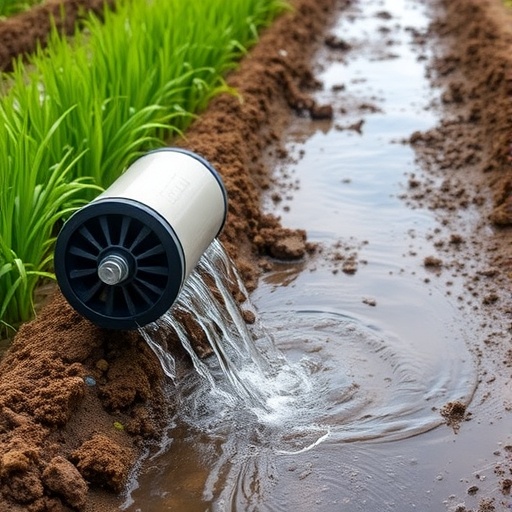
In a groundbreaking advancement for sustainable agriculture and water quality management, researchers at the University of Illinois Urbana-Champaign have unveiled an innovative edge-of-field water treatment system that significantly curtails the nutrient pollution from farm drainage. This system ingeniously integrates a traditional woodchip bioreactor with a novel biochar water-treatment module, targeting both nitrogen and phosphorus—two primary culprits in agricultural runoff that fuel widespread ecological damage, such as harmful algal blooms and freshwater eutrophication.
Traditional woodchip bioreactors have long been employed to mitigate nitrogen pollution by fostering denitrifying bacteria that transform nitrate—a prevalent and damaging nitrogen species in runoff—into benign nitrogen gas. However, these systems fall short when it comes to phosphorus removal, a critical gap given phosphorus’s role in exacerbating water quality degradation. Moreover, initial deployment of woodchip bioreactors can unintentionally elevate phosphorus levels, likely due to leaching from the wood itself, raising concerns for environmental managers seeking holistic nutrient pollution solutions.
Leading the charge, Wei Zheng and postdoctoral researcher Hongxu Zhou from the Illinois Sustainable Technology Center developed a “designer biochar” module to complement the woodchip bioreactor’s capabilities. This two-tiered approach involves routing drainage water through the bioreactor as usual, reducing nitrogen load through microbial processes, before passing it through a biochar-sorption channel engineered specifically to trap dissolved phosphorus. The chemical basis of phosphorus capture involves reactions that convert soluble phosphate into stable mineral compounds such as magnesium phosphate and calcium phosphate, which offer the added benefit of potential reuse as sustainable fertilizer inputs.
The biochar itself, crafted through a meticulous process of thermally treating a mixture of lime sludge—an industrial byproduct from water treatment—and fine sawdust under oxygen-limited conditions, is designed to maximize phosphorus affinity. After pyrolysis, the resulting biochar powder is pelletized, a critical design feature ensuring the material remains intact within the sorption channels, resisting washout and maintaining consistent nutrient capture capabilities. This innovation not only boosts treatment efficacy but also enhances operational resilience across variable flow regimes.
During a one-year, hectare-scale field trial, this hybrid bioreactor-biochar system demonstrated remarkable reductions in nutrient runoff. Nitrate-nitrogen levels dropped by 58%, while ammonium-nitrogen—a related, often overlooked pollutant—was reduced by 72%. Phosphorus removal was even more strikingly variable yet potent, with dissolved phosphorus decreasing between 3% and 92%, and total phosphorus loads curtailed by 20% to 92%, depending heavily on seasonal flow conditions and phosphorus concentrations. These results mark a major leap forward in multifunctional treatment technology critical for comprehensive nutrient management on agricultural lands.
Economic feasibility, a major consideration for farm-scale adoption, was rigorously assessed through techno-economic modeling. The unit cost of nitrate-nitrogen removal stood at an estimated $90.30 per kilogram per year, with dissolved reactive phosphorus removal costing $63.90 per kilogram annually. Importantly, projections suggest that scaling the system from one hectare to larger operational scales—such as 10 hectares—would drastically reduce these unit costs, making widespread implementation more financially viable, especially when coupled with the agronomic benefits of biochar reuse.
The potential for circular nutrient management does not end at water treatment. The biochar that captures phosphorus can be reapplied directly to farm soils, effectively turning a waste product into a valuable fertilizer resource. This nutrient recycling not only offsets the environmental footprint but can also enhance soil health, improve crop yields, and promote carbon sequestration. Farmers could additionally benefit from carbon credit markets, providing further incentives for adoption of this technology.
Scientists caution that while this combined system offers promising performance, larger-scale commercial testing is underway to validate effectiveness across diverse farming operations and hydrological conditions. Such investigations will help refine operational parameters, explore long-term stability, and evaluate maintenance requirements. The involvement and endorsement of regulatory bodies like the U.S. Environmental Protection Agency underscore the system’s potential environmental significance and policy relevance.
The ingenuity of this bioreactor-biochar system exemplifies how sustainable engineering coupled with novel material science can address complex environmental challenges. By tackling nitrogen and phosphorus pollution simultaneously through biologically and chemically synergistic pathways, this approach could reset standards in agricultural runoff management, protecting aquatic ecosystems from nutrient over-enrichment and the cascade of ecological disruptions that follow.
As farmers, policymakers, and environmental managers grapple with the escalating consequences of nutrient pollution worldwide, innovations such as this offer hope for scalable, economically viable solutions. Beyond mere mitigation, the technology envisions a regenerative future where wastes become resources and agriculture harmonizes more closely with natural ecosystem processes.
In conclusion, the Illinois team’s extensive experimental study and techno-economic analysis not only validate the functional and financial promise of this combined bioreactor-biochar approach but also highlight the indispensable role of interdisciplinary research in fostering next-generation environmental technologies. The full implications of this system’s deployment could extend beyond water quality, shaping broader strategies for sustainable nutrient management and climate-smart agriculture in the decades ahead.
Subject of Research: Not applicable
Article Title: Performance, stability, and cost-effectiveness of a bioreactor-biochar (B2) system for nutrient removal from agricultural drainage
News Publication Date: 4-Dec-2025
Web References:
Image Credits: Photo by Michelle Hassel
Keywords: Agricultural runoff, nutrient removal, bioreactor, biochar, phosphorus removal, nitrogen removal, water treatment, biochar pelletization, lime sludge, techno-economic analysis, sustainable agriculture, algal blooms, environmental chemistry


