


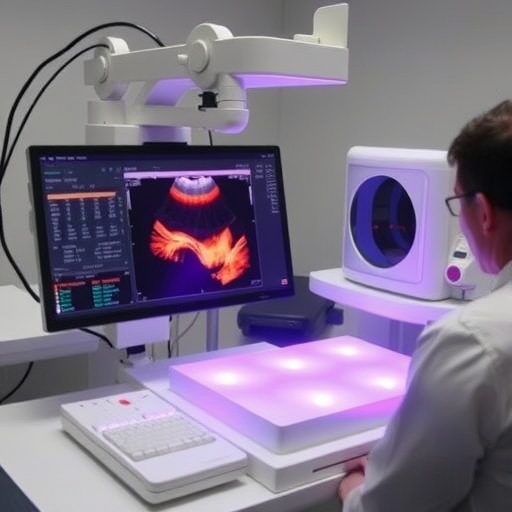
A pioneering research team at Carnegie Mellon University has unveiled a groundbreaking noninvasive brain stimulation technique that builds upon years of focused ultrasound research. This advance provides unprecedented insights into how focused ultrasound interacts with the human brain, revealing subtle modulations of neural activity without directly triggering neuron firing. Their findings not only resolve longstanding discrepancies in the field but also establish a new, more precise method of brain stimulation that holds vast therapeutic potential.
Focused ultrasound has intrigued neuroscientists and engineers alike for over a decade due to its ability to target brain regions with remarkable spatial precision. Unlike traditional electrical stimulation methods, ultrasound waves can penetrate deep brain structures noninvasively. Nonetheless, the detailed effects of these waves on human cortical activity remained elusive, largely because prior studies encountered two significant obstacles. First, the ultrasound device emits a faint beeping noise that inadvertently activates auditory pathways, confounding results. Second, functional MRI scans used in earlier experiments often generated misleading signals that complicated interpretations about direct neural activation.
To circumvent these limitations, the research group employed concurrent whole-brain electroencephalography (EEG) during resting-state conditions in 27 human participants. This approach allowed real-time monitoring of brainwave patterns with millisecond-level temporal resolution. They systematically compared three stimulation paradigms: low-intensity transcranial focused ultrasound (tFUS) alone, a mild form of electrical brain stimulation called transcranial direct current stimulation (tDCS), and an innovative hybrid technique that integrates both modalities, termed transcranial electro-acoustic stimulation (tEAS). Their rigorous experimental design was crucial to disentangle the distinct contributions of ultrasound and electrical inputs.
Intriguingly, the results demonstrated that neither tFUS nor tDCS in isolation generated robust or localized brain responses in the targeted cortical areas. However, the simultaneous application of these two forms of stimulation induced significant and highly specific cortical activation. This synergistic effect provides compelling evidence that focused ultrasound alone subtly primes neuronal excitability without directly causing firing, but when paired with electrical stimulation, the combined inputs surpass the activation threshold of neurons.
Professor Bin He, lead author and renowned biomedical engineering expert at Carnegie Mellon University, highlighted the importance of this discovery: “By combining ultrasound with electrical stimulation, we could for the first time clearly observe the influence of focused ultrasound on human cortical activity. This dual-stimulation strategy helps clarify why earlier studies reported conflicting outcomes, as ultrasound’s effects are more modulatory than stimulatory.”
The research team bolstered their empirical findings with a companion computational model, which elucidates the neural mechanisms underlying their observations. According to the model, ultrasound weakly modulates neuronal membrane potentials, effectively “priming” the neurons. Concurrent mild electrical currents then push these primed neurons beyond their activation threshold, triggering full action potentials. This additive effect explains the necessity of combining modalities to attain pronounced cortical responses and accounts for the inconsistencies in previous ultrasound-only studies.
This novel understanding redefines the role of focused ultrasound from a direct stimulator to a gentle modulator of brain excitability. The newly developed transcranial electro-acoustic stimulation technique leverages the spatial precision of ultrasound while harnessing the enhanced efficacy of concurrent electrical stimulation, opening new avenues for targeted neuromodulation therapies.
The implications of this research extend far beyond basic neuroscience. The noninvasive nature and safety profile of tEAS make it an attractive candidate for clinical applications, particularly for neurological disorders that require precise and controlled interventions. Conditions such as chronic pain syndromes and epilepsy, which have shown responsiveness to various brain stimulation techniques, could benefit significantly from this refined approach.
Looking ahead, Professor He and his collaborators plan to integrate transcranial focused ultrasound with advanced brain-computer interface (BCI) technologies. This integration seeks to enhance human-machine interaction by providing precise and controllable neural modulation, thereby improving the responsiveness and adaptability of BCIs. The team also aims to explore the therapeutic utility of tEAS in clinical populations, tailoring interventions that maximize specificity and minimize side effects.
Another striking aspect of this work is the methodological innovation that eliminates auditory confounds inherent in ultrasound stimulation. By carefully isolating the brain’s electrical responses via EEG, the study sets a new standard for future investigations in the field. This refined experimental framework enables researchers to disentangle genuine neural effects from sensory artefacts, ensuring more reliable and reproducible outcomes.
The multidisciplinary approach, combining engineering, computational modeling, and human neurophysiology, underscores the importance of collaborative efforts in advancing brain science. The convergence of these fields has created a powerful platform for addressing long-standing challenges in noninvasive brain stimulation and unlocking new therapeutic possibilities.
As tEAS technology evolves, it promises to enrich our understanding of brain function and plasticity, facilitating interventions that are both gentle and precise. This bears profound implications not only for treating neurological diseases but also for enhancing cognitive performance and mental well-being in healthy individuals.
In conclusion, Carnegie Mellon University’s breakthrough research represents a significant leap forward in noninvasive neuromodulation. By demonstrating the synergistic effects of concurrent transcranial focused ultrasound and electrical stimulation, the team has charted a new course for brain stimulation science, transforming ultrasound from a controversial tool into a sophisticated means of targeted cortical activation. This advance opens the door to a wide spectrum of clinical and technological applications that could redefine neurological healthcare in the years to come.
News Publication Date: 10-Mar-2026
Web References: DOI: 10.1038/s41467-026-69853-8
Keywords
Neuroscience, focused ultrasound, transcranial stimulation, EEG, brain modulation, neuromodulation, brain-computer interface, neuroengineering, epilepsy, chronic pain, noninvasive brain stimulation, computational modeling
Cite Scienmag News
Cassandra Pierce. (March 10, 2026). Innovative Stimulation Technique Advances Focused Ultrasound Research. Scienmag. https://scienmag.com/innovative-stimulation-technique-advances-focused-ultrasound-research/
Cassandra Pierce. "Innovative Stimulation Technique Advances Focused Ultrasound Research." Scienmag, 10 March 2026, https://scienmag.com/innovative-stimulation-technique-advances-focused-ultrasound-research/. Accessed 4 September 2026.
Cassandra Pierce. "Innovative Stimulation Technique Advances Focused Ultrasound Research." Scienmag. March 10, 2026. https://scienmag.com/innovative-stimulation-technique-advances-focused-ultrasound-research/


