


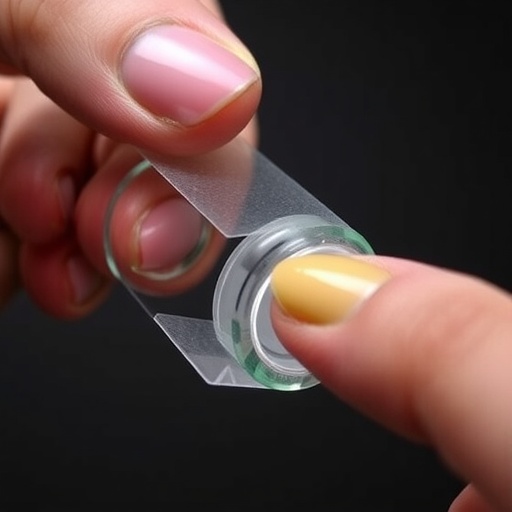
In the realm of materials science, strong adhesion has always posed a paradox—the very strength that anchors two surfaces together also renders the bond irreversible and single-use. For industries relying on adhesives, the challenge has been to create sticky materials that can repeatedly bond and detach without losing efficacy. Researchers at The University of Osaka have now cracked this conundrum by engineering a polymer adhesive capable of reversible, reusable adhesion through sophisticated supramolecular chemistry. This innovation could herald a new era in manufacturing and sustainability.
At the heart of this groundbreaking adhesive is the concept of reversible bonds embedded within the polymer interface. Adhesion fundamentally relies on an interface—a molecularly blended zone where two materials meet and intermingle. Traditionally, adhesive bonds are permanent due to irreversible chemical linkages formed at these interfaces. By integrating reversible bonds that respond dynamically to external stimuli, the interface itself becomes a tunable medium, capable of strong adhesion and facile disassembly.
Central to the reversible adhesion mechanism is the formation of host–guest complexes, a paradigm of supramolecular chemistry where a ‘host’ molecule contains a cavity tailored to transiently entrap a complementary ‘guest’ molecule, much like a lock’s fit with a specific key. This non-covalent interaction is inherently reversible, enabling bond formation and dissociation under controlled conditions. However, executing this within polymer systems presents considerable hurdles, as bulky polymer chains restrict the mobility necessary for these host–guest interactions to manifest effectively at the interface.
The researchers ingeniously addressed this mobility problem by manipulating the polymers’ glass-transition temperature (T_g), a critical thermal threshold where polymer chains transition from a rigid, glassy state into a more flexible, rubber-like state. When the polymer temperature surpasses T_g, individual chain segments gain increased mobility, facilitating the diffusion and interaction of the embedded host and guest molecules across the interface. This thermal activation enables the reversible host–guest complexes to assemble and disassemble efficiently, under programmable conditions.
To validate their design principles, the Osaka team synthesized two complementary polymers, each functionalized with either the host or the guest moiety. By fine-tuning the molecular architecture and thermal properties, they achieved an interface that dynamically responds to temperature stimuli. Beyond macroscopic testing of adhesion strength and reversibility, the researchers employed neutron reflectometry, a powerful scattering technique that probes the interface at molecular scales. This allowed unprecedented visualization of the adhesive interface’s dynamic behavior during the bonding and peeling cycles.
The neutron studies revealed that at temperatures above T_g, polymer chains interdiffuse, enabling the host and guest groups to approach and penetrate the interface, forming stable, yet reversible complexes. When cooled below T_g or upon chemical modulation, these complexes dissociate, weakening the interfacial adhesion and allowing clean separation. Reheating or reversing the chemical triggers restores the host–guest complexation, enabling the bond to reform. This cycle of reversible complexation was repeatable over multiple adhesion events without degradation, signaling durability.
Such reversible adhesion technology holds transformative potential for a wide spectrum of industrial applications. Precision manufacturing could leverage adhesives that allow components to be reliably attached and subsequently detached without residue or damage, markedly improving yields and reducing waste. Electronics assembly, for example, could benefit from repositionable adhesives that facilitate repair and recycling. Additionally, this system’s non-destructive peelability could enable innovations in packaging and temporary protective coatings, all grounded in the molecular-level control afforded by supramolecular chemistry.
Crucially, this advancement addresses sustainability challenges by reducing adhesive waste and enabling material recovery. Conventional adhesives often contribute to persistent material contamination and disposal problems since they cannot be efficiently removed or reused. In contrast, these new polymeric adhesives support circular material flows by permitting dismantling on demand, aligning with broader environmental goals of waste minimization and resource conservation.
The research also underscores the synergy of experimental techniques bridging chemistry and materials physics. The interfacial phenomenon of reversible adhesion was dissected using precise neutron scattering methods coupled with thermal analysis, offering a molecular window into the dynamic behaviors once hidden within opaque bulk polymers. Such fundamental insights provide a roadmap for designing next-generation smart adhesives utilizing supramolecular interactions.
Looking ahead, optimizing the responsiveness of these adhesives to external stimuli such as pH, light, or electric fields could extend their utility into adaptive systems and responsive materials. Integrating these polymers into composites or functional coatings may also open fresh pathways for innovation. The University of Osaka team’s pioneering work sets a benchmark for future explorations into interface engineering—where molecular recognition catalyzes functional reversibility and resource efficiency in adhesion.
This remarkable achievement reinvents how materials stick and unstick, promising new possibilities for engineering reusability into the very molecular fabric of adhesives. As industries increasingly demand materials that are not only high-performing but also sustainable, supramolecular interface engineering stands poised to redefine the fundamentals of adhesion science.
News Publication Date: 3-Oct-2025
Web References:
http://dx.doi.org/10.1002/adma.202507939
Keywords
Adhesives, Polymer engineering, Bond formation, Molecular dynamics, Supramolecular chemistry, Host guest chemistry, Molecular recognition, Materials testing, Structural analysis, Diffusion
Cite Scienmag News
Bethany Barker. (October 6, 2025). Innovative “Stick-Peel-Reuse” Adhesive Developed Using Lock-and-Key Chemistry. Scienmag. https://scienmag.com/innovative-stick-peel-reuse-adhesive-developed-using-lock-and-key-chemistry/
Bethany Barker. "Innovative “Stick-Peel-Reuse” Adhesive Developed Using Lock-and-Key Chemistry." Scienmag, 6 October 2025, https://scienmag.com/innovative-stick-peel-reuse-adhesive-developed-using-lock-and-key-chemistry/. Accessed 4 September 2026.
Bethany Barker. "Innovative “Stick-Peel-Reuse” Adhesive Developed Using Lock-and-Key Chemistry." Scienmag. October 6, 2025. https://scienmag.com/innovative-stick-peel-reuse-adhesive-developed-using-lock-and-key-chemistry/


