

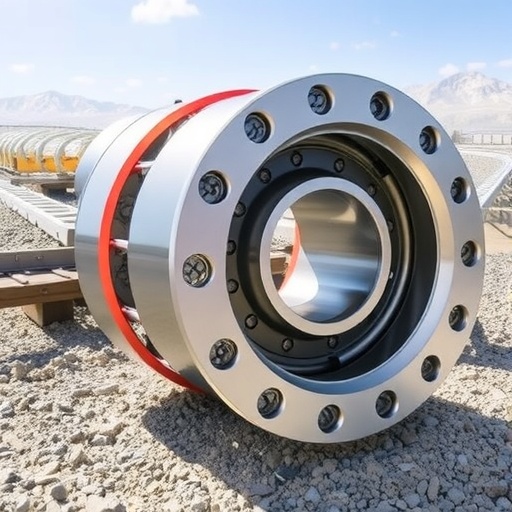
In the ever-evolving field of civil engineering and earthquake preparedness, the introduction of advanced isolation systems has garnered significant attention. A recent study, spearheaded by researchers Liu, B., Pan, D., and Song, C., et al., explores a state-of-the-art innovation: the sliding-rolling friction composite isolation bearing. This new approach promises to enhance the seismic performance of structures significantly, offering potential solutions to a pressing global issue—earthquake resilience.
Historically, the integrity of buildings during seismic events has been a major concern, particularly in tectonically active regions. Traditional isolation bearings have served their purpose, but challenges persist concerning their effectiveness, durability, and adaptability under intense seismic loads. The sliding-rolling friction composite isolation bearing presents a reimagined solution that integrates the benefits of both sliding and rolling systems to mitigate vibrational energy during earthquakes.
The innovative aspect of this new bearing is its design that combines two fundamental types of motion—sliding and rolling. By effectively merging these functionalities, the bearing aims to minimize the lateral forces transmitted to structures during seismic activities. This paradigm shift in design extends the lifespan of buildings and infrastructures while simultaneously reducing repair costs and enhancing safety for occupants.
Laboratory tests conducted as part of the research illustrate the outstanding mechanical properties of the composite bearing. These experiments reveal how well the material performs under various simulated seismic conditions, showcasing its ability to absorb and dissipate energy. Engineers and architects have expressed excitement over the preliminary results that indicate a considerably reduced risk of structural failure.
Key parameters affecting the performance of the sliding-rolling friction composite isolation bearing include its geometrical design, material selection, and the specifics of the friction mechanisms employed. Carefully balanced, these factors contribute to a system that maintains stability and performance throughout a tremor, allowing structures to sway and roll seamlessly without succumbing to damaging vibrations.
When researchers delved into the materials aspect of the composite isolation bearing, they emphasized the use of advanced composites engineered to withstand environmental stresses. Such materials are not only resilient but also lightweight, which is crucial for designs aimed at high-rise buildings. As cities continue to grow upward, reducing mass while maximizing safety becomes imperative for sustainable development.
The study discusses the advantages of incorporating this cutting-edge technology into urban design and infrastructural upgrades. With the growing frequency of earthquakes worldwide, especially in regions along fault lines, the potential for widespread adoption is immense. Civil engineering practices are evolving to prioritize resilience, and innovations such as these isolation bearings could set new standards.
Furthermore, the researchers note that implementation of this technology could have far-reaching implications for disaster preparedness and response. By equipping buildings with enhanced isolation systems, cities can become more robust, ensuring that critical infrastructure remains operational even in the aftermath of significant seismic events. This not only aids in recovery efforts but can also save lives and mitigate economic loss.
The research paper offers a comprehensive analysis that could serve as a foundational blueprint for future studies. It encourages further exploration into dynamic-response analysis, long-term performance under varied environmental conditions, and cost-benefit assessments for municipalities considering upgrades to older structures. Safety can no longer be an afterthought; it is pivotal, and engineering solutions must evolve alongside the challenges posed by nature.
Moving forward, Liu et al. call for collaboration between engineers, architects, municipalities, and policy-makers to foster a culture of safety through innovative designs. Engaging stakeholders across various sectors will facilitate broader implementation and acceptance of these technologies, paving the way for enhanced urban seismic safety.
The global significance of this research cannot be overstated. As climate change exacerbates natural disasters, the urgency for effective engineering solutions intensifies. The sliding-rolling friction composite isolation bearing serves not just as a technical advancement but also a necessary evolution in our approach to building safe, resilient cities in a world fraught with uncertainty.
An online portal for this groundbreaking research, complete with data, schematics, and further insights, may soon be made available to the public, allowing other researchers and practitioners to engage with the findings fully. Moreover, the hope is to spark an interdisciplinary discourse surrounding structural safety, sustainability, and resilience in the context of modern engineering challenges.
In conclusion, the work of Liu, B., Pan, D., and Song, C., et al., marks a significant milestone in the quest to reinforce structures against earthquakes. This innovative composite isolation bearing embodies a synergistic approach to engineering, blending advanced materials with cutting-edge design to confront one of our most daunting challenges head-on. The implications of this research are broad and impactful, heralding a future where cities are safer, sustainable, and prepared to face the seismic shocks of nature.
Subject of Research: Seismic performance of a new type of sliding-rolling friction composite isolation bearing
Article Title: Seismic performance of a new type of sliding-rolling friction composite isolation bearing
Article References: Liu, B., Pan, D., Song, C. et al. Seismic performance of a new type of sliding-rolling friction composite isolation bearing. Earthq. Eng. Eng. Vib. (2025). https://doi.org/10.1007/s11803-026-2363-7
Image Credits: AI Generated
DOI: https://doi.org/10.1007/s11803-026-2363-7
Keywords: seismic performance, isolation bearings, structural engineering, earthquake resilience, composite materials, sliding-rolling friction


