


In a groundbreaking advancement that could revolutionize water purification technology, chemical engineers at the University of Florida have developed an innovative gel-based material capable of filtering out per- and polyfluoroalkyl substances (PFAS) — often known as “forever chemicals” — from water with unprecedented efficiency. These synthetic compounds, widely used in industry and consumer products for their durability and resistance to degradation, pose significant environmental and health challenges due to their persistence and toxicity. The newly developed material offers a promising solution by selectively capturing PFAS molecules from contaminated water sources without relying on fluorinated compounds, setting a new benchmark for sustainable filtration approaches.
PFAS are notoriously difficult to remove from water because of their chemical stability and presence at extremely low concentrations, often in parts per trillion. This low concentration makes detection and extraction immensely challenging, akin to retrieving a single drop of dye from an Olympic-sized swimming pool. Despite these challenges, exposure to PFAS has been linked to severe health effects, including birth defects, cancer, and impaired immune response. Current filtration technologies, while effective to some extent, often incorporate fluorinated materials that risk reintroducing fluorinated contaminants into the environment upon degradation. The UF research team aimed to design a filtration medium that avoids these pitfalls by engineering a nonfluorinated polymer adsorbent, bringing a sustainable edge to the fight against water contamination.
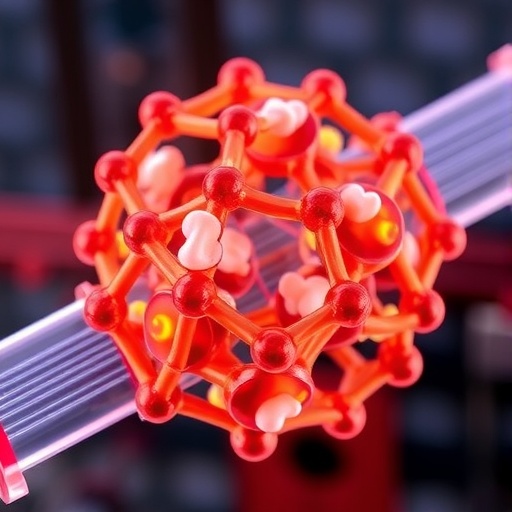
The key innovation lies in the creation of a gel-like polymer that exploits electrostatic interactions to trap PFAS molecules, particularly perfluorooctanoic acid (PFOA), one of the most abundant PFAS variants in polluted water. Unlike traditional adsorbents where binding sites are limited to material surfaces, the porous architecture of this gel allows PFOA molecules to be captured throughout the entire volume of the material. This three-dimensional immobilization significantly enhances the filtration capacity and efficiency, enabling the material to trap a higher amount of contaminants per unit mass. This breakthrough approach mimics functions similar to “molecular Velcro,” where the material’s charged sites snare PFAS compounds with high affinity and selectivity.
What sets this new material apart is its chemical modularity. The polymer adsorbent is constructed such that its chemical composition can be tuned in a stepwise fashion, opening avenues for tailoring the gel to capture a broader spectrum of PFAS molecules beyond PFOA. This modularity extends so that researchers can systematically alter side chain functionalities and polymer backbones to optimize the affinity towards diverse PFAS structures, many of which pose even greater removal challenges due to their unique molecular configurations. This tunability represents a paradigm shift that could yield a palette of custom-designed adsorbents focused on different PFAS contaminants, making water treatment processes more versatile and adaptive.
In terms of practical application, the gel’s reusability is a compelling advantage. After saturating the material with PFAS compounds, a simple solvent flush can regenerate the gel by eluting the captured pollutants, restoring its filtering capabilities for multiple cycles. This recyclability reduces operational costs and waste stream generation compared to disposable adsorbents. Moreover, because the gel does not incorporate fluorine in its composition, it eliminates concerns related to the breakdown and secondary emission of fluorinated compounds during routine maintenance or disposal, aligning well with environmental safety standards.
The UF team’s methodology involved experimental techniques that combined polymer synthesis with rigorous adsorption testing under controlled laboratory conditions. This process confirmed that the gel’s molecular design directly influences adsorption efficiency, revealing critical insights into the physicochemical interactions governing PFAS capture. Such detailed understanding is crucial, as it guides rational design principles for future adsorbents and can inform industrially scalable manufacturing protocols. Their results were recently published in the Journal of Energy and Environmental Materials, emphasizing the peer-reviewed validation of this novel filtration technology.
Beyond scientific novelty, the implications of this research extend into public health policy and environmental management. As regulatory agencies worldwide tighten permissible PFAS limits in drinking water, utilities and water treatment facilities face increasing pressure to implement effective remediation technologies. The availability of a nonfluorinated, reusable, and high-capacity adsorbent could significantly lower the ecological footprint and economic burden associated with PFAS removal, particularly in municipal and industrial-scale applications. The gel’s adaptability may also help address emerging contamination issues by enabling targeted filtration tailored to specific local pollution profiles.
Joshua Moon, Ph.D., the lead investigator and professor of chemical engineering at UF, underscores the importance of this breakthrough in overcoming existing technological roadblocks. He remarks that while PFAS filtration has seen incremental advancements, the leap made by this modular gel presents a fresh conceptual framework. Instead of relying on compounds mimicking PFAS themselves or other fluorinated materials, this approach harnesses strategic electrostatic design and polymer science innovation to achieve specificity and capacity that were previously unattainable with conventional adsorbents.
Looking toward the future, the UF research group is actively refining their material through further testing and collaborative efforts aimed at scaling production. They envision integrating this gel-based adsorbent into water treatment systems, with a particular focus on compatibility with existing infrastructure. Additionally, exploring synergistic combinations with other filtration technologies could accelerate the translation of this basic research into viable commercial solutions, potentially positioning this gel as a cornerstone technology in the global campaign against PFAS pollution.
While the immediate success centers on PFOA, ongoing studies aim to extend this chemical modularity to target longer-chain and more recalcitrant PFAS variants. These compounds have historically evaded removal due to subtle differences in molecular size and charge distribution, which complicate adsorption dynamics. The modular design potentially unlocks the ability to custom-fit adsorption sites to these challenging contaminants, paving the way for comprehensive PFAS remediation treatments that address the full contamination spectrum encountered in environmental waters worldwide.
In summary, the University of Florida’s development of a chemically modular, nonfluorinated polymer gel adsorbent signals a transformative moment in environmental engineering and water purification technology. By leveraging innovative polymer design and avoiding the environmental risks associated with fluorinated materials, this research not only provides a high-performance tool against persistent chemical pollutants but also charts a path for sustainable and adaptable filtration solutions. As the world grapples with safeguarding water resources from increasingly complex and hazardous contaminants, this advancement offers a beacon of hope grounded in cutting-edge science and environmental responsibility.
News Publication Date: 8-Jun-2026
Web References: DOI: 10.1002/eem2.70435
Keywords
PFAS, Water filtration, Polymer adsorbent, Nonfluorinated materials, Environmental contamination, Chemical engineering, Water purification, PFOA removal, Sustainable filtration, Molecular Velcro, Reusable adsorbent, Water treatment
Cite Scienmag News
Denise Maddox. (June 23, 2026). Innovative “Molecular Velcro” Method Captures PFAS Forever Chemicals with High Precision. Scienmag. https://scienmag.com/innovative-molecular-velcro-method-captures-pfas-forever-chemicals-with-high-precision/
Denise Maddox. "Innovative “Molecular Velcro” Method Captures PFAS Forever Chemicals with High Precision." Scienmag, 23 June 2026, https://scienmag.com/innovative-molecular-velcro-method-captures-pfas-forever-chemicals-with-high-precision/. Accessed 3 September 2026.
Denise Maddox. "Innovative “Molecular Velcro” Method Captures PFAS Forever Chemicals with High Precision." Scienmag. June 23, 2026. https://scienmag.com/innovative-molecular-velcro-method-captures-pfas-forever-chemicals-with-high-precision/


