


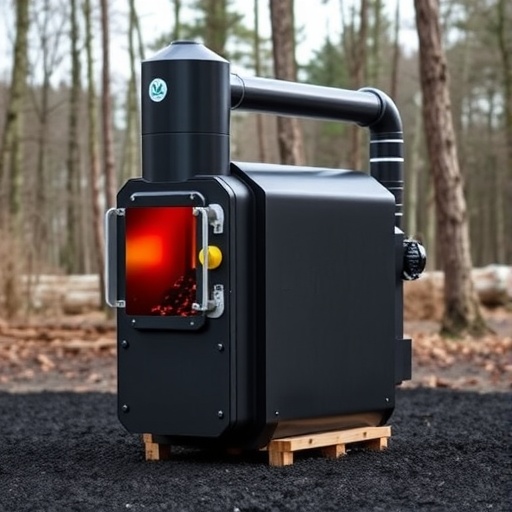
In a groundbreaking development poised to reshape the future of sustainable agriculture and carbon management, researchers from the Key Laboratory of Energy Resource Utilization from Agriculture Residue, Ministry of Agriculture and Rural Affairs, have unveiled new insights into the production of biochar via an innovative slow pyrolysis system. The study, published in the open-access journal Biochar X on March 13, 2026, delves deep into the physicochemical intricacies and energy dynamics of biochar derived from reed straw pellets using an internally heated cigar-type slow pyrolysis reactor.
Biochar, a carbon-rich byproduct of biomass pyrolysis conducted under oxygen-limited conditions, has garnered significant scientific and industrial attention due to its dual role in mitigating climate change and enhancing soil fertility. By converting organic matter into stable carbon structures, biochar serves as a long-term carbon sink, effectively reducing atmospheric CO₂ levels. Its porous microstructure further promotes improved soil aeration, water retention, and nutrient availability, making it invaluable for sustainable agriculture practices. However, the production process is a double-edged sword; it may yield polycyclic aromatic hydrocarbons (PAHs), toxic compounds that pose environmental and health risks. Understanding and optimizing biochar production to maximize benefits while minimizing toxic outputs have remained critical challenges in advancing commercial biochar applications.
Traditionally, biochar production employs batch slow pyrolysis systems with external heating, limiting heat transfer efficiency and scalability. Addressing these limitations, the research team explored a continuous, internally heated quasi-moving-bed pyrolysis reactor designed to enhance process efficiency and industrial viability. Unlike conventional reactors, this innovative system combusts a fraction of the biomass internally, generating heat directly within the reactor chamber. This approach significantly improves thermal homogeneity and reduces the energy input required from external sources, thereby lowering operational costs and environmental footprints.
The reactor’s design allows for versatile operation modes by switching the configurations of air inlets and gas outlets to implement either updraft or downdraft pyrolysis. This flexibility is crucial, as pyrolysis directionality influences heat distribution and mass transfer within the biomass bed. The researchers meticulously examined the effects of varying pyrolysis temperatures—specifically 550 °C, 600 °C, and 650 °C—alongside adjustments in air distribution rates and cooling methodologies, comparing high versus low airflow and contrasting water cooling with air insulation techniques. This comprehensive parametric analysis enabled a nuanced understanding of how individual and combined factors govern the qualities of the resulting biochar.
Assessment of the biochar encompassed an extensive suite of physical and chemical properties, including fixed carbon content, ash percentage, atomic element ratios (H/C, O/C), specific surface area (SSA), pH, cation exchange capacity (CEC), electrical conductivity, concentrations of PAHs, toxic equivalence quantities, and overall energy conversion efficiency. Remarkably, while several conventional metrics such as fixed carbon content (ranging from 38.46% to 44.02%) and atomic ratios indicated consistently stable carbon structures conducive to long-term sequestration, other vital properties displayed heightened sensitivity to processing conditions.
Of particular note was the behavior of specific surface area, a critical determinant in biochar’s ability to adsorb nutrients and contaminants, thereby influencing its efficacy in soil amendment and pollutant remediation. Elevated pyrolysis temperatures correlated with enhanced SSA values, with biochars produced at 650 °C demonstrating substantially greater surface areas, especially under downdraft operation coupled with low airflow and air-insulated cooling. Under these optimal conditions, SSA values surged to 1.46, 2.26, and 3.00 times higher compared to updraft, high airflow, and water-cooled scenarios, respectively. These findings underscore the nuanced interplay between thermal dynamics and reactor configuration in tailoring biochar microstructure.
Conversely, updraft operation combined with higher air distribution rates and traditional water cooling favored higher cation exchange capacity. This parameter reflects biochar’s capacity to retain and exchange essential cations like potassium, calcium, and magnesium in soil, thereby enhancing nutrient availability to plants. The observed enhancement in CEC under such conditions suggests that different pyrolysis regimes may be selectively employed depending on the target agricultural outcomes, whether prioritizing surface area for contaminant adsorption or nutrient retention for soil fertility improvement.
Environmental safety, a paramount concern, was evaluated through in-depth analysis of PAH content and associated toxic equivalence metrics in the biochar. Encouragingly, PAH concentrations measured between 0.03–0.44 mg/kg and toxic equivalence values from 0.39 to 5.68 µg/kg were consistently well below internationally established safety thresholds. However, the study revealed a clear trend toward elevated PAHs under high airflow and water-cooled conditions. Quantitatively, at 550 °C, high airflow increased PAH formation by a factor of 2.66 compared to low airflow, while at 650 °C, employing water cooling instead of air insulation elevated PAH levels by nearly sevenfold (6.89 times). This data highlights a crucial trade-off in cooling strategies, necessitating precise process control to minimize toxic emissions without compromising biochar quality.
Energy efficiency, another key metric in industrial scalability, improved with increasing pyrolysis temperature, with the average energy conversion efficiency reaching approximately 75.31%. This efficiency metric considers the chemical energy preserved in biochar and the calorific value of produced syngas relative to the biomass input energy. Such high conversion rates underscore the feasibility of leveraging internally heated slow pyrolysis systems to achieve energy-neutral or even energy-positive biochar production cycles.
Critically, the comprehensive investigation divulged that no single set of operating conditions simultaneously optimizes all desirable biochar attributes. While downdraft operation excels in maximizing specific surface area essential for pollutant adsorption and soil structure enhancement, updraft operation favors cation exchange capacity along with improved energy efficiency and production throughput. Hence, the study advocates for a balanced approach in pyrolysis design to tailor biochar functionality according to intended agricultural or environmental applications.
The implications of this research are far-reaching. By elucidating the complex relationships between reactor design, operating parameters, biochar quality, and environmental safety, this work paves a practical path towards industrial-scale biochar manufacturing with customizable properties. Such advancements may accelerate the adoption of biochar in sustainable farming regimes, enabling more effective carbon sequestration strategies, soil health improvement, and cleaner biomass utilization methods globally.
Beyond agricultural benefits, the reduced toxic risks associated with optimized internally heated slow pyrolysis systems may catalyze biochar’s expanded role in environmental remediation and carbon trading frameworks. The dual advantage of enhanced energy recovery and fine-tuned biochar characteristics marks a significant leap forward in biochar science, bridging fundamental research and real-world industrial application.
Looking forward, the authors emphasize the need for continued interdisciplinary efforts integrating chemical engineering, environmental science, and agronomy to refine reactor technologies further and broaden the applicability of biochar across diverse crops and soil types. The convergence of improved thermal design, process control, and feedstock management holds the promise of unlocking biochar’s full potential in combating climate change and fostering resilient agricultural ecosystems.
In summary, this pioneering study confirms that internally heated cigar-type slow pyrolysis reactors represent a robust and efficient technology for producing high-quality, safe biochar from reed straw pellets. By meticulously adjusting process conditions and understanding their impact on physicochemical properties and energy dynamics, it is now possible to tailor biochar for specific industrial and environmental functions. As the world grapples with mounting environmental challenges, such technological innovations in biochar production emerge as vital tools to harness biomass residues sustainably while mitigating greenhouse gas emissions and bolstering soil productivity.
Cite Scienmag News
Alan Morgan. (May 6, 2026). Innovative Internal-Heating Pyrolyzer Generates Cleaner, Agriculture-Ready Biochar. Scienmag. https://scienmag.com/innovative-internal-heating-pyrolyzer-generates-cleaner-agriculture-ready-biochar/
Alan Morgan. "Innovative Internal-Heating Pyrolyzer Generates Cleaner, Agriculture-Ready Biochar." Scienmag, 6 May 2026, https://scienmag.com/innovative-internal-heating-pyrolyzer-generates-cleaner-agriculture-ready-biochar/. Accessed 4 September 2026.
Alan Morgan. "Innovative Internal-Heating Pyrolyzer Generates Cleaner, Agriculture-Ready Biochar." Scienmag. May 6, 2026. https://scienmag.com/innovative-internal-heating-pyrolyzer-generates-cleaner-agriculture-ready-biochar/


