
Friday, February 6, 2026
Science
No Result
View All Result
  • Login
  • HOME
  • SCIENCE NEWS
  • CONTACT US
  • HOME
  • SCIENCE NEWS
  • CONTACT US
No Result
View All Result
Scienmag
No Result
View All Result
Home Science News Cancer

Innovative, highly accurate AI model can estimate lung function just by using chest x-rays

July 8, 2024
in Cancer
Reading Time: 3 mins read
0
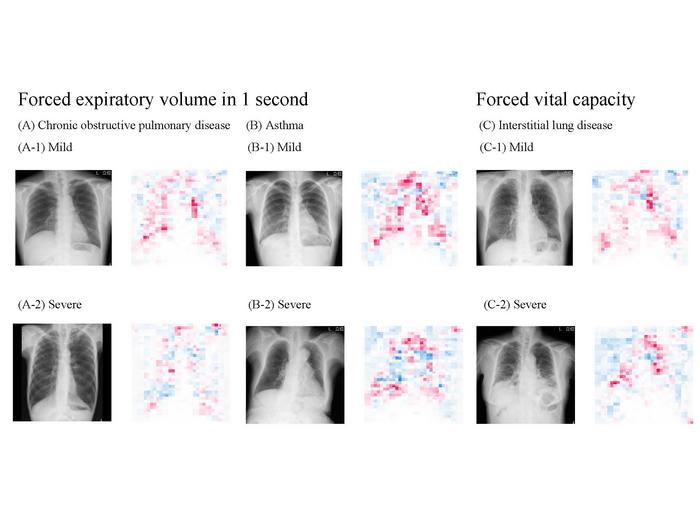
Chest radiographs and average saliency maps
67
SHARES
605
VIEWS
Share on FacebookShare on Twitter
ADVERTISEMENT

If there is one medical exam that everyone in the world has taken, it’s a chest x-ray. Clinicians can use radiographs to tell if someone has tuberculosis, lung cancer, or other diseases, but they can’t use them to tell if the lungs are functioning well.

Chest radiographs and average saliency maps

Credit: Osaka Metropolitan University

If there is one medical exam that everyone in the world has taken, it’s a chest x-ray. Clinicians can use radiographs to tell if someone has tuberculosis, lung cancer, or other diseases, but they can’t use them to tell if the lungs are functioning well.

Until now, that is.

In findings published in The Lancet Digital Health, a research group led by Associate Professor Daiju Ueda and Professor Yukio Miki at Osaka Metropolitan University’s Graduate School of Medicine has developed an artificial intelligence model that can estimate lung function from chest radiographs with high accuracy.

Conventionally, lung function is measured using a spirometer, which requires the cooperation of the patient, who is given specific instructions on how to inhale and exhale into the instrument. Accurate evaluation of the measurements is difficult if the patient has a hard time following instructions, which can occur with infants or persons with dementia, or if the person is prone.

Professor Ueda and the research group trained, validated, and tested the AI model using over 140,000 chest radiographs from a nearly 20-year period. They compared the actual spirometric data to the AI model’s estimates to fine-tune its performance. The results showed a remarkably high agreement rate, with a Pearson’s correlation coefficient (r) of more than 0.90, indicating that the method is sufficiently promising for practical use.

The AI model developed in this study has the potential to expand the options for pulmonary function assessment for patients who have difficulty performing spirometry.

“Highly significant is the fact that just by using the static information from chest x-rays, our method suggests the possibility of accurately estimating lung function, which is normally evaluated through tests requiring the patients to exert physical energy,” Professor Ueda explained. “This AI model was built through the cooperation of many people, from physicians, researchers, and technicians to patients at several institutions. If it can help lessen the burden on patients while also reducing medical costs, that would be a wonderful thing.”

###

About OMU

Established in Osaka as one of the largest public universities in Japan, Osaka Metropolitan University is committed to shaping the future of society through “Convergence of Knowledge” and the promotion of world-class research. For more research news, visit and follow us on social media: X, Facebook, Instagram, LinkedIn.


Journal

The Lancet Digital Health

DOI

10.1016/S2589-7500(24)00113-4

Method of Research

Imaging analysis

Subject of Research

People

Article Title

A deep learning-based model to estimate pulmonary function from chest x-rays: multi-institutional model development and validation study in Japan

Article Publication Date

8-Jul-2024

COI Statement

The authors have nothing to disclose.

Share27Tweet17
Previous Post

University of Cincinnati, Swing Therapeutics study: Mobile app therapy leads to significant improvement in fibromyalgia management

Next Post

Combining popular diabetes drugs offers complementary heart and kidney benefits

Related Posts

blank
Cancer

Outcomes of Sacituzumab Govitecan in Advanced Breast Cancer

February 6, 2026
blank
Cancer

New Study Reveals That Inhibiting a Crucial Protein Induces Unique Stress in Cancer Cells, Potentially Re-Sensitizing Chemotherapy-Resistant Tumors

February 6, 2026
blank
Cancer

‘Sticky Coat’ Enhances Metastatic Potential of Triple-Negative Breast Cancer

February 6, 2026
blank
Cancer

Immune Marker Identified as Predictor of Poor Outcomes Across Multiple Tumor Types and Species

February 5, 2026
blank
Cancer

Immune System ‘Hijacking’ Offers Insight into Cancer Evolution

February 5, 2026
blank
Cancer

Astrocytes: Brain Disorder Guardians or Troublemakers?

February 5, 2026
Next Post
Combining popular diabetes drugs offers complementary heart and kidney benefits

Combining popular diabetes drugs offers complementary heart and kidney benefits

  • Mothers who receive childcare support from maternal grandparents show more parental warmth, finds NTU Singapore study

    Mothers who receive childcare support from maternal grandparents show more parental warmth, finds NTU Singapore study

    27610 shares
    Share 11040 Tweet 6900
  • University of Seville Breaks 120-Year-Old Mystery, Revises a Key Einstein Concept

    1017 shares
    Share 407 Tweet 254
  • Bee body mass, pathogens and local climate influence heat tolerance

    662 shares
    Share 265 Tweet 166
  • Researchers record first-ever images and data of a shark experiencing a boat strike

    528 shares
    Share 211 Tweet 132
  • Groundbreaking Clinical Trial Reveals Lubiprostone Enhances Kidney Function

    514 shares
    Share 206 Tweet 129
Science

Embark on a thrilling journey of discovery with Scienmag.com—your ultimate source for cutting-edge breakthroughs. Immerse yourself in a world where curiosity knows no limits and tomorrow’s possibilities become today’s reality!

RECENT NEWS

  • Maternal Perinatal Depression Linked to Elevated Risk of Autism-Related Traits in Girls
  • New Study Uncovers the Scope of Rare Deep-Earthquakes Beneath Earth’s Crust
  • Adaptive Governance Essential to Mitigate AI-Driven Biosecurity Risks in Biological Data
  • Study Suggests Babies Are Born With an Innate Sense of Rhythm

Categories

  • Agriculture
  • Anthropology
  • Archaeology
  • Athmospheric
  • Biology
  • Biotechnology
  • Blog
  • Bussines
  • Cancer
  • Chemistry
  • Climate
  • Earth Science
  • Editorial Policy
  • Marine
  • Mathematics
  • Medicine
  • Pediatry
  • Policy
  • Psychology & Psychiatry
  • Science Education
  • Social Science
  • Space
  • Technology and Engineering

Subscribe to Blog via Email

Enter your email address to subscribe to this blog and receive notifications of new posts by email.

Join 5,190 other subscribers

© 2025 Scienmag - Science Magazine

Welcome Back!

Login to your account below

Forgotten Password?

Retrieve your password

Please enter your username or email address to reset your password.

Log In
No Result
View All Result
  • HOME
  • SCIENCE NEWS
  • CONTACT US

© 2025 Scienmag - Science Magazine

Discover more from Science

Subscribe now to keep reading and get access to the full archive.

Continue reading