


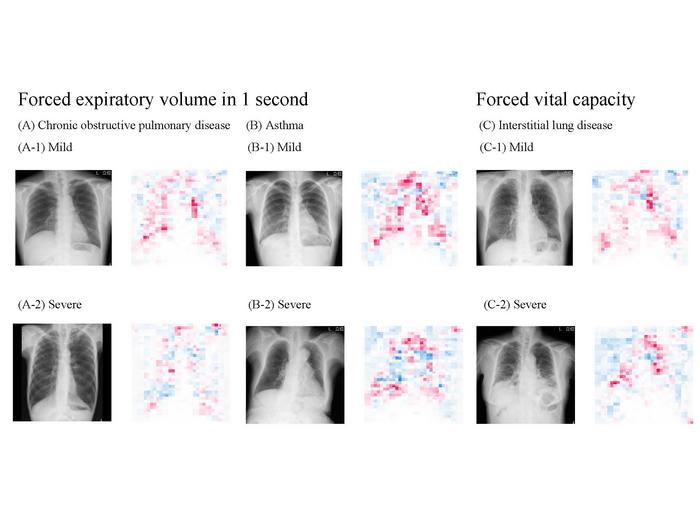
If there is one medical exam that everyone in the world has taken, it’s a chest x-ray. Clinicians can use radiographs to tell if someone has tuberculosis, lung cancer, or other diseases, but they can’t use them to tell if the lungs are functioning well.

Credit: Osaka Metropolitan University
If there is one medical exam that everyone in the world has taken, it’s a chest x-ray. Clinicians can use radiographs to tell if someone has tuberculosis, lung cancer, or other diseases, but they can’t use them to tell if the lungs are functioning well.
Until now, that is.
In findings published in The Lancet Digital Health, a research group led by Associate Professor Daiju Ueda and Professor Yukio Miki at Osaka Metropolitan University’s Graduate School of Medicine has developed an artificial intelligence model that can estimate lung function from chest radiographs with high accuracy.
Conventionally, lung function is measured using a spirometer, which requires the cooperation of the patient, who is given specific instructions on how to inhale and exhale into the instrument. Accurate evaluation of the measurements is difficult if the patient has a hard time following instructions, which can occur with infants or persons with dementia, or if the person is prone.
Professor Ueda and the research group trained, validated, and tested the AI model using over 140,000 chest radiographs from a nearly 20-year period. They compared the actual spirometric data to the AI model’s estimates to fine-tune its performance. The results showed a remarkably high agreement rate, with a Pearson’s correlation coefficient (r) of more than 0.90, indicating that the method is sufficiently promising for practical use.
The AI model developed in this study has the potential to expand the options for pulmonary function assessment for patients who have difficulty performing spirometry.
“Highly significant is the fact that just by using the static information from chest x-rays, our method suggests the possibility of accurately estimating lung function, which is normally evaluated through tests requiring the patients to exert physical energy,” Professor Ueda explained. “This AI model was built through the cooperation of many people, from physicians, researchers, and technicians to patients at several institutions. If it can help lessen the burden on patients while also reducing medical costs, that would be a wonderful thing.”
###
About OMU
Established in Osaka as one of the largest public universities in Japan, Osaka Metropolitan University is committed to shaping the future of society through “Convergence of Knowledge” and the promotion of world-class research. For more research news, visit and follow us on social media: X, Facebook, Instagram, LinkedIn.
Journal
The Lancet Digital Health
Method of Research
Imaging analysis
Subject of Research
People
Article Title
A deep learning-based model to estimate pulmonary function from chest x-rays: multi-institutional model development and validation study in Japan
Article Publication Date
8-Jul-2024
COI Statement
The authors have nothing to disclose.
Cite Scienmag News
Nathaniel Bowman. (July 8, 2024). Innovative, highly accurate AI model can estimate lung function just by using chest x-rays. Scienmag. https://scienmag.com/innovative-highly-accurate-ai-model-can-estimate-lung-function-just-by-using-chest-x-rays/
Nathaniel Bowman. "Innovative, highly accurate AI model can estimate lung function just by using chest x-rays." Scienmag, 8 July 2024, https://scienmag.com/innovative-highly-accurate-ai-model-can-estimate-lung-function-just-by-using-chest-x-rays/. Accessed 5 September 2026.
Nathaniel Bowman. "Innovative, highly accurate AI model can estimate lung function just by using chest x-rays." Scienmag. July 8, 2024. https://scienmag.com/innovative-highly-accurate-ai-model-can-estimate-lung-function-just-by-using-chest-x-rays/

