

Friday, September 4, 2026
Science
No Result
View All Result
  • Login
  • HOME
  • SCIENCE NEWS
  • CONTACT US
  • HOME
  • SCIENCE NEWS
  • CONTACT US
No Result
View All Result
Scienmag
No Result
View All Result
Home Science News Chemistry

Innovative GREENSKY model elevates UAV efficiency in next-gen wireless networks

April 23, 2024
in Chemistry
Bethany Barker
By Bethany Barker Scienmag Editorial Profile - Catalysis
Reading Time: 3 mins read
0
Innovative GREENSKY model elevates UAV efficiency in next-gen wireless networks
67
SHARES
610
VIEWS
Share on FacebookShare on Twitter
ADVERTISEMENT

Researchers from the University of Missouri-Kansas City, School of Computing and Engineering, and independent researchers have developed a groundbreaking model, dubbed GREENSKY, that significantly enhances the energy efficiency and operational time of Unmanned Aerial Vehicles (UAVs) in cellular networks.

Innovative GREENSKY Model Elevates UAV Efficiency in Next-Gen Wireless Networks

Credit: GREEN ENERGY AND INTELLIGENT TRANSPORTATION

Researchers from the University of Missouri-Kansas City, School of Computing and Engineering, and independent researchers have developed a groundbreaking model, dubbed GREENSKY, that significantly enhances the energy efficiency and operational time of Unmanned Aerial Vehicles (UAVs) in cellular networks.

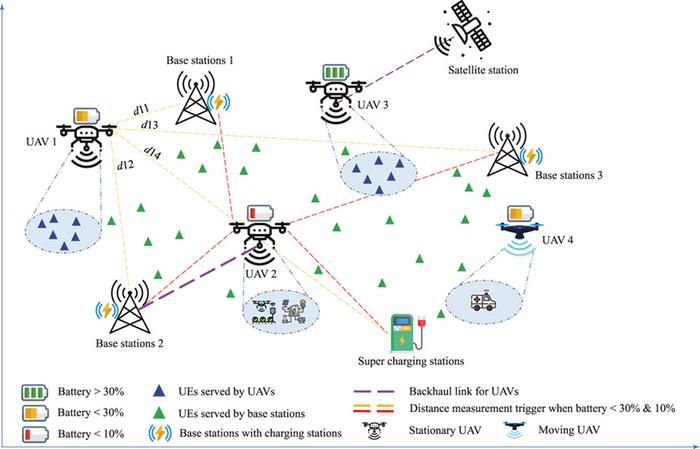
In the ever-evolving landscape of wireless communication, UAVs play a pivotal role, especially in rural, remote, and disaster-struck areas where traditional network infrastructure is absent. The GREENSKY model optimizes UAV charging behavior between static ground base stations and mobile supercharging stations, enhancing energy use and enabling longer operational periods without frequent recharging.

By integrating Mixed Integer Linear Programming, the GREENSKY model optimizes the recharging and routing processes for UAVs, thereby maximizing flight duration while minimizing energy consumption. The model strategically uses existing cellular base stations as opportunistic charging points, significantly reducing travel distances to recharge and ensuring UAVs can operate longer with less energy. Results show that GREENSKY achieves a significant reduction in energy consumption—9.1% less than traditional heuristic solutions.

Lead researcher Pratik Thantharate explains, “Our model is designed to make UAV networks more sustainable and efficient. By optimizing how and where UAVs recharge, we can extend their operational time dramatically, which is crucial for continuous and reliable service in critical areas.”

The development of this optimization model not only increases the efficiency of UAV networks but also pushes forward the innovation in energy management for UAVs serving as aerial base stations.This approach not only promises enhanced connectivity for underserved regions but also paves the way for smarter, energy-conscious technology deployments in 5G and beyond.

As UAVs become more embedded in various industries, the introduction of the GREENSKY model offers a more efficient, cost-effective approach to UAV energy management and task execution. The implications of the GREENSKY model extend beyond improved service reliability. By effectively leveraging both static and mobile charging stations, the model facilitates a smarter and more robust framework for future aerial communication networks. This approach not only promises enhanced connectivity for underserved regions but also paves the way for smarter, energy-conscious technology deployments in 5G and beyond.

References

Authors: Pratik Thantharate, Anurag Thantharate, Atul Kulkarni

Affiliation: School of Computing and Engineering, University of Missouri, Kansas City, MO, USA

Title of original paper: Innovative GREENSKY Model Elevates UAV Efficiency in Next-Gen Wireless Networks

Article link:

Journal: Green Energy and Intelligent Transportation


Journal

Green Energy and Intelligent Transportation

DOI

10.1016/j.geits.2023.100130

Method of Research

Experimental study

Subject of Research

Not applicable

Article Title

GREENSKY: A fair energy-aware optimization model for UAVs in next-generation wireless networks

Article Publication Date

6-Jan-2024

COI Statement

The authors declare no conflict of interest.

Subject of Research: Chemistry

Article Title: Innovative GREENSKY model elevates UAV efficiency in next-gen wireless networks

Article References: Thantharate, P., Thantharate, A., & Kulkarni, A. (2024). GREENSKY: A fair energy-aware optimization model for UAVs in next-generation wireless networks. Green Energy and Intelligent Transportation, 3(1), Article 100130. https://doi.org/10.1016/j.geits.2023.100130

Image Credits: AI Generated

DOI: 10.1016/j.geits.2023.100130

Keywords: Not provided

Cite Scienmag News

Bethany Barker. (April 23, 2024). Innovative GREENSKY model elevates UAV efficiency in next-gen wireless networks. Scienmag. https://scienmag.com/innovative-greensky-model-elevates-uav-efficiency-in-next-gen-wireless-networks/

Bethany Barker. "Innovative GREENSKY model elevates UAV efficiency in next-gen wireless networks." Scienmag, 23 April 2024, https://scienmag.com/innovative-greensky-model-elevates-uav-efficiency-in-next-gen-wireless-networks/. Accessed 4 September 2026.

Bethany Barker. "Innovative GREENSKY model elevates UAV efficiency in next-gen wireless networks." Scienmag. April 23, 2024. https://scienmag.com/innovative-greensky-model-elevates-uav-efficiency-in-next-gen-wireless-networks/

Share27Tweet17
Previous Post

FDA approves immunotherapy drug combo for non-muscle invasive bladder cancer after UCLA-led research shows improved outcomes for patients

Next Post

UNC-Chapel Hill researchers create artificial cells that act like living cells

Related Posts

Partially covalent desolvated cations boost electrochemical CO2 conversion
Chemistry

Partially covalent desolvated cations boost electrochemical CO2 conversion

September 4, 2026
Ferricyanide enables peptide hydrazide ligation in neutral water
Chemistry

Ferricyanide enables peptide hydrazide ligation in neutral water

September 4, 2026
How microplastics may weaken the human immune system
Chemistry

How microplastics may weaken the human immune system

September 4, 2026
New NiO–Cu3Mo2O9 Catalyst Boosts Hydrogen Production from Ammonia Borane
Chemistry

New NiO–Cu3Mo2O9 Catalyst Boosts Hydrogen Production from Ammonia Borane

September 4, 2026
Antimicrobial PVA silver nanoparticle zeolite nanofibers developed for wound dressings
Chemistry

Antimicrobial PVA silver nanoparticle zeolite nanofibers developed for wound dressings

September 4, 2026
Layered double hydroxides in sustained antibiotic delivery: a bibliometric review
Chemistry

Layered double hydroxides in sustained antibiotic delivery: a bibliometric review

September 3, 2026
Next Post
UNC-Chapel Hill researchers create artificial cells that act like living

UNC-Chapel Hill researchers create artificial cells that act like living cells

  • Mothers who receive childcare support from maternal grandparents show more optimized

    Mothers who receive childcare support from maternal grandparents show more parental warmth, finds NTU Singapore study

    27656 shares
    Share 11059 Tweet 6912
  • University of Seville Breaks 120-Year-Old Mystery, Revises a Key Einstein Concept

    1061 shares
    Share 424 Tweet 265
  • Bee body mass, pathogens and local climate influence heat tolerance

    682 shares
    Share 273 Tweet 171
  • Researchers record first-ever images and data of a shark experiencing a boat strike

    546 shares
    Share 218 Tweet 137
  • Groundbreaking Clinical Trial Reveals Lubiprostone Enhances Kidney Function

    531 shares
    Share 212 Tweet 133
Science

Embark on a thrilling journey of discovery with Scienmag.com—your ultimate source for cutting-edge breakthroughs. Immerse yourself in a world where curiosity knows no limits and tomorrow’s possibilities become today’s reality!

RECENT NEWS

  • Wearable sensors quantify impact loading to guide osteoporosis prevention
  • Hierarchical Dynamic Object Removal Boosts Dual-Stage LiDAR-Inertial SLAM Performance
  • Precise radionuclide separation via diffusion barrier control in graphene oxide nanochannels
  • Machine learning approach predicts damage in slender reinforced concrete walls

Categories

  • Agriculture
  • Anthropology
  • Archaeology
  • Athmospheric
  • Biology
  • Biotechnology
  • Blog
  • Bussines
  • Cancer
  • Chemistry
  • Climate
  • Earth Science
  • Editorial Policy
  • Marine
  • Mathematics
  • Medicine
  • Pediatry
  • Policy
  • Psychology & Psychiatry
  • Science Education
  • Social Science
  • Space
  • Technology and Engineering

Subscribe to Blog via Email

Enter your email address to subscribe to this blog and receive notifications of new posts by email.

Join 5,151 other subscribers

© 2025 Scienmag - Science Magazine

Welcome Back!

Login to your account below

Forgotten Password?

Retrieve your password

Please enter your username or email address to reset your password.

Log In
No Result
View All Result
  • HOME
  • SCIENCE NEWS
  • CONTACT US

© 2025 Scienmag - Science Magazine

Discover more from Science

Subscribe now to keep reading and get access to the full archive.

Continue reading