


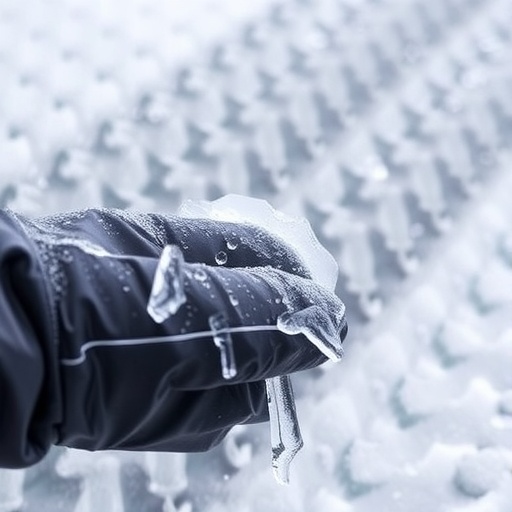
In a groundbreaking study, researchers led by Liu, J., alongside Huang, X., and Wang, X., have developed an innovative coating designed to significantly reduce ice adhesion strength. This cutting-edge technology stems from a deep understanding of the interface elastic modulus inhomogeneity—a crucial property that governs how materials interact at their surfaces. The focus of this research delves into the realms of materials science, aiming to unveil new methodologies for combating ice accumulation, which poses persistent challenges in various industrial applications, from aviation to renewable energy.
Ice adhesion is a phenomenon that has long plagued many sectors, especially those that rely on optimal surface performance during extreme weather conditions. Traditional anti-ice strategies have often employed chemical treatments or mechanical designs; however, these approaches come with their own set of drawbacks, such as chemical persistence or physical wear. This new coating, designed based on a nuanced understanding of material elasticity, promises to provide a more efficient, durable, and environmentally friendly solution to ice buildup.
The unique aspect of this coating lies in its inhomogeneous elastic properties, which engineers have manipulated to create surfaces that are not only resistant to ice adhesion but also capable of self-cleaning once the ice starts to form. When ice comes into contact with a surface treated with this new coating, the variances in stiffness at the interface effectively disrupt the adhesion process. By tailoring the elastic moduli, the researchers have essentially created a surface that ice finds itself struggling to latch on to, thus enhancing the detachment when conditions change, such as an increase in temperature or shifting mechanical stresses.
What sets this research apart from prior attempts is its foundation in fundamental physics and materials science principles. The researchers employed theoretical models to predict the behavior of ice adhesion on a variety of surface treatments, which they then validated through rigorous experimental work. Their findings suggest that careful engineering of material properties at the microscale can lead to exponentially greater performance in ice resistance, with potential applications in aircraft wings, wind turbine blades, and power lines—areas that suffer significant operational hindrances due to ice accumulation.
Moreover, the design process undertaken by the team utilized cutting-edge fabrication techniques that allow for the application of these coatings in real-world environments. Incorporating advanced nanotechnology, the coating’s application can be fine-tuned based on the specific needs of various industries. The team anticipates that these techniques could ultimately lead to the creation of new standard coatings for diverse applications, thus propelling industries toward greater efficiency and reduced downtime during adverse weather conditions.
In addition to its practical applications, this research also provides a platform for future studies. Researchers have identified several critical areas for further exploration, including the interactions between various forms of ice and the coatings under different environmental conditions. They are also investigating how to enhance the longevity and durability of the coating, ensuring that it not only performs well initially but continues to do so over time without significant wear.
The potential economic impacts of this innovation are significant. Reduced ice adhesion could translate to fewer airline delays due to ice on wings, lower maintenance costs for wind turbines, and improved safety and reliability for energy transmission lines. As the world continues to grapple with climate-related challenges, such technologies could enhance operational resilience and play a crucial role in the sustainability of various sectors.
Furthermore, this study sheds light on the broader implications of material science in addressing climate change issues. As industries strive to become more sustainable, innovations like these provide promising pathways to solving practical problems linked directly to environmental challenges. With each advancement in materials engineering, society moves closer to developing solutions that are not only effective but also environmentally responsible, ensuring that progress does not come at the cost of our planet.
The researchers have documented their findings meticulously, providing a comprehensive overview of their methodologies and experimental results. This attention to detail ensures that subsequent researchers can build upon their work, fostering a spirit of collaboration and innovation within the scientific community. The hope is that this research will inspire further exploration into materials that can address other sticky challenges, literally and figuratively.
In summary, Liu, J., Huang, X., and Wang, X. are leading a pivotal advancement in the field of materials science with their development of a low ice adhesion coating based on interface elastic modulus inhomogeneity. Their work not only addresses the pressing issue of ice accumulation across various industries but also sets a precedent for future research in innovative material performance. As we approach the winter months, this technology could become increasingly relevant, showcasing the power of scientific inquiry to produce impactful, real-world solutions.
With the 21st Century presenting numerous challenges, including severe weather phenomena and their disruptive effects, innovations like this coating offer a glimmer of hope. The future of coatings designed to minimize ice adhesion appears promising, opening avenues for enhanced efficiency and safety in many essential services across the globe.
Cite Scienmag News
Neil Sanderson. (January 16, 2026). Innovative Coating Reduces Ice Adhesion Strength. Scienmag. https://scienmag.com/innovative-coating-reduces-ice-adhesion-strength/
Neil Sanderson. "Innovative Coating Reduces Ice Adhesion Strength." Scienmag, 16 January 2026, https://scienmag.com/innovative-coating-reduces-ice-adhesion-strength/. Accessed 4 September 2026.
Neil Sanderson. "Innovative Coating Reduces Ice Adhesion Strength." Scienmag. January 16, 2026. https://scienmag.com/innovative-coating-reduces-ice-adhesion-strength/


