


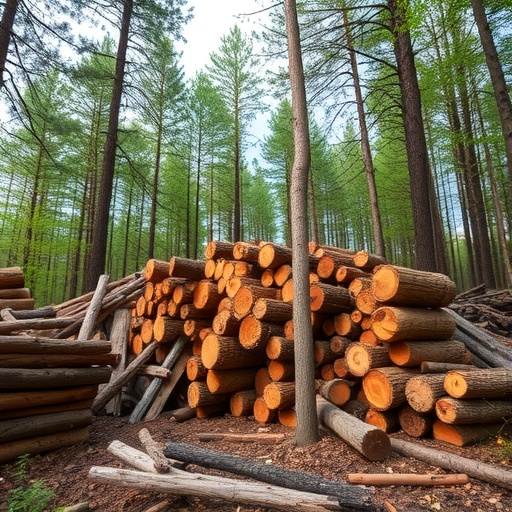
Taking decisive action to combat climate change necessitates innovative approaches to carbon sequestration, and a promising methodology has emerged from Cornell University researchers that could reshape our understanding of carbon capture strategies. This research presents a low-tech yet sophisticated method that leverages the substantial amounts of wood debris generated from managed forests, proposing an avenue to effectively sequester carbon dioxide from the atmosphere. By burying this wood debris, the researchers assert that a substantial amount of carbon can be captured, thereby contributing to global efforts in mitigating climate change.
The scale of this proposed method is monumental. In a study published in the prestigious journal Nature Geoscience, researchers estimate that burying wood debris from managed forests over the next several decades could potentially remove an astonishing range of 770 to 937 gigatons of carbon dioxide from the atmosphere. This quantity is not merely theoretical; it could result in a tangible reduction of global temperatures by as much as 0.42 degrees Celsius, a significant achievement in the fight against global warming. The implications of this study stress the urgent need to rethink how we manage forest resources and the by-products generated from these environments.
Managed forests, often associated with logging activities, typically produce large quantities of wood debris, which in the past has commonly been burnt or left to decompose. These practices unfortunately result in the emission of carbon dioxide as the wood breaks down naturally. However, the innovative approach proposed by the researchers offers a transformative solution: by burying the wood debris, the carbon contained within this biomass can be preserved in the soil, limiting its release into the atmosphere. This additional carbon storage capacity is essential for creating a balanced ecosystem and for mitigating excessive atmospheric carbon emissions.
One of the key factors supporting this method is the natural insulating properties of soil. Soil acts as an effective barrier against the decomposition of organic material. By burying wood debris at a depth of two meters, this practice can ensure that the wood remains preserved for hundreds, if not thousands, of years. This long-term preservation can have significant ramifications for carbon emissions, offering a radical shift in how forestry and waste management practices are approached in relation to climate change initiatives.
The breadth of the study scoped beyond solely managed forests; it highlighted sawmills and discarded wooden furniture as considerable sources of wood debris that could be utilized for carbon capture. By focusing on these substantial contributors to wood waste, the researchers present a sustainable method that not only captures carbon but also fosters a circular economy approach to forest management. The incorporation of wood from urban maintenance and from agricultural sectors like orchards and farms further amplifies the practical applicability of this concept.
Collaboration is essential within the realm of climate science, and Yiqi Luo, the lead author of the study, is working alongside colleagues to explore the feasibility of achieving carbon neutrality within orchards in New York State through the implementation of similar wood burial practices. This work reinforces the notion that innovative solutions can be customized to fit various environmental contexts and needs, providing communities with tailored strategies to combat climate change effectively.
Moreover, the study illustrates another potential benefit arising from the proposed wood debris burial method. In areas susceptible to wildfires, this practice could aid in lowering the available fuel sources that contribute to fire intensity. By removing potentially hazardous debris from the forest floor, not only can carbon be captured effectively, but the risk of catastrophic wildfires may also be diminished, creating a synergistic effect in forest management strategies.
Despite the promising outcomes of this research, the authors emphasize the necessity for large-scale demonstrations to evaluate the practical impacts of their proposed method on soil health, ecosystem dynamics, methane emissions, soil nutrients, and biodiversity. This requirement for further research emphasizes the complexity of ecological interactions, as introducing new practices can have unforeseen consequences beyond immediate carbon capture.
The support for this research stems from a range of esteemed organizations, including the National Science Foundation and the Department of Energy, which underlines the critical intersection between research, funding, and actionable climate solutions. As researchers galvanize efforts to develop sustainable carbon capture practices, interdisciplinary collaboration could yield innovative strategies that address not only carbon emissions but also the broader challenges posed by environmental degradation.
This groundbreaking research posits that simple actions—such as burying wood debris—can lead to profound environmental impacts. It challenges the status quo by suggesting that effective carbon sequestration does not necessarily require advanced technologies or overly complicated procedures. Instead, it points towards a sustainable and pragmatic approach leveraging existing resources and practices within forest management and urban maintenance.
As the world engages in an ongoing dialogue about climate change mitigation, the findings from Cornell University serve as a clarion call for increased research and implementation of innovative carbon capture methods. The study advocates for a paradigm shift in how wood debris is viewed and managed, fostering a proactive stance against climate change through sustainable practices that could rival technologically advanced carbon capture systems.
In summary, this research opens the door to transformative practices surrounding carbon capture, providing a robust foundation for sustainable forestry and waste management strategies. The potential to achieve significant reductions in atmospheric carbon dioxide emphasizes the necessity for systemic changes that can have far-reaching implications for the fight against global warming.
Keywords
Carbon capture, Sustainable forestry, Carbon sequestration, Environmental science, Climate change, Managed forests.
Cite Scienmag News
Sloane Callahan. (June 25, 2025). Innovative Carbon Capture: Storing Wood Debris in Managed Forests. Scienmag. https://scienmag.com/innovative-carbon-capture-storing-wood-debris-in-managed-forests/
Sloane Callahan. "Innovative Carbon Capture: Storing Wood Debris in Managed Forests." Scienmag, 25 June 2025, https://scienmag.com/innovative-carbon-capture-storing-wood-debris-in-managed-forests/. Accessed 4 September 2026.
Sloane Callahan. "Innovative Carbon Capture: Storing Wood Debris in Managed Forests." Scienmag. June 25, 2025. https://scienmag.com/innovative-carbon-capture-storing-wood-debris-in-managed-forests/


