

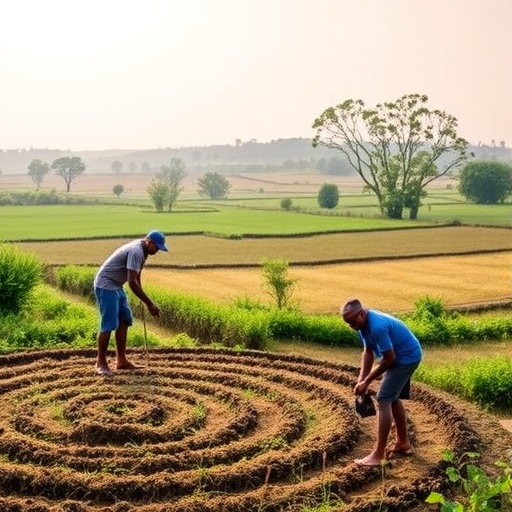
In a world increasingly driven by the imperative of sustainability, smallholder mixed farming systems occupy a critical nexus where innovation can dramatically influence environmental health, societal welfare, and economic resilience. Recent advances have shed light on the profound potential of systems-oriented innovation to transform these agricultural practices, simultaneously enhancing productivity and conservation efforts. The pioneering research by Martínez-Ramón, López-Ridaura, Cossu, and colleagues offers an insightful exploration of how an integrative approach can catalyze sustainable development tailored specifically for smallholder farmers who juggle diverse crops and livestock in mixed farming setups.
At the core of this transformative strategy lies the recognition that smallholder mixed farms operate within complex socio-ecological systems characterized by interdependent biological and human factors. The integration of crop and livestock production not only optimizes resource utilization but also fosters resilience against climatic and market uncertainties. Understanding and innovating within these systems require a holistic lens that transcends conventional single-sector interventions. The research illustrates how systems-oriented methods enable the identification of leverage points where innovation can yield cascading benefits across environmental, social, and economic dimensions.
One of the breakthrough aspects the study highlights is the application of advanced systems modeling and multi-criteria decision-making tools to elucidate the intricate interactions among farm components. These computational techniques allow researchers and farmers to simulate various management scenarios, predict outcomes under different climate or market conditions, and prioritize sustainable practices that maximize productivity without compromising ecosystem services. Such predictive capacity represents a paradigm shift from reactive to proactive agricultural management, empowering smallholder farmers to anticipate challenges and adapt accordingly.
Furthermore, the research underscores the pivotal role of inclusive innovation processes that actively involve farmers, local communities, researchers, and policymakers. By embedding farmer knowledge and preferences into the innovation cycle, the systems-oriented approach ensures that solutions are contextually relevant and feasible to implement. This participatory method enhances adoption rates of sustainable practices and nurtures a sense of ownership, which is crucial for long-term impact and scalability. Additionally, it fosters social learning and capacity building that bolster community resilience.
In practical terms, the innovations discussed in the paper cover a spectrum of technological and management strategies. These include diversified crop rotations, integrated pest management, agroforestry practices, nutrient cycling optimization, and precision livestock feeding regimes. Collectively, these innovations reduce dependency on external inputs, enhance soil fertility and biodiversity, and mitigate greenhouse gas emissions. Notably, the systems perspective helps to reveal synergies and trade-offs—for example, balancing between maximizing crop yield and maintaining pasture quality to support livestock health.
The study also provides compelling evidence that sustainable smallholder mixed farming can contribute significantly to global food security. By efficiently utilizing land and water resources and exploiting complementary interactions among farm components, these systems can enhance productivity per unit of input while preserving natural capital. Such efficiency gains are vital in the face of increasing pressure on agricultural landscapes from climate change, urban expansion, and intensifying demand for food.
Technological innovation is another major pillar supporting the transition towards sustainable mixed farming. The integration of remote sensing, IoT-enabled monitoring systems, and mobile platforms facilitates real-time data collection and decision support tailored to smallholder contexts. These technologies bridge the information gap, enabling farmers to make informed decisions about planting schedules, irrigation, pest control, and livestock management. Coupled with predictive analytics, they can result in optimized resource use and reduced environmental footprints.
Moreover, economic incentives and policy frameworks need to align with systems-oriented innovation to scale-up adoption and impact. The research highlights that supportive policies include access to credit, extension services, market integration, and risk management tools that accommodate the unique vulnerabilities faced by smallholder farmers. Policies designed with systems thinking promote cross-sectoral coordination and encourage innovation networks that link farmers with researchers, agribusinesses, and environmental agencies, fostering an enabling environment for sustainable transformations.
In addition to environmental and economic benefits, the study brings attention to the social implications of sustainable innovation in smallholder mixed farming. Enhancements in farm resilience directly contribute to food and livelihood security, reducing rural poverty and improving nutrition outcomes. The multidimensional nature of systems-oriented innovation fosters gender equity and youth engagement by creating diversified income opportunities and lowering labor burdens through mechanization and better resource management.
The researchers detail case studies from diverse agro-ecological zones, illustrating the adaptability of systems-oriented innovation. From semi-arid regions to tropical highlands, the principles and methodologies developed prove robust across varying climates, soil types, and cultural contexts. This adaptability speaks to the universality of the approach and its potential for replication across global smallholder farming communities, amplifying its relevance in worldwide sustainable agriculture discussions.
Importantly, the research addresses challenges and knowledge gaps that must be overcome to fully realize the promise of systems-oriented innovation. Among these are the need for enhanced data collection frameworks that capture the multi-dimensional facets of smallholder systems, better integration of social science insights, and the development of participatory platforms that effectively connect diverse stakeholders. Overcoming institutional silos and fostering interdisciplinary collaboration are essential steps in moving from pilot projects to large-scale implementation.
Sustainability metrics and monitoring frameworks are also elaborated upon, illustrating how the development of tailored indicators can track progress in economic viability, environmental health, and social well-being simultaneously. These metrics are critical for adaptive management and policy evaluation, ensuring that interventions remain relevant as conditions evolve. The continuous feedback loops inherent in a systems approach enable iterative learning and refinement, key features for enduring success.
The research further emphasizes the importance of resilience building in the face of climate variability. Smallholder mixed farming systems inherently offer resilience advantages due to biodiversity and diversification; however, climate change intensifies risks related to drought, pests, and diseases. Systems-oriented innovation integrates climate-smart agriculture practices and risk mitigation strategies—such as improved water management, drought-resistant crop varieties, and diversified income sources—to sustain productivity and livelihoods under increasingly volatile conditions.
Crucially, the paper calls for a paradigm shift in how sustainable agriculture research and development is conceived and funded. A move towards transdisciplinary, systems-based approaches necessitates greater investment in collaborative platforms, open data sharing, and capacity development tailored for smallholders. Such investments will empower marginalized farming communities to participate actively in shaping their future while preserving ecosystem integrity for generations to come.
In conclusion, the work of Martínez-Ramón and colleagues constitutes a landmark contribution to the field of sustainable agriculture. By elucidating how systems-oriented innovation can unlock the potential of smallholder mixed farming, the research charts a roadmap for pathways towards agricultural sustainability that are both scientifically grounded and socially inclusive. This holistic vision not only promises to boost productivity and resilience but also aligns with global goals related to climate action, biodiversity conservation, and equitable rural development.
The implications of these findings resonate well beyond the smallholder farm gate. They call upon researchers, practitioners, and policymakers to embrace systems thinking for a future where agriculture nourishes people and ecosystems in harmony. As the global community grapples with the twin challenges of food insecurity and environmental degradation, the evidence presented underscores that sustainable innovation, grounded in systemic awareness and collaborative action, holds the key to transformative agricultural pathways.
Subject of Research: Systems-oriented innovation for enhancing sustainability in smallholder mixed farming systems.
Article Title: Systems-oriented Innovation towards Sustainable Smallholder Mixed Farming.
Article References:
Martínez-Ramón, V., López-Ridaura, S., Cossu, A. et al. Systems-oriented Innovation towards Sustainable Smallholder Mixed Farming. npj Sustainable Agriculture 4, 5 (2026). https://doi.org/10.1038/s44264-025-00114-9
Image Credits: AI Generated


