

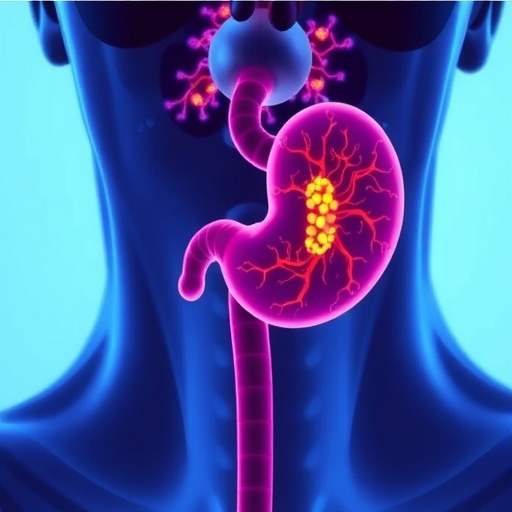
Gastric cancer, a prevalent form of malignancy, continues to pose significant challenges in oncological treatment, primarily due to its dismal prognosis. Researchers across the globe are increasingly focusing on elucidating the underlying mechanisms driving gastric cancer progression. One particularly intriguing aspect of this cancer type is its interaction with the immune system, especially the role of macrophages in tumor development and metastasis. Recent studies have unveiled the intricate pathways through which gastric cancer cells modulate immune responses to create a favorable environment for their survival and growth.
A study led by Shi et al. proposes a novel mechanism that links the regulation of a protein known as INHBA with macrophage polarization in the context of gastric cancer. This protein, governed by C/EBPβ transcription factor, is shown to play a pivotal role in transforming macrophages into a pro-tumorigenic M2 phenotype. The shift towards M2 polarization is particularly significant as these macrophages are known for their role in suppressing immune responses while promoting tissue repair and tumor progression.
The research underscores that INHBA is not merely a passive participant but a crucial player in orchestrating tumor immunity. Its induced M2 macrophage polarization influences multiple facets of tumor biology, including enhanced tumor growth and increased metastatic potential. One of the most critical aspects of the findings is the identification of the signaling pathways activated by INHBA. The study highlighted the PI3K/AKT pathway as a central player in mediating these effects, linking metabolic alterations to cellular responses that ultimately favor tumor survival.
Delving deeper into the molecular mechanisms, the activation of the PI3K/AKT pathway instigates a host of downstream effects that contribute to the tumor microenvironment’s permissiveness. This pathway is well-documented for its role in cellular growth, proliferation, and survival. When gastric cancer cells exploit this signaling circuit, it results in a robust survival advantage, particularly under stress conditions common within the tumor microenvironment, such as hypoxia and nutrient deficiency.
Furthermore, the interaction between gastric cancer cells and macrophages presents a complex landscape wherein both cellular types adapt their functions to support tumor progression. M2 macrophages, in particular, release a variety of cytokines and growth factors that can facilitate cancer cell survival, migration, and invasion. The research implies that targeting the INHBA-C/EBPβ axis could represent a promising therapeutic strategy to disrupt this symbiotic relationship and potentially reduce the aggressiveness of gastric cancer.
The findings of this study carry significant implications for developing novel therapeutic interventions. By targeting the pathways activated by INHBA or the resulting M2 macrophage polarization, it may be possible to improve the overall prognosis of gastric cancer patients. Additionally, understanding the precise role of the immune microenvironment in gastric cancer could lead to more effective immunotherapeutic approaches.
Immunotherapy, an exciting frontier in cancer treatment, has shown promise in various cancer types; however, gastric cancer has been historically resistant to these methods. The discovery that INHBA promotes immune evasion through macrophage transformation opens new avenues for combining traditional therapies with immune-modulating strategies. The overarching goal is to reinvigorate anti-tumor immune responses while simultaneously targeting malignant cells directly.
Moreover, the study emphasizes the importance of a comprehensive understanding of gastric cancer’s biology, which may vary vastly between patients. Personalized approaches that consider the unique immune landscapes and molecular signatures associated with each tumor will be essential for advancing treatment options in gastric cancer.
As the field of cancer research embraces personalized medicine, the spotlight on the interplay between tumor cells and the immune system will undoubtedly lead to transformative therapies. The ability to counteract the immune-suppressive tactics used by gastric cancer is imperative for enhancing treatment effectiveness and, ultimately, patient outcomes.
The authors of the study advocate for future research to further elucidate the pathways influenced by the INHBA-C/EBPβ axis and to explore their potential as biomarkers for gastric cancer progression and prognosis. The integration of this knowledge into clinical settings could revolutionize how healthcare professionals approach the treatment of gastric cancer.
In conclusion, the multifactorial nature of gastric cancer necessitates a concerted effort towards unraveling its complexities. Research that bridges the gap between tumor biology and immunology represents a crucial step towards developing innovative strategies that can shift the tide in favor of patient survival.
Understanding the mechanisms that bolster tumor growth and metastasis in gastric cancer, such as those involving INHBA and macrophage polarization, provides hope for the future. With continued focus and investment in this area, the medical community may transform gastric cancer from a once intractable problem into a manageable condition.
Subject of Research: The Role of INHBA in Macrophage Polarization and Tumor Progression in Gastric Cancer
Article Title: INHBA, regulated by C/EBPβ, induces M2 macrophage polarization to promote tumor metastasis and growth via activating the PI3K/AKT pathway in gastric cancer.
Article References:
Shi, DB., Qin, YC., Liu, S. et al. INHBA, regulated by C/EBPβ, induces M2 macrophage polarization to promote tumor metastasis and growth via activating the PI3K/AKT pathway in gastric cancer. Br J Cancer (2026). https://doi.org/10.1038/s41416-025-03326-5
Image Credits: AI Generated
DOI:
Keywords: Gastric cancer, INHBA, M2 macrophage polarization, PI3K/AKT pathway, tumor growth, metastasis, immunotherapy, C/EBPβ.


