


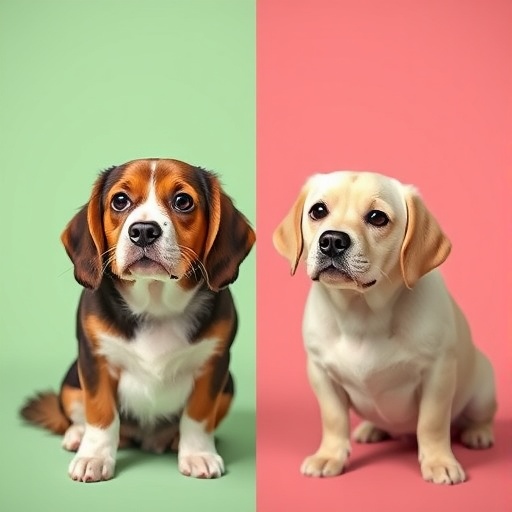
In a groundbreaking study, researchers have uncovered remarkable insights into the cognitive abilities of dogs, particularly in their capacity for olfactory discrimination. The interdependent relationship between canine senses and their environmental interactions has long intrigued scientists and animal behaviorists alike. The research conducted by Ricci-Bonot, Duncan, and Mills, published in “Animal Cognition,” traces how dogs manage to differentiate between various scents, a task tied to their evolutionary history as hunters and scavengers. This study goes deeper than merely stating that dogs can smell better than humans; it delves into the mechanisms behind their impressive olfactory perception and the complex learning processes involved.
At the crux of this study is “same-different learning,” a concept exploring how dogs can discern between two or more scents presented to them. This type of learning is vital for not just survival, but also for tasks that range from search-and-rescue operations to aiding humans in various therapeutic roles. The researchers conducted rigorous experiments using distinct odor pairs to assess the dogs’ understanding of sameness and difference. Observing the dogs’ reactions, they collected data on their ability to define scents that belong to the same category versus those that were entirely different.
Prior studies have established a basic understanding of canine olfactory prowess, suggesting that dogs possess upwards of 300 million scent receptors compared to a human’s meager 5 million. However, this new research is pioneering in its focus on the cognitive aspects of scent discrimination rather than solely relying on the biological framework. It proposes a more evolved perspective on how dogs process scents cognitively, encouraging thoughts about their problem-solving capabilities when it comes to smell.
Through an innovative experimental design, the research team employed various olfactory stimuli to gauge how well dogs remember and categorize scents over time. The dogs were shown two bottles of different odors and tasked with identifying whether they were the same or different. This behavioral experiment was crucial for assessing the dogs’ cognitive processes and revealing their intrinsic ability to understand olfactory signals. Remarkably, the results indicated that not only do dogs have the ability to differentiate scents accurately, but they can also learn and remember these distinctions over various time frames.
The experimentation process itself was intricate, involving repeated trials where consistency in the task setup was paramount. This ensured that any variations in performance could be accurately attributed to the dogs’ learning capabilities rather than confounding factors within the experimental design. By meticulously developing the methodologies employed in the experiment, the researchers minimized potential biases and maximized the validity of their findings, which is crucial in the world of scientific research.
What makes this study truly compelling extends beyond the results; it heralds the possibility of further exploring canine intelligence regarding smell. The insights gained from these experiments can pave the way for new training methodologies among service dogs and working animals, ultimately enhancing their utility in various human-centric assistance roles. Currently, dogs hold critical positions in law enforcement, search and rescue, and therapy, but understanding their cognitive processing linked with smells can augment these capabilities even further.
Interestingly, the concept of “same-different learning” not only encapsulates a functional skill set for dogs but also poses questions about their emotional and social intelligence when interacting with humans. By discerning subtle differences in smells, dogs may enhance their synchronicity with human emotions. Such factors might lead to incremental advancements in human-dog relationships, thereby enriching the quality of life for both species.
Moreover, the research holds profound implications for future studies centered around evolutionary biology, animal cognition, and perhaps even the way humans perceive the world around them. Dogs, as companions, present a unique lens to understand sensory processing and cognitive agility in animals. The results of this research can ignite discussions regarding the untapped potential of other domesticated species and their cognitive landscapes as well.
The findings serve to challenge some entrenched notions about dog intelligence, promoting the idea that they possess a level of understanding and cognitive flexibility that is often underestimated. This has crucial ramifications not only for how we train and communicate with dogs but also how societies value animal intelligence and capabilities. The broader awareness generated by such research has the potential to redefine the roles of dogs within human communities, from pets to partners.
In conclusion, the study led by Ricci-Bonot and colleagues significantly enriches our understanding of olfactory learning in dogs. It courageously expands on the dog-human connection and signifies a leap towards recognizing the complex cognitive lives of our canine companions. As the research community continues to delve into the pets’ abilities, a combined patience and curiosity can illuminate avenues for enhancing human-animal relations. The cerebral activity involved in scent differentiation may be, after all, just one facet of a much richer tapestry of potential cognitive experiences shared between dogs and humans.
Ricci-Bonot, C., Duncan, A., Mills, D.S. et al. Same-different learning of odour stimuli in dogs.
Anim Cogn (2026). https://doi.org/10.1007/s10071-025-02035-z
Cite Scienmag News
William Thompson. (January 18, 2026). Dogs Demonstrate Same-Different Odor Learning Abilities. Scienmag. https://scienmag.com/dogs-demonstrate-same-different-odor-learning-abilities/
William Thompson. "Dogs Demonstrate Same-Different Odor Learning Abilities." Scienmag, 18 January 2026, https://scienmag.com/dogs-demonstrate-same-different-odor-learning-abilities/. Accessed 3 September 2026.
William Thompson. "Dogs Demonstrate Same-Different Odor Learning Abilities." Scienmag. January 18, 2026. https://scienmag.com/dogs-demonstrate-same-different-odor-learning-abilities/


