


A groundbreaking new study from the University of Pittsburgh School of Medicine sheds light on the earliest neural underpinnings of infant emotional development, opening pathways to potentially revolutionize early interventions for children at risk of emotional and behavioral challenges. Using state-of-the-art neuroimaging, researchers have identified specific white matter microstructural patterns at just three months of age that forecast changes in emotional reactivity and self-regulation over the subsequent six months, marking a pivotal advance in developmental neuroscience.
Led by Dr. Yicheng Zhang and Dr. Mary L. Phillips, the research utilized Neurite Orientation Dispersion and Density Imaging (NODDI), a sophisticated MRI technique that surpasses traditional diffusion imaging by disentangling the complexity of neural tissue architecture. NODDI quantifies aspects such as neurite dispersion and density, offering unprecedented insight into the organization and maturity of white matter tracts that serve as critical communication highways in the brain.
The study followed 95 infant-caregiver pairs longitudinally, analyzing the infants’ white matter microstructure at three months and tracking their emotionality—including negative emotionality and positive emotion—and self-soothing abilities through nine months. The findings highlight that microstructural characteristics of white matter tracts in early infancy are not merely passive anatomical features, but are actively linked to the trajectory of emotional development during this sensitive window.
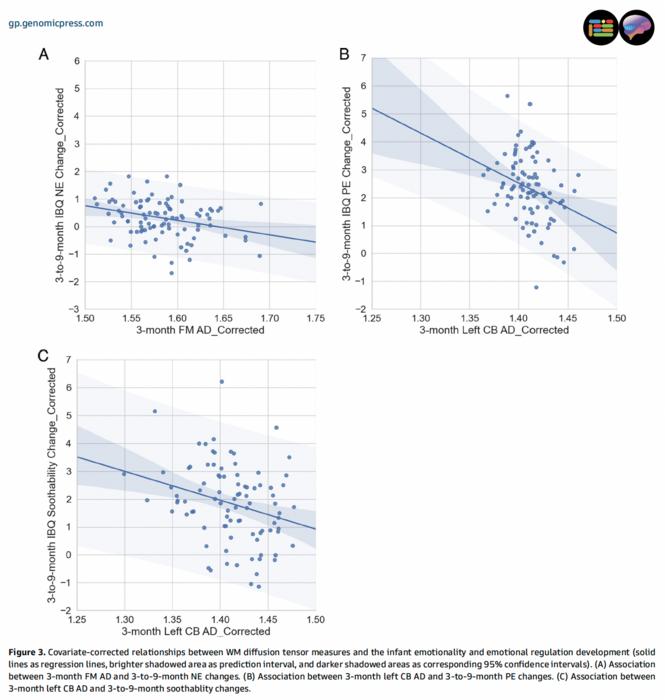
Specifically, increased neurite orientation dispersion within the forceps minor—a commissural tract that interconnects the brain’s hemispheres—was associated with heightened negative emotionality changes from three to nine months. This suggests that greater neural fiber complexity or disorganization in this region may predispose infants to greater emotional reactivity, potentially laying the foundation for future vulnerability to anxiety or mood disorders.
Conversely, more intricate microstructure in the left cingulum bundle, a major pathway linking regions implicated in executive control and emotion regulation, correlated with enhanced positive emotional development and improved self-soothing capacity. These associations imply that early white matter development in networks responsible for cognitive-emotional integration supports the maturation of adaptive emotional responses essential for healthy psychological growth.
What sets this research apart is not only its use of cutting-edge NODDI imaging but also its rigorous longitudinal design and validation through independent replication in an additional cohort of 44 infants. The comprehensive approach accounted for confounding variables such as caregiver mental health, socioeconomic status, and infant demographics, bolstering confidence that observed brain-behavior relationships reflect fundamental neurodevelopmental processes.
The implications of these findings extend far beyond academic insight. By elucidating the neural signatures that presage emotional development, this work paves the way for early detection of infants at risk for emotional dysregulation before clinical symptoms manifest. Such early identification could revolutionize pediatric mental health by facilitating targeted interventions during critical periods when neural plasticity is greatest, potentially altering life-course trajectories toward resilience and wellbeing.
Moreover, the successful application of NODDI demonstrates its power as a neuroimaging modality capable of resolving the intricate microstructural changes occurring in the developing brain. Traditional imaging modalities often lack the specificity to parse the complex cellular environment of infant white matter—a barrier that NODDI effectively overcomes by estimating neurite density and dispersion as discrete metrics.
The study focused on three principal white matter tracts intimately involved in emotional processing and regulation: the forceps minor, the cingulum bundle, and the uncinate fasciculus. Each serves as a conduit connecting key cortical and subcortical regions. Understanding how variation in these pathways relates specifically to different facets of emotional growth provides a neural blueprint of early affective development.
This research also touches upon broader, unanswered questions in neuroscience. How stable are these microstructural markers across childhood and beyond? Can environmental enrichment or targeted behavioral therapies modulate white matter development to foster emotional resilience? These avenues remain ripe for investigation through future longitudinal and intervention studies.
Furthermore, the findings underscore the importance of the first year of life as a critical window for brain organization. Rapid white matter maturation during this period lays down the neurobiological foundation for emotion regulation, social cognition, and subsequent mental health. As such, insights gleaned here resonate with wider public health concerns, emphasizing investment in early childhood development programs and caregiver support.
Clinically, the identification of objective neural biomarkers holds transformative potential for pediatric practice. Rather than relying solely on observable behaviors, which often emerge later, neuroimaging-based markers could enable precision screening strategies that identify vulnerability at the neural level. This shift toward proactive, neuroscience-informed pediatric care represents a major leap forward in mental health prevention.
Ultimately, this study marks a new era in developmental neuroscience, illustrating how advanced imaging technologies can unravel previously hidden dimensions of brain-behavior interplay. By mapping the earliest white matter microstructural predictors of emotional growth, the research not only enhances our scientific understanding but offers a vision of hope: that by intervening early and effectively, we may shape healthier emotional trajectories from infancy onward.
The article, entitled “Early infant white matter tract microstructure predictors of subsequent change in emotionality and emotional regulation,” is published open access on June 3, 2025, in Genomic Psychiatry. It signals an exciting frontier wherein genetics, neuroimaging, and behavioral science converge to decode the origins of emotion and set the stage for a future in which mental health challenges are detected and addressed before they take root.
Cite Scienmag News
Cassandra Pierce. (June 3, 2025). Infant Brain Connectivity at 3 Months Forecasts Emotional Development. Scienmag. https://scienmag.com/infant-brain-connectivity-at-3-months-forecasts-emotional-development/
Cassandra Pierce. "Infant Brain Connectivity at 3 Months Forecasts Emotional Development." Scienmag, 3 June 2025, https://scienmag.com/infant-brain-connectivity-at-3-months-forecasts-emotional-development/. Accessed 4 September 2026.
Cassandra Pierce. "Infant Brain Connectivity at 3 Months Forecasts Emotional Development." Scienmag. June 3, 2025. https://scienmag.com/infant-brain-connectivity-at-3-months-forecasts-emotional-development/


