


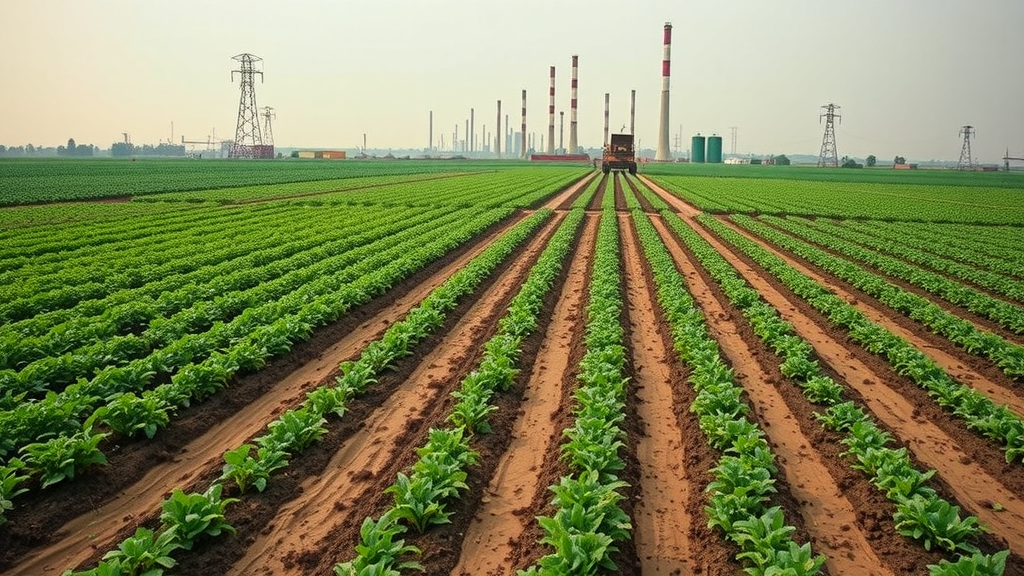
A bumper harvest is not always a safe harvest. That is the unsettling conclusion of a sweeping new review published in the journal Discover Soil, which synthesizes global evidence showing that industrial waste is contaminating agricultural soils with heavy metals, persistent organic pollutants, microplastics, PFAS and engineered nanoparticles — often without any visible effect on crop yields. The review, led by Muhammad Khizar Hayat of Sakarya University of Applied Sciences and Md. Nahid Mahmud of IUBAT in Bangladesh, argues that the world’s food systems are being judged by a dangerously incomplete metric: productivity alone. Fields that produce record quantities of wheat, rice and vegetables can simultaneously be delivering chronic doses of toxic substances to billions of consumers, a phenomenon the authors call hidden toxicity.
The scale of the problem is difficult to overstate. Global assessments cited in the review estimate that between 14 and 17 percent of the world’s cropland exceeds safety thresholds for at least one toxic metal, including arsenic and cadmium. A separate global evaluation found that 16 to 20 percent of cultivated soils exceed guideline values for heavy metals, with the worst hotspots concentrated in rapidly industrializing regions of Asia and parts of Africa. Unlike nutrient depletion or erosion, this contamination rarely announces itself. Heavy metals such as cadmium, lead, arsenic, mercury and chromium are non-degradable and can accumulate in crop tissues without stunting growth or reducing tonnage, meaning farmers and regulators may see no warning signs at all.
The sources of these contaminants are as varied as modern industry itself. Mining runoff, smelting emissions, electroplating discharge, coal combustion residues, wastewater irrigation and phosphate fertilizers all deposit chemically reactive metals into soils that were once shaped only by natural weathering. Peri-urban farmland near petrochemical facilities and traffic corridors frequently carries polycyclic aromatic hydrocarbons at concentrations between 500 and 3,000 micrograms per kilogram of soil. In Turkey, soils adjacent to industrial zones have been found contaminated with cadmium, arsenic, lead, zinc and mercury despite continuing agricultural use. Even agricultural intensification contributes its own burden: intensive greenhouse cultivation with heavy nutrient and antibiotic inputs builds up residues in soils while short-term yields remain unaffected.
The review pays particular attention to contaminants of emerging concern that classical soil risk models were never designed to handle. Per- and polyfluoroalkyl substances, the so-called forever chemicals, enter farmland through biosolids and reclaimed wastewater, with treated sludge soils showing total PFAS loads of 10 to 1,000 micrograms per kilogram. Uptake has been documented in leafy vegetables and grains, and recent European reports found PFAS-derived compounds in widely consumed cereal products. Microplastics, meanwhile, are accumulating in agricultural soils at rates that may exceed marine inputs, driven by plastic mulch films, sewage sludge and irrigation water. Estimates suggest that 31,000 to 42,000 tons of microplastics are applied to European farmland annually through sludge amendments alone, potentially making European agricultural soils the largest terrestrial plastic reservoir on the planet.
What makes these pollutants especially insidious is how they interact. The review highlights evidence that microplastics are not inert: they alter soil aggregation and water retention, and they can adsorb heavy metals and hydrophobic organic compounds, effectively increasing the mobility and bioavailability of co-contaminants. Meta-analyses show that the presence of microplastics can raise the bioavailability of cadmium and lead in soils, meaning plant uptake and food safety risks may increase even where measured contamination levels have not changed. Multi-metal studies reveal similar non-additive effects, with joint exposure to cadmium and lead or cadmium and zinc disrupting soil microbial networks and enzyme activity more severely than single metals alone. Contaminated soils, in other words, behave as complex interacting systems rather than simple chemical reservoirs.
The pathway from soil to dinner plate runs through plant physiology. Metals such as cadmium, lead and zinc are taken up at the root-soil interface through membrane transporters that normally carry essential nutrients, including the ZIP and NRAMP transporter families. Arsenate mimics phosphate and enters through phosphate transporters, while arsenite slips through aquaglyceroporin channels in flooded paddy conditions — one reason rice is such an efficient arsenic accumulator. Once inside the plant, phytochelatins and metallothioneins chelate the metals and shuttle them through the xylem toward shoots and grains. Bioconcentration factors for cadmium in leafy vegetables range from 0.5 to 2.5, and translocation factors above 1.0 in hyperaccumulating species indicate effective movement into edible tissues. Foliar deposition of airborne particulates adds a second entry route, particularly in peri-urban farmland.
Case studies from three continents illustrate the paradox of high yields amid hidden contamination. In China’s major grain belts, roughly 16 percent of cultivated land exceeds safety thresholds for toxic metals, and rice grown in Hunan Province near mining and smelting sites frequently exceeds cadmium limits even though yields match unaffected areas. In France, cadmium — a proven human carcinogen — has been detected in bread, pasta and potatoes at levels approaching or exceeding health guidance values, prompting health professionals to warn of a public health time bomb. On the Indo-Gangetic Plain, intensive irrigation sustains some of the highest wheat and rice yields in South Asia, yet groundwater laced with geogenic arsenic in West Bengal and Bangladesh loads the grain with a carcinogen that never appears in yield statistics. In the United States, a 2025 review found millions of pounds of PFAS applied annually to California cropland, largely through pesticide formulations.
The human health consequences of chronic dietary exposure are severe and well documented. Cadmium, with a biological half-life of 10 to 30 years, accumulates in the kidneys and liver and is linked to renal tubular dysfunction, osteoporosis, hypertension and increased risks of lung, prostate and breast cancers; chronic exposure through contaminated rice historically produced the devastating Itai-itai disease in Japan. Arsenic is classified by the International Agency for Research on Cancer as a Group 1 human carcinogen, associated with skin, bladder, lung and liver cancers as well as cardiovascular disease and developmental disorders. Lead has no known safe blood level, and even low dietary exposure impairs neurological development and reduces IQ in children. Methylmercury crosses both the placental and blood-brain barriers, threatening fetal brain development. Because these exposures are continuous and low-dose, damage often accumulates silently for years before symptoms appear.
The review also maps a way forward. Nature-based remediation offers promising tools: hyperaccumulator plants such as Sedum alfredii, Brassica juncea and Pteris vittata can extract or stabilize cadmium, arsenic, lead and zinc, especially when assisted by plant growth-promoting rhizobacteria and arbuscular mycorrhizal fungi. Biochar, particularly engineered variants modified with iron or manganese oxides, can immobilize metals while improving soil structure and microbial diversity. Persistent organic pollutants yield to microbial bioremediation using organisms such as Pseudomonas, Sphingomonas and white-rot fungi, as well as emerging enzymatic and advanced oxidation treatments. For plastics, the priorities are prevention — biodegradable mulch films, stricter sludge regulation and better recycling — alongside experimental techniques such as magnetic nanoparticle extraction. Precision agriculture, remote sensing, hyperspectral imaging, biosensors and machine learning are converging to enable real-time contamination mapping that laboratory methods alone could never deliver.
Ultimately, the authors argue, the deepest problem is conceptual. Agricultural success has been measured in tons per hectare for a century, and that measure is now actively misleading. A field can be agronomically excellent and toxicologically compromised at the same time, and no farmer, consumer or policymaker will know without testing. Closing the gap requires interdisciplinary collaboration among soil scientists, agronomists, toxicologists and public health experts, alongside stronger regulatory frameworks, routine monitoring of both soils and food commodities, and research into how climate change will reshape pollutant mobility and bioavailability. Sustainable agriculture, the review concludes, must be judged not only by what the land produces, but by what that produce carries — and by the health of the soils, ecosystems and people that depend on them.
Subject of Research: Toxicological risks of industrial waste contaminants in agricultural soils for food safety and environmental sustainability
Article Title: Toxicological risks of industrial waste in agricultural soils for food safety and environmental sustainability
Article References: Hayat, M. K., Mahmud, M. N., Muniza, N. T., Batool, R., Al Kafi, A., Tahara, T., Ullah, Q., & Haider, W. (2026). Toxicological risks of industrial waste in agricultural soils for food safety and environmental sustainability. Discover Soil, 3(1), Article 156. https://doi.org/10.1007/s44378-026-00309-7
Image Credits: AI Generated
DOI: 10.1007/s44378-026-00309-7
Keywords: industrial waste, soil contamination, heavy metals, PFAS, microplastics, food safety, food chain transfer, hidden toxicity, soil remediation, sustainable agriculture, human health risk, agricultural soils
Cite Scienmag News
Alan Morgan. (September 23, 2026). Industrial Waste Is Quietly Poisoning the World’s Most Productive Farmland. Scienmag. https://scienmag.com/industrial-waste-is-quietly-poisoning-the-worlds-most-productive-farmland/
Alan Morgan. "Industrial Waste Is Quietly Poisoning the World’s Most Productive Farmland." Scienmag, 23 September 2026, https://scienmag.com/industrial-waste-is-quietly-poisoning-the-worlds-most-productive-farmland/. Accessed 4 October 2026.
Alan Morgan. "Industrial Waste Is Quietly Poisoning the World’s Most Productive Farmland." Scienmag. September 23, 2026. https://scienmag.com/industrial-waste-is-quietly-poisoning-the-worlds-most-productive-farmland/


