


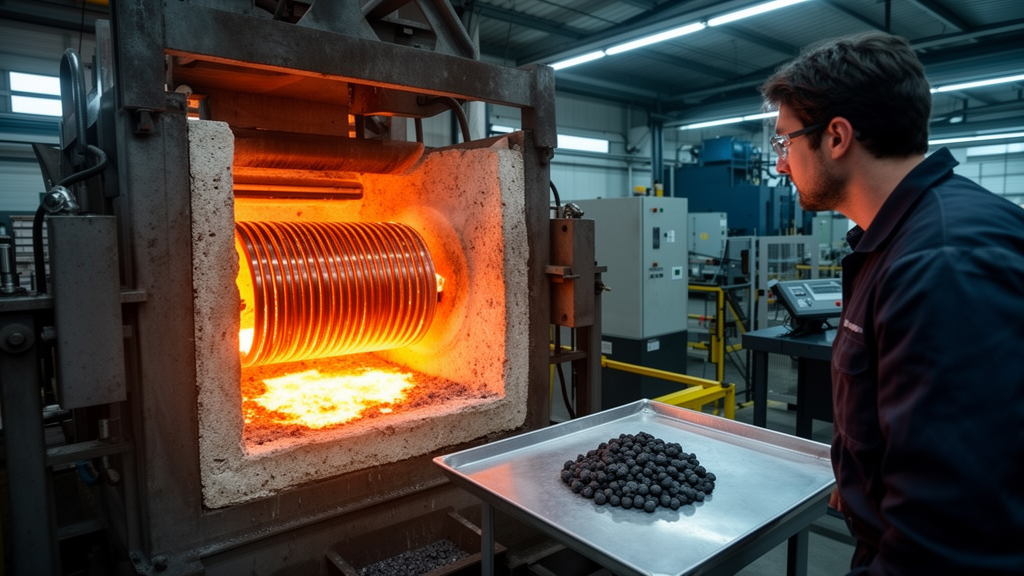
In a preliminary laboratory study, iron was recovered from hematite–goethite pellets in an induction furnace at rates of up to 73% when the researchers controlled slag basicity and the carbon-to-oxygen ratio at 1,300 °C. The best result was obtained at a basicity of 1.3 and a carbon-to-oxygen ratio of 1.4, according to the study in Clean Technologies and Environmental Policy. At these conditions, 1.99 tonnes of pellets were required for every tonne of recovered cast iron.
The experiment focused on an alternative to the blast-furnace ironmaking route, which the paper describes as the most widely used method for producing iron but also as a significant source of carbon dioxide emissions. The researchers used hematite–goethite pellets as feed material in the induction furnace and varied basicity and the carbon-to-oxygen ratio to assess their relationship with iron recovery. The reported maximum of 73% was achieved under a specific combination of conditions rather than through furnace temperature alone, because the temperature was maintained at 1,300 °C while the charge composition and carbon-to-oxygen ratio were adjusted.
Metal recovery was closely associated with two calculated properties of the slag: its estimated liquidus temperature and its viscosity. These properties were evaluated using FactSage 6.0, allowing the researchers to compare the operating conditions with modeled estimates of slag behavior. The study’s central technical finding is that the highest recovery coincided with a basicity of 1.3 and a carbon-to-oxygen ratio of 1.4. It also supplies a material-use benchmark: at the optimum conditions, 1.99 tonnes of pellets were needed per tonne of recovered cast iron.
The environmental results are modeled scenarios rather than direct measurements of the furnace’s full emissions performance. Electricity consumption and off-gas were not measured experimentally, so the researchers conducted a calculated material-and-carbon assessment and used published induction-furnace energy data to estimate electricity-related emissions. For electricity consumption of 500–800 kilowatt-hours per tonne, the scenario gives emissions of approximately 410–736 kilograms of carbon dioxide per tonne when an electricity factor of 0.82–0.92 kilograms of carbon dioxide per kilowatt-hour is applied. These values depend on the assumed energy consumption and electricity carbon intensity and should not be read as observed emissions from the reported trials.
Within the paper’s assessment, replacing fossil-fuel-related heating with an induction furnace could cut carbon dioxide emissions by approximately 258 kilograms per tonne when the furnace uses near-zero-carbon electricity. The authors identify three principal decarbonization opportunities: low-carbon electricity, higher metal recovery, and reduced use of fossil carbon in metal reduction. The experimental recovery result and the pellet requirement therefore provide a preliminary technical baseline, while the emissions savings remain conditional on the energy source and the assumptions used in the scenario analysis.
Subject of Research: Laboratory assessment of induction-furnace production of cast iron from hematite–goethite pellets
Article Title: Cast iron production from hematite–goethite pellets using the induction furnace
Article References: Chiwandika, E. K., Maritsa, S., & Masuka, S. M. (2026). Cast iron production from hematite–goethite pellets using the induction furnace. Clean Technologies and Environmental Policy, 28(11), Article 283. https://doi.org/10.1007/s10098-026-03629-y
Image Credits: AI Generated
DOI: 10.1007/s10098-026-03629-y
Keywords: induction furnace, cast iron, hematite–goethite pellets, iron recovery, slag basicity, carbon-to-oxygen ratio, FactSage, metallurgy, carbon dioxide emissions, low-carbon electricity, Cast, iron
Cite Scienmag News
Sloane Callahan. (October 21, 2026). Induction furnace study recovers up to 73% iron from ore pellets. Scienmag. https://scienmag.com/induction-furnace-study-recovers-up-to-73-iron-from-ore-pellets/
Sloane Callahan. "Induction furnace study recovers up to 73% iron from ore pellets." Scienmag, 21 October 2026, https://scienmag.com/induction-furnace-study-recovers-up-to-73-iron-from-ore-pellets/. Accessed 21 October 2026.
Sloane Callahan. "Induction furnace study recovers up to 73% iron from ore pellets." Scienmag. October 21, 2026. https://scienmag.com/induction-furnace-study-recovers-up-to-73-iron-from-ore-pellets/


