


Income inequality and carbon dioxide emissions for high-income nations such as the United States, Denmark and Canada are intrinsically linked – but a new study from Drexel University has taken a deeper look at the connection and found this relationship is less fixed, can change over time, and differ across emission components. The findings could help countries set a course toward reducing emissions of the harmful greenhouse gas and alleviating domestic income inequality at the same time.

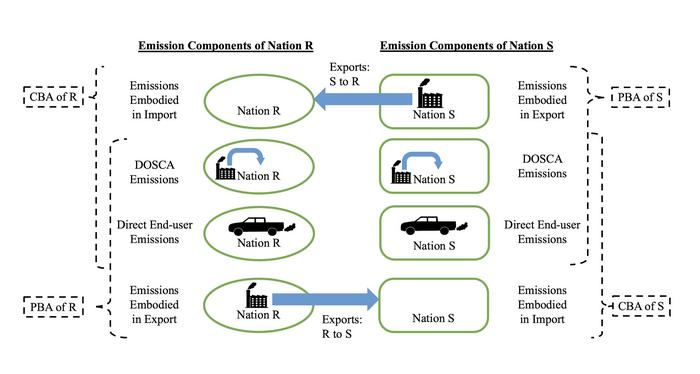
Credit: The figure is adapted from Figure 3.1 in Huang (2022) and is originally inspired by Steininger et al. (2014).
Income inequality and carbon dioxide emissions for high-income nations such as the United States, Denmark and Canada are intrinsically linked – but a new study from Drexel University has taken a deeper look at the connection and found this relationship is less fixed, can change over time, and differ across emission components. The findings could help countries set a course toward reducing emissions of the harmful greenhouse gas and alleviating domestic income inequality at the same time.
The study, conducted by Xiaorui Huang, PhD, an assistant professor in the College of Arts and Sciences, applies a multidimensional emissions profile (MEP) framework to examine how the relationship between income inequality and emissions can differ by category of human activity.
The study, published in Social Forces, considers four emission components — carbon dioxide-emitting activities — with distinct implications for climate change mitigation, using data from 34 wealthy nations between 2004-2015:
- emissions generated by domestic-oriented supply chain activities
- emissions embodied in exports
- direct emissions of end-user activities
- emissions embodied in imports
These components are identified as distinct points of intervention for climate change mitigation, and they are interconnected via domestic and global supply chains. Huang applied MEP framework to investigate how these four emission components may be heterogeneously related to nations’ income inequality. The multidimensional analysis identifies emission components that may be mitigated by inequality-reducing policies — synergy— and emission components that may grow due to such policies — trade-offs.
The research employed statistical models to examine the link between carbon dioxide emissions and the income share of the top 10% of a country’s population – a measure capturing the concentration of income at the top of the distribution. Huang found that the income share of the top 10% is negatively related to direct end-user emissions from 2009 to 2011 following the Great Recession, and positively related to emissions embodied in exports from 2011 to 2015.
“I theorize that direct end-user emissions and emissions embodied in exports are related to the top 10% income share via different mechanisms,” Huang said.
Prior research establishes three co-existing theoretical mechanisms: power and political economy, how income inequality shapes consumption patterns or the ‘Veblen effect’, and households’ marginal propensity to emit.
“The political economy mechanism focuses on how income concentration at the top of the distribution empowers the wealthy to undermine regulations on carbon emissions from general production activities including export-oriented industries,” said Huang. “Income share of the top 10% is related to emissions embodied in exports via the political economy mechanism, which became more pronounced from 2011 to 2015.”
“In contrast, the ‘Veblen effect’ and the marginal propensity mechanisms are more closely linked to consumption activities: the former concerns how domestic income inequality spurs competitive and emulative consumption, while the latter concerns the societal distribution of households at different income levels with varying marginal propensity to spend additional income and emit CO2 as a result,” said Huang. “Income inequality is related to direct end-user emissions through these two mechanisms—the strength of which changed due to the Great Recession of 2008, resulting in the negative relationship from 2009 to 2011.”
The paper suggests that reducing income concentration at the top end of the distribution could synergistically reduce emissions embodied in exports, but might increase direct end-user emissions at times, such as during and immediately after a recession.
“To mitigate the dual crises of climate change and growing economic inequality, it is vital to enhance the synergy between CO2 emissions abatement and inequality reduction,” said Huang.
Huang suggests that these insights can guide policy efforts to improve the synergy while minimizing the trade-offs. Inequality-reducing policies – one example currently being considered is a global tax on billionaires – should be implemented along with measures that improve the well-being of lower-income populations without causing inadvertent growth in their direct fossil fuel consumption.
Journal
Social Forces
Method of Research
Meta-analysis
Subject of Research
People
Article Title
Harness the Co-Benefit and Avoid the Trade-off: The Complex Relationship between Income Inequality and Carbon Dioxide Emissions
Article Publication Date
24-May-2024
Cite Scienmag News
Courtney Benton. (June 10, 2024). Income inequality and carbon dioxide emissions have a complex relationship. Scienmag. https://scienmag.com/income-inequality-and-carbon-dioxide-emissions-have-a-complex-relationship/
Courtney Benton. "Income inequality and carbon dioxide emissions have a complex relationship." Scienmag, 10 June 2024, https://scienmag.com/income-inequality-and-carbon-dioxide-emissions-have-a-complex-relationship/. Accessed 4 September 2026.
Courtney Benton. "Income inequality and carbon dioxide emissions have a complex relationship." Scienmag. June 10, 2024. https://scienmag.com/income-inequality-and-carbon-dioxide-emissions-have-a-complex-relationship/

