


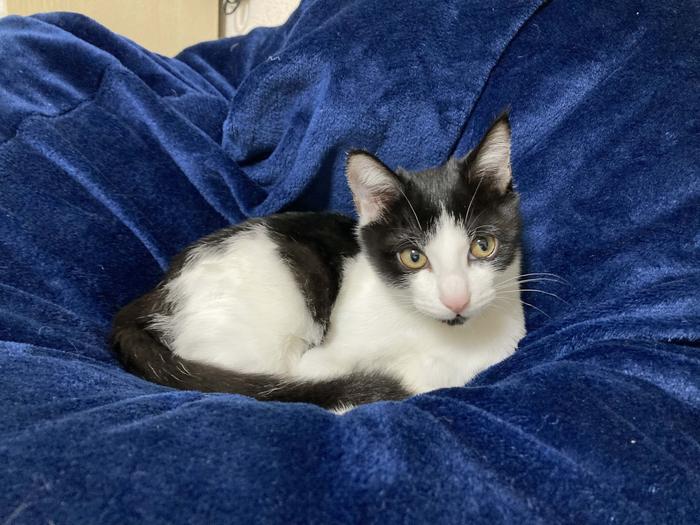
A common image of cats today comes in the form of cute cat memes online, but these furry felines commonly experience kidney disease. Amid advances in medicine to improve people’s quality of life, an Osaka Metropolitan University-led team has, for the first time in the world, generated high-quality feline induced pluripotent stem cells (iPSCs), which have the potential to help companion animals and humans alike.

Credit: Osaka Metropolitan University
A common image of cats today comes in the form of cute cat memes online, but these furry felines commonly experience kidney disease. Amid advances in medicine to improve people’s quality of life, an Osaka Metropolitan University-led team has, for the first time in the world, generated high-quality feline induced pluripotent stem cells (iPSCs), which have the potential to help companion animals and humans alike.
Human iPSCs have been generated using just four genes known as transcription factors, but feline iPSCs have been difficult to generate. Graduate School of Veterinary Science Professor Shingo Hatoya led the team in introducing six transcription factors via the Sendai virus vector to generate feline iPSCs from the cells of cats, including those derived from the uterus that were donated when cats were sterilized.
The team reports in Regenerative Therapy that these are the first high-quality feline iPSCs. They exhibit the properties that many iPS cells do, such as the formation of teratomas, which proves that they can differentiate into a variety of cells. The stem cells generated also do not have a genetic footprint, meaning there is lower risk that they form tumors when implanted in another cat. Furthermore, they can be maintained without feeder, such as fibroblast from mice, making them safer as they do not mix cells from different species.
“Especially in cats, chronic kidney disease and diabetes are serious problems,” Professor Hatoya declared. “Establishing a method to have cells form a kidney or pancreas from feline iPSCs will be a challenge for future research.”
Professor Hatoya, who previously reported on advancements in feeder-free canine iPSCs, added, “High-quality feline iPSCs made possible by this research are expected to be provided to researchers around the world for use in veterinary regenerative medicine research, understanding of the pathophysiology of genetic diseases, and development of new therapeutic agents.”
###
About OMU
Established in Osaka as one of the largest public universities in Japan, Osaka Metropolitan University is committed to shaping the future of society through “Convergence of Knowledge” and the promotion of world-class research. For more research news, visit and follow us on social media: X, Facebook, Instagram, LinkedIn.
Journal
Regenerative Therapy
Method of Research
Experimental study
Subject of Research
Animals
Article Title
Generation of footprint-free, high-quality feline induced pluripotent stem cells using Sendai virus vector
Article Publication Date
2-Sep-2024
COI Statement
This study was funded by Anicom Specialty Medical Institute Inc. Y.M., G.I., and K.W. are employees of Anicom Specialty Medical Institute Inc.
Cite Scienmag News
William Thompson. (September 4, 2024). In world 1st, high-quality feline iPSCs generated without genetic footprint. Scienmag. https://scienmag.com/in-world-1st-high-quality-feline-ipscs-generated-without-genetic-footprint/
William Thompson. "In world 1st, high-quality feline iPSCs generated without genetic footprint." Scienmag, 4 September 2024, https://scienmag.com/in-world-1st-high-quality-feline-ipscs-generated-without-genetic-footprint/. Accessed 3 September 2026.
William Thompson. "In world 1st, high-quality feline iPSCs generated without genetic footprint." Scienmag. September 4, 2024. https://scienmag.com/in-world-1st-high-quality-feline-ipscs-generated-without-genetic-footprint/

