

Thursday, October 22, 2026
Science
No Result
View All Result
  • Login
  • HOME
  • SCIENCE NEWS
  • CONTACT US
  • HOME
  • SCIENCE NEWS
  • CONTACT US
No Result
View All Result
Scienmag
No Result
View All Result
Home Science News Technology and Engineering

In-Situ Graphene Networks Strengthen Nickel Composites

October 22, 2026
in Technology and Engineering
Neil Sanderson
By Neil Sanderson Scienmag Editorial Profile - Materials Characterization
Reading Time: 2 mins read
0
In-Situ Graphene Networks Strengthen Nickel Composites

In-Situ Graphene Networks Strengthen Nickel Composites

65
SHARES
587
VIEWS
Share on FacebookShare on Twitter
ADVERTISEMENT

Nickel composites reinforced with three-dimensional graphene-like networks achieved substantially higher tensile performance than pure nickel in a laboratory materials study. Under optimized processing conditions, the 3D-GLN/nickel nanocomposite recorded a 33.53% increase in yield strength and a 54.93% increase in ultimate tensile strength, while maintaining a balance of strength, toughness and ductility. The researchers formed the reinforcement directly on nickel powder particles using a solid carbon precursor and rapid thermal annealing.

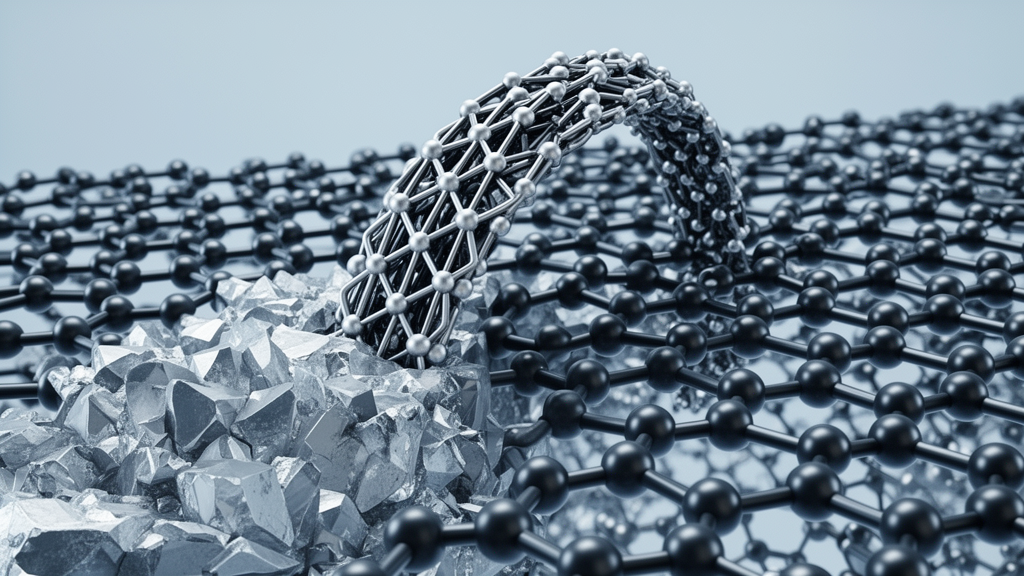
For the study, Omid Hatami Farzaneh and colleagues mixed sucrose homogeneously with nickel powders before rapidly annealing the mixture. During this treatment, the sucrose served as the carbon source and three-dimensional, multilayer graphene-like networks formed on the surfaces of the nickel particles. Importantly, the annealing process preserved the morphology of the powders, producing graphene-coated particles that could subsequently be consolidated into a bulk metal-matrix composite.

The fabrication sequence combined in-situ network formation with consolidation by spark plasma sintering. The source reports that this method enabled uniform and efficient incorporation of graphene within nickel, with the three-dimensional graphene-like networks serving as the reinforcing phase. Because the structures were grown from a precursor mixed directly with the metal powder, the process was designed to place the carbon network at the nickel-particle surfaces before the composite was consolidated.

Mechanical testing indicated that the optimized 3D-GLN/nickel nanocomposite outperformed the pure-nickel baseline in both yield strength and ultimate tensile strength. The reported improvements were relative to pure nickel and applied to the composite produced under the researchers’ optimized conditions. The results also showed that strengthening did not come solely at the expense of toughness or ductility: the authors described the material as combining notable gains in strength with those two mechanical properties.

The work offers a manufacturing strategy for metal-matrix composites in which a solid carbon precursor is mixed with metal powder and converted into a three-dimensional graphene-like reinforcement during rapid thermal annealing. The study’s evidence is limited to the reported fabrication and mechanical testing of nickel-based composites; the supplied article abstract does not provide detailed specimen specifications, test conditions, statistical uncertainty or results for other metal systems. The article was published in npj Advanced Manufacturing as an accepted, open-access research article, with the displayed version subject to further editorial changes before the final version of record.

Subject of Research: Mechanical strengthening of nickel composites using in-situ three-dimensional graphene-like networks

Article Title: Fabrication of three-dimensional graphene-like networks 3D-GLNs for strengthening nickel-based composites

Article References: Hatami Farzaneh, O., Dar, J., Abbott, S., Roach, D. J., & Lin, D. (2026). Fabrication of three-dimensional graphene-like networks 3D-GLNs for strengthening nickel-based composites. npj Advanced Manufacturing. https://doi.org/10.1038/s44334-026-00117-5

Image Credits: AI Generated

DOI: 10.1038/s44334-026-00117-5

Keywords: nickel composites, graphene-like networks, metal-matrix composites, rapid thermal annealing, spark plasma sintering, sucrose precursor, yield strength, tensile strength, nanocomposites, in-situ fabrication, Fabrication, three-dimensional

Cite Scienmag News

Neil Sanderson. (October 22, 2026). In-Situ Graphene Networks Strengthen Nickel Composites. Scienmag. https://scienmag.com/in-situ-graphene-networks-strengthen-nickel-composites/

Neil Sanderson. "In-Situ Graphene Networks Strengthen Nickel Composites." Scienmag, 22 October 2026, https://scienmag.com/in-situ-graphene-networks-strengthen-nickel-composites/. Accessed 22 October 2026.

Neil Sanderson. "In-Situ Graphene Networks Strengthen Nickel Composites." Scienmag. October 22, 2026. https://scienmag.com/in-situ-graphene-networks-strengthen-nickel-composites/


Tags: carbon source in metal reinforcementenhancement of mechanical properties in nickelFabricationgraphene-based metal matrix compositesgraphene-coated nickel particlesgraphene-like networksin-situ fabricationIn-situ graphene network reinforcementin-situ network formation in metalsmetal matrix compositesnanocomposite tensile strengthnanocompositesnickel composite materialsnickel compositesrapid thermal annealingrapid thermal processing of nickel-graphene materialsspark plasma sinteringspark plasma sintering metal compositessucrose precursortensile strengththermal annealing of nickel powdersthree-dimensionalthree-dimensional graphene-like structuresyield strength
Share26Tweet16
Previous Post

Updated arsenic toxicity values shift risk estimates in Eskişehir water study

Next Post

MRI metrics predicted stroke outcomes with internal accuracy in 353-patient study

Related Posts

Engineered yeast produces cheese-making protein but exposes secretion bottlenecks
Science News

Engineered yeast produces cheese-making protein but exposes secretion bottlenecks

October 22, 2026
Chiral gold nanorods improve infected-wound healing in mice
Technology and Engineering

Chiral gold nanorods improve infected-wound healing in mice

October 22, 2026
Sine-guided network outperforms 21 methods in remote-sensing detection
Technology and Engineering

Sine-guided network outperforms 21 methods in remote-sensing detection

October 22, 2026
TU Graz develops sensor-linked autonomous on-demand shuttle service
Technology and Engineering

TU Graz develops sensor-linked autonomous on-demand shuttle service

October 22, 2026
Optimized fast radiative transfer improves FY-3F water-vapor channel simulations
Earth Science

Optimized fast radiative transfer improves FY-3F water-vapor channel simulations

October 22, 2026
Selective orientation correction lowers VIO error without full-state UKF backend cost
Technology and Engineering

Selective orientation correction lowers VIO error without full-state UKF backend cost

October 22, 2026
Next Post
MRI metrics predicted stroke outcomes with internal accuracy in 353-patient study

MRI metrics predicted stroke outcomes with internal accuracy in 353-patient study

  • Mothers who receive childcare support from maternal grandparents show more optimized

    Mothers who receive childcare support from maternal grandparents show more parental warmth, finds NTU Singapore study

    27656 shares
    Share 11059 Tweet 6912
  • University of Seville Breaks 120-Year-Old Mystery, Revises a Key Einstein Concept

    1061 shares
    Share 424 Tweet 265
  • Bee body mass, pathogens and local climate influence heat tolerance

    682 shares
    Share 273 Tweet 171
  • Researchers record first-ever images and data of a shark experiencing a boat strike

    546 shares
    Share 218 Tweet 137
  • Groundbreaking Clinical Trial Reveals Lubiprostone Enhances Kidney Function

    531 shares
    Share 212 Tweet 133
Science

Embark on a thrilling journey of discovery with Scienmag.com—your ultimate source for cutting-edge breakthroughs. Immerse yourself in a world where curiosity knows no limits and tomorrow’s possibilities become today’s reality!

RECENT NEWS

  • MRI metrics predicted stroke outcomes with internal accuracy in 353-patient study
  • In-Situ Graphene Networks Strengthen Nickel Composites
  • Updated arsenic toxicity values shift risk estimates in Eskişehir water study
  • Sphenopalatine ganglion block reduced epidural patch use in 14-patient headache cohort

Categories

  • Agriculture
  • Anthropology
  • Archaeology
  • Athmospheric
  • Biology
  • Biotechnology
  • Blog
  • Bussines
  • Cancer
  • Chemistry
  • Climate
  • Earth Science
  • Editorial Policy
  • Marine
  • Mathematics
  • Medicine
  • Pediatry
  • Policy
  • Psychology & Psychiatry
  • Science Education
  • Science News
  • Social Science
  • Space
  • Technology and Engineering

Subscribe to Blog via Email

Enter your email address to subscribe to this blog and receive notifications of new posts by email.

Join 5,151 other subscribers

© 2025 Scienmag - Science Magazine

Welcome Back!

Login to your account below

Forgotten Password?

Retrieve your password

Please enter your username or email address to reset your password.

Log In
No Result
View All Result
  • HOME
  • SCIENCE NEWS
  • CONTACT US

© 2025 Scienmag - Science Magazine

Discover more from Science

Subscribe now to keep reading and get access to the full archive.

Continue reading