


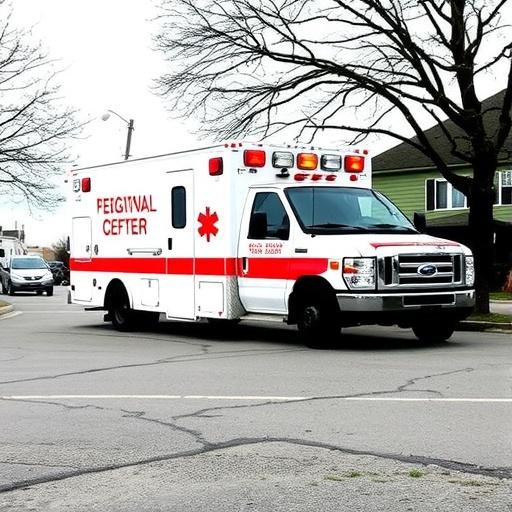
In a groundbreaking cross-sectional study recently published in JAMA Network Open, researchers have uncovered persistent structural inequities in rapid emergency medical services (EMS) access closely aligned with historically redlined neighborhoods. This research sheds light on the enduring ramifications of discriminatory urban policies enacted nearly a century ago, which continue to shape disparities in healthcare accessibility today. By integrating spatial analysis and EMS response data, the study rigorously quantifies the disproportionate delays in prehospital emergency care faced by residents living in these marginalized zones, underlining the urgent need for systemic reforms and resource reallocation.
The investigation delves into the complex intersection of social determinants of health, urban planning, and emergency response systems, illustrating how historical redlining—a discriminatory practice systematically denying investment and services to predominantly minority communities—has perpetuated a dangerous gap in EMS infrastructure. Despite advances in medical technology and protocol, the findings suggest that these communities remain systematically underserved in critical emergency scenarios, exacerbating health inequities and potentially affecting survival rates in life-threatening events such as cardiac arrest, trauma, and stroke.
Using sophisticated geographic information system (GIS) mapping and temporal analysis of EMS dispatch and arrival times, the authors demonstrated that neighborhoods previously subjected to redlining policies exhibit statistically significant delays in EMS response times compared to non-redlined areas. This gap is not merely a reflection of current socioeconomic status but is deeply rooted in historic urban segregation and disinvestment. Such delays can critically affect patient outcomes, especially in high-acuity cases where every second counts, amplifying the health disparities experienced by racial and ethnic minority populations.
The study’s nuanced methodology allowed for a multivariate approach, controlling for confounding factors such as population density, traffic patterns, and EMS station location. This robust analytic framework strengthens the assertion that historical legacies, rather than contemporaneous variables alone, drive EMS inequities. By establishing a direct correlation between redlining history and EMS accessibility, the research provides compelling evidence for policymakers and healthcare planners to prioritize strategic resource allocation targeting these underserved communities.
Moreover, the authors advocate for a deliberate system redesign, highlighting the insufficiency of minor adjustments to address the entrenched nature of these disparities. They argue for comprehensive reforms including the potential redistribution of EMS stations, improvement in infrastructure, investment in community paramedicine, and enhanced training of emergency responders on the social complexities underlying healthcare access. The ultimate goal is to create an equitable EMS framework that ensures swift, life-saving interventions irrespective of geographic or racial boundaries.
This study stands as a clarion call within the public health and emergency medicine communities to recognize and dismantle structural barriers that perpetuate inequality. As the global health agenda increasingly targets social determinants, integrating historical context into readiness planning is paramount. Communities historically marginalized by redlining face compounded risks that extend beyond EMS delays, including chronic health disparities and limited access to preventive services—a syndemic of structural disadvantage with profound public health implications.
Critically, the research also touches upon the potential economic and policy ramifications. Delayed EMS response leads not only to poorer health outcomes but amplifies downstream healthcare costs due to prolonged hospital stays and more complex clinical interventions. By investing in equitable EMS infrastructure, health systems could realize both ethical and economic benefits, advancing goals of health justice and efficiency.
The investigation further sparks important ethical questions about how modern EMS systems incorporate equity into their operational frameworks. The persistence of unequal access highlights the need for collaboration between emergency services, urban planners, public health officials, and community stakeholders. Such interdisciplinary approaches are essential to redesign EMS systems that are adaptable, culturally competent, and strategically positioned to serve historically disenfranchised populations effectively.
Underlying the study is an implicit critique of urban development policies that ignore or perpetuate racial and socioeconomic segregation. The physical landscape of cities, shaped by practices such as redlining, fundamentally influences health infrastructure distribution. This insight prompts a reevaluation of how historical zoning discrimination continues to manifest in contemporary public health crises, underscoring that tackling emergent disparities requires addressing foundational urban inequalities.
In sum, the findings represent a significant stride in exposing the legacy of systemic racism embedded within public health logistics. They compel the emergency medicine community to move beyond clinical metrics alone and engage with the broader sociopolitical determinants that influence patient care outcomes. As policymakers grapple with confronting structural racism, this study provides a rigorous, data-driven foundation to implement transformative EMS reforms that align with principles of equity and justice.
The study’s relevance extends beyond the United States, offering a model for assessing how historical inequities in urban policy shape emergency healthcare access globally. It challenges the international emergency medicine field to scrutinize local histories of spatial injustice and their contemporary impacts, paving the way for globally informed equity-oriented EMS system redesigns.
While this research marks an important advancement, the authors emphasize the need for further longitudinal studies that monitor the effects of policy interventions aimed at mitigating these disparities. Future investigations could expand to include patient outcome data, community engagement metrics, and comparative analyses across different metropolitan regions. Such continued scholarship will be essential to guide effective, sustained EMS equity initiatives grounded in empirical evidence.
Ultimately, this compelling study not only diagnoses a critical public health issue but also offers a hopeful framework for actionable change. By confronting the legacy of redlining within emergency medical services, healthcare systems can take a decisive step toward delivering equitable, rapid emergency care for all communities, ensuring that geography and history no longer dictate the timeliness or quality of lifesaving interventions.
References: (doi:10.1001/jamanetworkopen.2025.25681)
Corresponding Author Contact: Cherisse Berry, MD; cherisse.berry@rutgers.edu
Cite Scienmag News
Courtney Benton. (August 5, 2025). Improving Emergency Medical Response Times in Historically Redlined Communities. Scienmag. https://scienmag.com/improving-emergency-medical-response-times-in-historically-redlined-communities/
Courtney Benton. "Improving Emergency Medical Response Times in Historically Redlined Communities." Scienmag, 5 August 2025, https://scienmag.com/improving-emergency-medical-response-times-in-historically-redlined-communities/. Accessed 5 September 2026.
Courtney Benton. "Improving Emergency Medical Response Times in Historically Redlined Communities." Scienmag. August 5, 2025. https://scienmag.com/improving-emergency-medical-response-times-in-historically-redlined-communities/


