


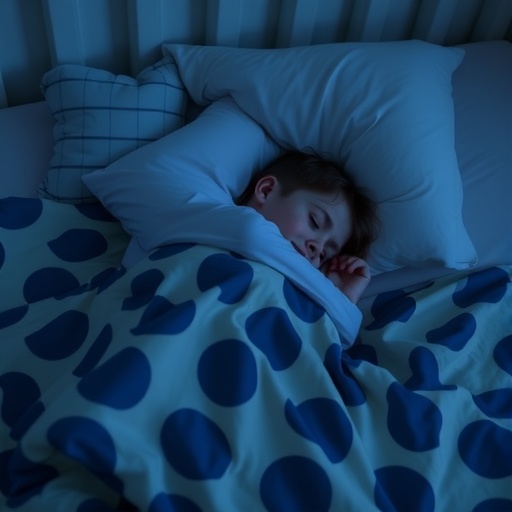
In a groundbreaking study set to be published in BMC Pediatrics, researchers Malmborg et al. delve into the intricate relationship between sleep disorders and attention-deficit/hyperactivity disorder (ADHD) in children. The growing prevalence of ADHD, affecting millions worldwide, has sparked an avalanche of research aimed at unraveling its complexities. Importantly, this research highlights how sleep disturbances may exacerbate ADHD symptoms, leading to significant challenges for affected children and their families. This study looks beyond conventional treatments to explore the efficacy of weighted blankets as a possible intervention.
Weighted blankets, designed to apply gentle pressure similar to a hug, have gained popularity as a non-pharmaceutical option for those struggling with sleep disturbances. The researchers conducted a controlled study to assess the impact of this innovative tool on children diagnosed with ADHD. The use of weighted blankets is particularly intriguing given their ability to induce a state of calmness and improve sleep quality, which is essential for overall well-being.
The structure of the study was meticulously crafted, with a focus on comparing health-related factors between children with ADHD who experienced sleep problems and those who did not. By isolating these variables, the researchers aimed to unveil the underlying mechanisms at play when utilizing weighted blankets. It was imperative to ensure that all participants were in similar environments and conditions to derive accurate conclusions.
In the initial phases of the study, the participants were first assessed to determine their baseline sleep patterns and ADHD symptoms. Standard questionnaires and sleep diaries were utilized to gather data regarding sleep duration, sleep onset latency, and overall sleep quality. The meticulous nature of this data collection laid the groundwork for an informed analysis of the subsequent interventions.
Once the baseline data had been collected, the families of children experiencing sleep issues were then provided with weighted blankets. Over a six-week period, parents reported back on their children’s responses to the blankets, noting changes in sleep duration, sleeping patterns, and behavioral improvements. This longitudinal approach enabled researchers to observe the long-term implications of the weighted blankets on sleep and ADHD symptoms.
Preliminary findings suggested that children who used weighted blankets reported significantly fewer sleep disturbances when compared to those who did not receive the intervention. The effects on behavior were equally notable; parents observed reductions in hyperactivity and improvements in focus during daily activities. These shifts underscore the interplay between sleep and ADHD symptoms, emphasizing the importance of addressing sleep issues early on in treatment plans.
Furthermore, the study takes into account the neurobiological underpinnings of the issues at hand. Sleep plays a crucial role in cognitive function, emotional regulation, and even physical health. Children with ADHD, who often struggle with executive function, may find that sleep deprivation exacerbates their difficulties. Consequently, enhancing sleep quality via weighted blankets, which elicit a calming effect, may serve as an effective strategy to mitigate ADHD symptoms.
As the research progresses, the findings hold significant implications for treatment approaches in pediatric mental health. Weighted blankets could represent an accessible, cost-effective intervention for families seeking non-invasive methods to improve their children’s sleep quality. The gravitational pressure provided by weighted blankets has the potential not only to improve sleep quality but also to enhance overall psychological well-being in children with ADHD.
Moreover, this study contributes to the body of literature advocating for a holistic approach to treating ADHD. With a growing awareness of the intricate relationship between various health factors, there is a shift toward considering comprehensive treatment plans that address physiological, psychological, and environmental aspects. The integration of weighted blankets into such plans is a testament to the evolving perspectives on ADHD management.
Importantly, these findings also elevate discussions surrounding the stigma often associated with ADHD and sleep disorders. By investigating non-pharmacological interventions, the research provides a platform for recognizing behavioral and environmental adjustments that can significantly improve the quality of life for affected individuals. In a sense, it demystifies ADHD and puts forth a narrative of hope and possibility.
The research team is hopeful that their findings will lead to further studies examining the long-term effects of weighted blankets on ADHD, sleep disorders, and overall health outcomes. There remains a critical need for expansive research to further validate these initial promising results while bridging the gap between pediatric sleep medicine and behavioral health.
Ultimately, this study champions the potential of innovative and non-invasive strategies for enhancing the lives of children with ADHD. With attention to sleep’s significant role in health and behavior, the understanding of ADHD continues to deepen, promising a future where children can thrive in a supportive and understanding environment. The implications for families struggling with sleep and ADHD issues are profound, emphasizing a clear path toward improved mental health and well-being through community awareness and scientific inquiry.
Cite Scienmag News
Ophelia Keating. (September 9, 2025). Impact of Weighted Blankets on ADHD Sleep Issues. Scienmag. https://scienmag.com/impact-of-weighted-blankets-on-adhd-sleep-issues/
Ophelia Keating. "Impact of Weighted Blankets on ADHD Sleep Issues." Scienmag, 9 September 2025, https://scienmag.com/impact-of-weighted-blankets-on-adhd-sleep-issues/. Accessed 5 September 2026.
Ophelia Keating. "Impact of Weighted Blankets on ADHD Sleep Issues." Scienmag. September 9, 2025. https://scienmag.com/impact-of-weighted-blankets-on-adhd-sleep-issues/


