

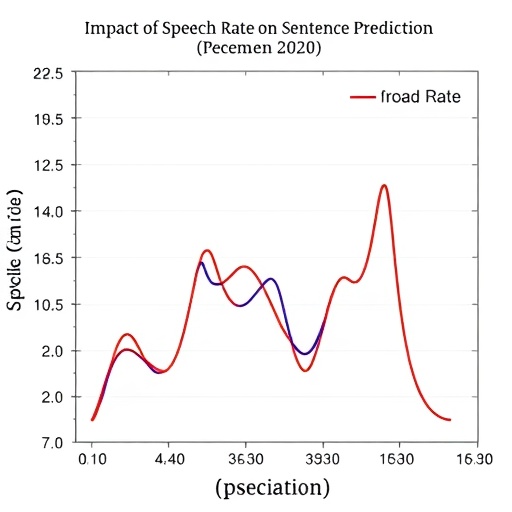
In a groundbreaking study published in the journal Attention, Perception, and Psychophysics, researcher Alyssa Kukona delves into the intricate relationship between speech rate and predictive sentence processing. This exploration brings to light how the speed at which we speak can influence not only our comprehension but also our anticipatory cognitive mechanisms when interpreting language. Kukona’s findings are set to have significant implications for various fields such as linguistics, psychology, and artificial intelligence, furthering our understanding of human communication and cognition.
The central theme of Kukona’s investigation revolves around the concept of predictive processing in language comprehension. When individuals listen to spoken language, they do not merely passively receive information; instead, they actively engage in predicting what comes next based on contextual cues. This cognitive ability allows listeners to make sense of rapid speech, integrating their previous knowledge and the unfolding discourse into their understanding. The speed of speech can dramatically alter the effectiveness of this predictive process, shedding light on the intricate dynamics of auditory cognition.
Importantly, the study also examines the degree to which varying speech rates impact the formation of associations between words and concepts. When speech is delivered at a brisk pace, listeners may engage in quicker cognitive processing, which can lead to the formation of stronger associations between spoken words and their meanings. This aspect of Kukona’s research emphasizes the potentially multifaceted role that speech rate plays in how effectively listeners comprehend and respond to spoken language, opening avenues for further inquiry into this underexplored dimension of communicative interaction.
A detailed exploration of Kukona’s methodology reveals a rigorously designed experiment involving diverse age groups and linguistic backgrounds. Participants were exposed to varying speech rates while engaging with complex sentences that required anticipatory processing. By recording response times and accuracy in comprehension tasks, Kukona was able to capture the nuances of how speech rate influences predictive processing. Such methodological rigor ensures that the findings contribute robustly to existing literature on language processing, turning a spotlight on the nuances of auditory perception.
Kukona’s findings also challenge conventional wisdom regarding speech delivery in both formal and informal settings. The common adage that “slow and steady wins the race” may not hold true in all contexts, especially when it comes to auditory information. The results indicate that a faster speech rate can sometimes enhance comprehension and retention, particularly in scenarios where brevity is crucial, such as in news broadcasting or classroom instruction. These insights are bound to resonate with educators and communicators who are keen on optimizing their speech delivery for maximum audience engagement and understanding.
The implications of Kukona’s research extend beyond theoretical discourse and into practical applications. In educational settings, for instance, teachers might adjust their speech rates to facilitate better understanding among students, particularly in language acquisition contexts where predictive processing is vital. Additionally, advancements in technology, such as language processing software and speech recognition systems, could leverage insights from Kukona’s research to improve user experience and comprehension in AI-driven interfaces.
Another significant facet of Kukona’s study is its exploration of individual differences in cognitive processing, particularly how variations in language proficiency or auditory processing abilities can influence the relationship between speech rate and comprehension. By considering these individual differences, Kukona adds layers of complexity to our understanding of predictive processing, highlighting that there is no one-size-fits-all when it comes to language comprehension. This recognition is essential for tailoring communication strategies to diverse populations, whether in education, mental health, or interpersonal interactions.
Kukona’s research also draws attention to the social implications of speech rate variations. In a world where communication efficiency is often paramount, the findings may prompt reflection on how societal expectations surrounding speech delivery shape interpersonal dynamics. For instance, societal pressures to conform to rapid speech norms may hinder effective communication for individuals who process language more slowly, thus perpetuating misunderstandings. Through this lens, Kukona’s work invites discourse on inclusivity in communication and the importance of adapting speech to accommodate diverse processing styles.
As the field of psycholinguistics continues to evolve, Kukona’s investigation contributes significantly to a better understanding of the cognitive processes underpinning language comprehension. The interplay between speech rate and predictive processing opens new avenues for exploring how we craft and interpret meaning in conversation. Moreover, it encourages future research aimed at unraveling the complexities of communication, particularly in digitally mediated environments where speech patterns may be altered or disrupted.
Kukona’s findings also intersect with ongoing discussions surrounding the cognitive demands of multitasking in modern communication. In an era characterized by rapid information exchange, understanding how speech rate influences predictive processing could inform strategies for managing cognitive load during multitasking. This research prompts questions about how we can optimize information delivery and retention in an increasingly fast-paced world, thereby ensuring more effective communication strategies across various contexts.
In conclusion, Alyssa Kukona’s research on speech rate and predictive sentence processing represents a significant stride in the field of psycholinguistics, deepening our understanding of the cognitive mechanisms that shape language comprehension. By intricately linking speech rate to the anticipatory processes in language understanding, this study invites further exploration into how we communicate and comprehend in diverse settings. As researchers and practitioners continue to investigate these dynamics, Kukona’s work stands as a testament to the complexity of human communication, offering a roadmap for future advancements in both research and practical applications.
As we move forward, it will be exciting to see how these findings will influence our approaches to communication, language education, and technology development. The world of linguistics and cognitive psychology is poised for an evolution driven by such insightful research, paving the way for enhanced understanding and interaction among diverse communicators. The synergy between speech rate and predictive processing revealed by Kukona may not only enrich academic discourse but also reshape practical strategies employed in various communicative contexts.
In an age where communication technology is rapidly advancing, the necessity for foundational research such as Kukona’s cannot be overstated. It reminds us that the nuances of how we deliver and process speech continue to play a vital role in our daily interactions, highlighting the intricate dance between language, cognition, and the human experience.
Subject of Research: The influence of speech rate on predictive sentence processing.
Article Title: Speech rate and associations in predictive sentence processing.
Article References: Kukona, A. Speech rate and associations in predictive sentence processing. Atten Percept Psychophys 88, 8 (2026). https://doi.org/10.3758/s13414-025-03160-0
Image Credits: AI Generated
DOI: https://doi.org/10.3758/s13414-025-03160-0
Keywords: speech rate, predictive processing, comprehension, cognitive psychology, language acquisition, communication strategies.


