


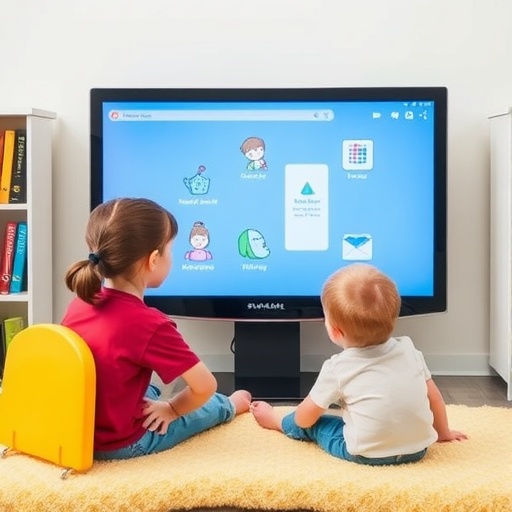
In an era where digital devices increasingly infiltrate every facet of daily life, a groundbreaking Canadian study has illuminated the profound implications of excessive screen time on children’s academic performance. Published in the prestigious open-access journal JAMA Network Open, this prospective cohort study provides compelling evidence that high total screen time, encompassing television and digital media exposure during early childhood, significantly correlates with diminished achievement in standardized reading and mathematics assessments during elementary school years.
The study, meticulously conducted with a diverse cohort of Canadian children recruited from primary care settings, represents one of the most comprehensive explorations into how early-life media consumption patterns might influence educational trajectories. It addresses a growing concern among educators, parents, and policymakers regarding the potential cognitive and developmental ramifications of ubiquitous screen engagement among young children.
Delving deeply into longitudinal data, the researchers employed rigorous methodologies to track children’s screen time habits from an early age and linked these patterns with their later academic outcomes, measured via standardized testing instruments. These tests, designed to objectively assess reading fluency and mathematical understanding, revealed a noteworthy inverse relationship with early screen exposure, suggesting that time spent in front of screens may displace critical activities conducive to cognitive growth, such as interactive reading, problem-solving, and social interaction.
Neuroscientific perspectives lend support to these findings, as excessive screen exposure during formative years may disrupt neural pathways associated with language acquisition, executive function, and attention regulation. The rapid and sometimes overstimulating nature of screen content could interfere with the development of sustained attention spans, which are paramount for academic success, especially in foundational subjects like reading and mathematics.
Insights from developmental psychology emphasize the importance of active, hands-on learning and interpersonal communication in early cognitive development. In contrast, passive consumption of screen media offers limited opportunities for such engagement, potentially attenuating language acquisition and numeracy skills. The study’s findings echo concerns raised in prior smaller-scale research but underscore the urgency of deploying early interventions on a population level.
The implications of these results extend beyond individual academic outcomes, signaling potential long-term effects on social mobility and educational equity. Children most at risk for high screen time often include those from socioeconomically disadvantaged backgrounds, where alternative resources for stimulating environments may be scarce. Therefore, targeted public health strategies are essential to mitigate these disparities and promote healthier media consumption habits.
Critically, the study advocates for the development and empirical testing of early interventions aimed at reducing screen time exposure. Such interventions could involve educational campaigns for parents, incorporation of screen time guidelines into pediatric care, and the promotion of enriching, screen-free activities that foster cognitive and socioemotional growth. Identifying optimal windows for intervention and tailoring approaches to diverse populations remain vital next steps.
Furthermore, the research prompts a reevaluation of current digital media usage guidelines set by health organizations globally. While recommendations often emphasize limiting screen time, this study elucidates the tangible academic consequences of exceeding recommended exposure durations, providing an evidentiary basis for more stringent policies and caregiver support programs.
In the broader context of a rapidly digitizing world, balancing the potential educational benefits of technology with the risks highlighted by this study is paramount. Interactive educational tools and digital learning platforms can offer remarkable enhancements when used appropriately; however, indiscriminate or excessive use, especially in very young children, might paradoxically hinder the foundational skills necessary for future academic achievement.
To advance understanding, future research lines may explore the differential effects of various media types, content quality, and contextual factors such as co-viewing or guided usage. Additionally, dissecting the mechanisms through which screen time impairs learning—be it attentional deficits, reduced sleep quality, or diminished physical activity—could inform more nuanced intervention strategies.
This pioneering Canadian study thus serves as a clarion call to researchers, clinicians, educators, and families alike to critically assess and strategically manage screen exposure in early childhood. The stakes are substantial, as fostering optimal reading and mathematics skills at a young age is critical for lifelong learning success, career readiness, and personal development.
In conclusion, while screens have become an inextricable part of modern childhood, understanding their impact on cognitive and academic outcomes is crucial. This study’s robust evidence spotlights the urgency of reconciling digital engagement with healthy developmental practices, ensuring that the digital revolution enriches rather than impedes future generations’ educational attainment.
News Publication Date: [Not provided]
Web References: [Not provided]
References: (doi:10.1001/jamanetworkopen.2025.37092)
Cite Scienmag News
Reid Dalton. (October 10, 2025). Impact of Screen Time on Standardized Academic Performance in Elementary Students. Scienmag. https://scienmag.com/impact-of-screen-time-on-standardized-academic-performance-in-elementary-students/
Reid Dalton. "Impact of Screen Time on Standardized Academic Performance in Elementary Students." Scienmag, 10 October 2025, https://scienmag.com/impact-of-screen-time-on-standardized-academic-performance-in-elementary-students/. Accessed 5 September 2026.
Reid Dalton. "Impact of Screen Time on Standardized Academic Performance in Elementary Students." Scienmag. October 10, 2025. https://scienmag.com/impact-of-screen-time-on-standardized-academic-performance-in-elementary-students/


