


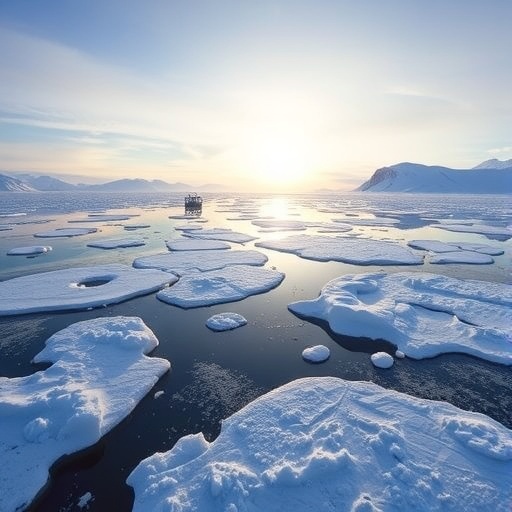
As the Arctic region continues to undergo dramatic transformations due to climate change, the complex interplay between environmental factors and marine ecosystems draws increasing attention from researchers around the globe. A recent study conducted by a group of scientists, including von Friesen, Farnelid, and von Appen, sheds light on an underexplored yet crucial aspect of the Arctic’s ecology: nitrogen fixation in the context of declining sea ice. This research is not only significant for its scientific contributions but also for its implications regarding the future of nitrogen dynamics in the changing Arctic environment.
The study emphasizes the principal role that nitrogen fixation plays in marine nitrogen cycles. Nitrogen, an essential nutrient for the growth of phytoplankton and other marine organisms, is predominantly found in the ocean in the form of molecular nitrogen (N2). However, this form of nitrogen is inaccessible to most marine life. To overcome this limitation, certain microorganisms, including diazotrophic bacteria, engage in nitrogen fixation, converting N2 into ammonia (NH3), which can be directly utilized by other organisms. This process forms a critical link in the marine food web, supporting both primary production and the entire marine ecosystem.
Interestingly, the scientists found that as Arctic sea ice declines, it could potentially alter the distribution and abundance of these diazotrophic communities. With the retreat of sea ice, access to warmer waters and increased sunlight may facilitate the growth of these microorganisms. The implications of enhancing nitrogen fixation in these new conditions could be profound, as it may lead to shifts in phytoplankton dynamics, affecting not only local fisheries but the entire marine food chain. The study illustrates that the correlation between nitrogen fixation rates and physical changes in the Arctic environment warrants careful monitoring.
The researchers conducted their study during the Arctic summer months when conditions are typically most favorable for both nitrogen fixation and phytoplankton growth. Utilizing advanced methodologies, including metagenomics and geochemical analyses, the team was able to investigate the composition of microbial communities in relation to their nitrogen-fixing capabilities. The findings indicate a robust response by diazotrophic bacteria to warmer sea temperatures and reduced ice cover. This adaptive response raises questions about the interactions between climate change and nutrient cycling, highlighting the resilience of certain microbial communities in the face of environmental stressors.
Further exploration revealed that the increased availability of nutrients, a consequence of changing sea ice dynamics, might trigger a cascading effect on Arctic food webs. For instance, an enhanced nitrogen availability could lead to blooms of phytoplankton that benefit from this additional nutrient input. However, the researchers caution against assuming that all responses will be beneficial. The harmonization of species composition and nutrient ratios is delicate, and imbalances caused by rapid environmental changes could lead to adverse repercussions, such as harmful algal blooms, which pose risks to marine life and human health.
Moreover, the decline in sea ice alters light penetration in aquatic environments, profoundly impacting primary production. As ice cover decreases, light availability increases, promoting the growth of photosynthetic organisms. This increased productivity in turn may stimulate higher rates of nitrogen fixation, further complicating the landscape of Arctic marine dynamics. The study posits that understanding these interactions will be paramount for predicting how Arctic ecosystems will adapt to ongoing environmental changes.
An important angle of the research is its implications for global nutrient cycling. As the Arctic contributes to global oceanic processes, alterations in nitrogen fixation rates have the potential to influence broader biogeochemical cycles. For instance, enhancing nitrogen availability in the Arctic could impact nutrient dynamics in surrounding marine regions, eventually affecting the productivity of major oceanic systems. This relationship highlights the interconnectedness of Earth’s ecosystems and the importance of a holistic understanding of environmental changes.
To capture the significance of these findings, the researchers emphasize the need for continuous monitoring of nitrogen fixation activities in the Arctic. They advocate for an integrated approach that combines oceanographic, biochemical, and ecological research to obtain a comprehensive understanding of how these systems interact under changing climatic conditions. Such efforts would enable scientists to create more accurate predictive models, aiding policymakers in addressing the imminent challenges posed by climate change.
The focus on nitrogen fixation also calls attention to the role of marine microorganisms as bioindicators of environmental change. These microbial communities can provide valuable insights into the health of marine ecosystems and their responses to stressors like warming temperatures, salinity shifts, and altered ice dynamics. Recognizing the significance of such indicators may help to devise strategies for monitoring ecological health and ecosystem service sustainability in the Arctic.
In conclusion, the study by von Friesen and colleagues elucidates the profound connections between declining Arctic sea ice and nitrogen fixation processes, ultimately revealing a complex narrative of resilience and adaptability. As climate change continues to reshape the Arctic landscape, understanding how these changes influence essential marine processes is critical. Advancing research in this area will be imperative for safeguarding the future of Arctic ecosystems and the myriad services they provide.
The findings of this research pave the way for broader investigations into the cascading impacts of climate change on marine nitrogen dynamics, emphasizing the importance of continued scientific inquiry in the face of an uncertain future.
von Friesen, L.W., Farnelid, H., von Appen, WJ. et al. Nitrogen fixation under declining Arctic sea ice.
Commun Earth Environ 6, 811 (2025). https://doi.org/10.1038/s43247-025-02782-4
Cite Scienmag News
Gavin Prescott. (October 20, 2025). Impact of Melting Arctic Ice on Nitrogen Fixation. Scienmag. https://scienmag.com/impact-of-melting-arctic-ice-on-nitrogen-fixation/
Gavin Prescott. "Impact of Melting Arctic Ice on Nitrogen Fixation." Scienmag, 20 October 2025, https://scienmag.com/impact-of-melting-arctic-ice-on-nitrogen-fixation/. Accessed 5 September 2026.
Gavin Prescott. "Impact of Melting Arctic Ice on Nitrogen Fixation." Scienmag. October 20, 2025. https://scienmag.com/impact-of-melting-arctic-ice-on-nitrogen-fixation/


