


Professor Yunje Cho’s research team from the Department of Life Sciences at Pohang University of Science and Technology (POSTECH, Republic of Korea) has collaborated with Professor Kwang Pyo Kim’s group from the Department of Applied Chemistry at Kyung Hee University (KHU, ROK), Professor Vsevolod Katritch’s team from the University of Southern California (USC, USA), and Professor Carol V. Robinson from the University of Oxford (UK) to uncover the mysteries surrounding a specific receptor protein associated with hearing. Their findings have recently been published in the online edition of Nature Structural & Molecular Biology.

Credit: POSTECH
Professor Yunje Cho’s research team from the Department of Life Sciences at Pohang University of Science and Technology (POSTECH, Republic of Korea) has collaborated with Professor Kwang Pyo Kim’s group from the Department of Applied Chemistry at Kyung Hee University (KHU, ROK), Professor Vsevolod Katritch’s team from the University of Southern California (USC, USA), and Professor Carol V. Robinson from the University of Oxford (UK) to uncover the mysteries surrounding a specific receptor protein associated with hearing. Their findings have recently been published in the online edition of Nature Structural & Molecular Biology.
Deep within the inner ear lie the cochlea, responsible for sound detection, and the vestibular apparatus, which oversees balance. Cells within these regions harbor a class C orphan G-protein-coupled receptor (GPCR) called GPR156. When this receptor is activated, it binds with G-proteins inside the cell, facilitating signal transmission. Unlike its counterparts, GPR156 exhibits sustained activity even in the absence of external stimuli, playing a pivotal role in upholding auditory and balance functions. Unveiling the structural and functional intricacies of GPR156 holds promise for devising interventions for individuals with congenital hearing impairments.
The research team employed cryo-electron microscopy (cryo-EM) analysis to delve into the GPR156 in the Go-free and Go-coupled states, achieving unprecedented resolution. Their investigation unearthed the mechanisms behind GPR156’s ability to maintain heightened activity sans activators.
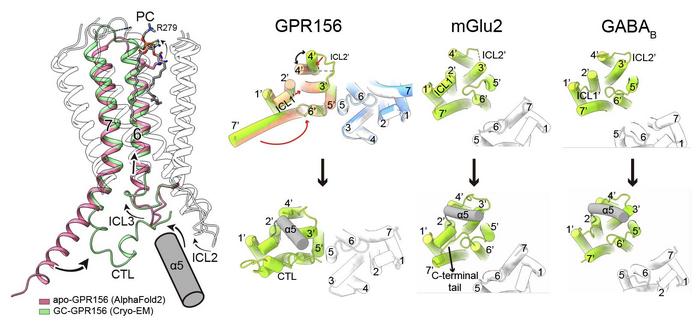
Their analysis confirmed that GPR156 activation hinges on its interaction with abundant lipids in the cell membrane, triggering structural shifts upon engagement with G-proteins in the cytoplasm. Notably, unlike conventional GPCRs, GPR156 exhibits flexibility in altering the structure of the seventh helix as it traverses the cell membrane, thereby facilitating binding with G-proteins and orchestrating signal activation to detect sound. This study represents a crucial step forward in unraveling the structural dynamics and activation mechanisms of GPR156.
Professor Yunje Cho of POSTECH remarked, “Congenital hearing and balance impairments afflict numerous individuals. I am hopeful that our research will pave the way for groundbreaking treatments and drug discoveries to alleviate their suffering.”
This research received financial support from the National Research Foundation of Korea.
Journal
Nature Structural & Molecular Biology
Article Title
Constitutive activation mechanism of a class C GPCR
Article Publication Date
8-Feb-2024
Cite Scienmag News
Drew Townsend. (April 16, 2024). Illuminating the path to hearing recovery. Scienmag. https://scienmag.com/illuminating-the-path-to-hearing-recovery/
Drew Townsend. "Illuminating the path to hearing recovery." Scienmag, 16 April 2024, https://scienmag.com/illuminating-the-path-to-hearing-recovery/. Accessed 5 September 2026.
Drew Townsend. "Illuminating the path to hearing recovery." Scienmag. April 16, 2024. https://scienmag.com/illuminating-the-path-to-hearing-recovery/

