


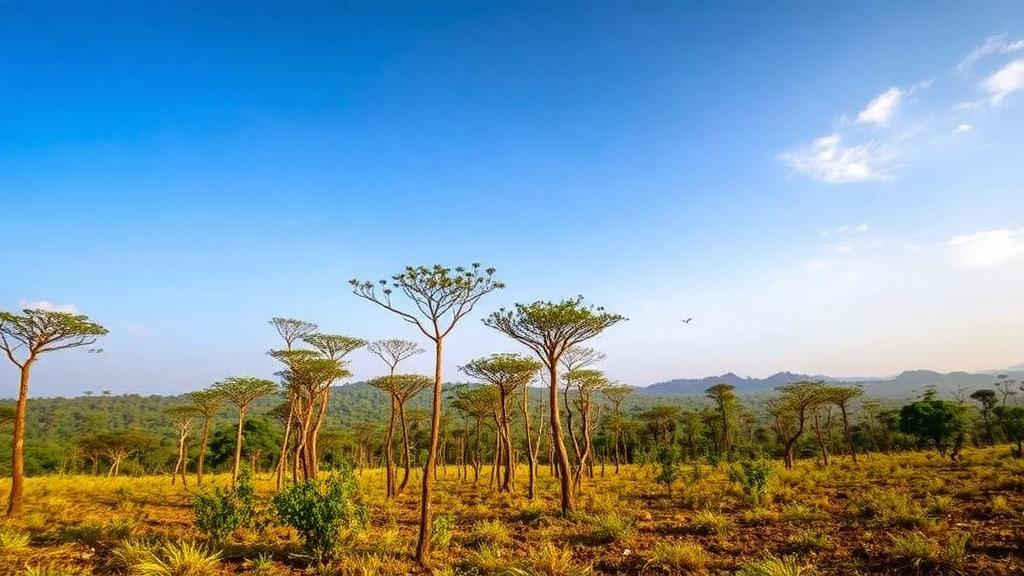
Deep in the Eastern Arc Mountains of Tanzania, a quiet pharmacological treasury is under siege. A new ecological and social study conducted around the Mkingu Nature Forest Reserve (MNFR) has documented twenty plant species that local communities rely on to treat malaria, one of Africa’s deadliest infectious diseases, and has revealed that human activities are eroding the diversity of these botanical remedies faster inside the protected forest than outside it. The findings, published in the journal Discover Conservation, offer a rare quantitative window into how illegal logging, agricultural expansion, unauthorized grazing, and charcoal production are reshaping the living pharmacy of rural Tanzania, and they suggest that the fate of these medicinal species may depend as much on economics and education as on ecology.
The research, carried out by Mhuji Kilonzo of the University of Dodoma, focused on four villages, Kwelikwiji, Mafuta, Maskat, and Mloguzi, adjacent to the reserve in Mvomero district, Morogoro. The MNFR spans 26,334 hectares of montane forest receiving between 1,200 and 4,000 millimeters of rainfall annually, with temperatures ranging from 12 to 24 degrees Celsius. The study adopted a mixed-methods design combining systematic ecological sampling with household questionnaires, focus group discussions, and key informant interviews. In the field, transects separated by five kilometers hosted plots measuring 20 by 10 meters, with fifty plots established in the grazing land and a sampling intensity of 0.02 calculated for the reserve itself. Within each plot, researchers identified medicinal plant species, recorded their abundance, and scored the intensity of human disturbance on a graded scale ranging from absent to high.
The ethnobotanical results underscore just how deeply traditional medicine is woven into rural healthcare. According to the World Health Organization, more than 80 percent of the global population depends on traditional medicine as a primary healthcare source, and in rural Tanzania, where clinics are distant and costly, herbal remedies fill a critical gap. Malaria remains a leading cause of death among children under five, and the twenty species documented in the study, spanning multiple plant families and life forms, represent the community’s accumulated knowledge of how to manage the disease. Leaves were the most commonly used plant part, followed by roots and bark, with preparations typically administered orally as concoctions. That leaf-harvesting predominance matters for conservation: as the study notes, harvesting leaves allows plants to regenerate, whereas uprooting roots or stripping bark increases a species’ vulnerability to local extinction.
The disturbance data tell a starkly divided story. Inside the MNFR, illegal logging registered the highest average disturbance score of 20, driven largely by poverty in surrounding communities where timber, firewood, charcoal, and poles remain vital survival resources amid scarce income opportunities. Agricultural encroachment scored 15 within the reserve, a trend the author links to rising crop prices that incentivize farmers to push cultivation into forest margins, a phenomenon consistent with broader research showing that commodity prices persistently drive tropical agricultural expansion. In the grazing land, by contrast, agriculture was the dominant pressure with an average score of 14, while illegal logging, charcoal production, and unauthorized grazing registered zero, likely because the land lacks suitable timber species and grazing there is legally sanctioned.
The abundance patterns revealed a striking inversion of expectations. In the grazing land, Maesa lanceolata emerged as the dominant medicinal species at 6.45 percent, an outcome the study attributes to its capacity to colonize quickly in disturbed soils and open canopies. At the opposite extreme, Leucas jamesii accounted for just 1.94 percent, suggesting low tolerance of grazing pressure and weak competitiveness in open environments. Inside the forest reserve, Solanum incanum dominated overwhelmingly at 23.81 percent, a figure reflecting its tolerance of shade, drought resilience, efficient nutrient uptake, prolific seed production, and resistance to herbivory, all traits that let it flourish in disturbed and semi-disturbed understory. Grewia villosa, at a mere 0.85 percent, fared worst in the reserve, apparently ill-suited to closed-canopy conditions.
Diversity metrics sharpened the picture further. Using the Shannon-Wiener index computed in PAST software, the study found that the grazing land harbored higher diversity of malaria-treatment plants (H’ = 3.14) than the forest reserve itself (H’ = 2.37), a statistically significant difference (p = 0.00312). Evenness followed the same pattern, at 0.986 in the grazing land versus 0.747 in the reserve. The counterintuitive result, that a formally protected forest holds less medicinal plant diversity than an actively used grazing area, is explained by the interplay of disturbance regimes and vegetation structure. Moderate grazing can suppress competitive exclusion and promote secondary succession, allowing pioneer and late-establishing species to coexist, whereas the reserve’s closed canopy favors a handful of shade-tolerant species while limiting light and suppressing understory regeneration. Heavy exploitation inside the reserve compounds this by selectively removing vulnerable species.
Correlation analysis quantified the human footprint with unsettling clarity. In the grazing land, anthropogenic activities showed a weak negative correlation with medicinal plant diversity (r = -0.39), indicating limited but measurable harm. Within the MNFR, the correlation was moderate and negative (r = -0.59), meaning that human pressure there is substantially eroding the diversity of plants the community depends on for malaria care. The author situates these findings within a wider literature: comparable studies in Ethiopia documented significant reductions in plant species diversity and evenness under human disturbance, and research in China reported similar negative correlations between anthropogenic activity and plant diversity. The convergence across continents suggests a systemic pattern rather than a local anomaly.
Perhaps the most hopeful dimension of the study lies in its social findings. Surveying 150 households per village, supplemented by five focus group discussions and four key informant interviews per village, the research found that conservation participation was remarkably broad-based. Ninety point two percent of respondents aged 18 to 30 reported involvement in conserving malaria-treatment plants, compared with 69.6 percent of those over 51, but the association with age was not statistically significant (p = 0.460). Gender told a similar story, with 83.8 percent of men and 72.9 percent of women participating, a non-significant difference (p = 0.312). Marital status likewise showed no significant effect (p = 0.273), with 82 percent of married and 70.6 percent of single respondents engaged. Focus group participants emphasized that both elders and youth value the plants and harvest only leaves, never uprooting whole plants, so that remedies can regrow for future use.
Two socio-economic variables did emerge as significant predictors of conservation behavior. Education level was strongly associated with participation (p = 0.002), with 88.9 percent of secondary-educated respondents reporting involvement, a pattern the author attributes to the rural residence and direct healthcare dependence of educated villagers, in contrast to more urbanized university graduates. Occupation also mattered significantly (p = 0.005): self-employed respondents, many of them herbalists who sell medicinal plants, showed the highest participation at 90.9 percent, followed by the employed at 89.5 percent, while pastoralists lagged at 50 percent. For those whose livelihoods rest on a steady supply of medicinal plants, conservation is not altruism but economic self-interest, aligning ecological stewardship with income security.
The study’s conclusions carry weighty implications for policy and public health. Without a strategic plan to organize sustainable extraction and utilization, the continued exploitation and habitat degradation documented around the MNFR could eliminate valuable medicinal resources, threatening both ecosystem integrity and the traditional healthcare practices that rural Tanzanians rely upon. The author recommends future research focused on documenting the most vulnerable species, assessing sustainable harvesting methods, and building the evidentiary basis for conservation policy. Notably, the study is careful to state that it documents traditional use and ecological status but does not evaluate pharmacological or antiplasmodial efficacy, which would require dedicated phytochemical and laboratory investigation. Even so, the message is unambiguous: the plants that hold out hope against malaria in one of the world’s most malaria-burdened regions are disappearing from the very reserve designed to protect them, and reversing that trend will require pairing forest enforcement with the community engagement, education, and livelihood alternatives that this research shows are already taking root.
Subject of Research: Diversity and conservation of medicinal plants traditionally used for malaria treatment in and around Mkingu Nature Forest Reserve, Tanzania
Article Title: Evaluating diversity and abundance of plants traditionally used for malaria treatment and the role of local communities in their conservation at Mkingu Nature Forest Reserve, Tanzania
Article References: Kilonzo, M. (2026). Evaluating diversity and abundance of plants traditionally used for malaria treatment and the role of local communities in their conservation at Mkingu Nature Forest Reserve, Tanzania. Discover Conservation, 3(1), Article 13. https://doi.org/10.1007/s44353-026-00086-y
Image Credits: AI Generated
DOI: 10.1007/s44353-026-00086-y
Keywords: medicinal plants, malaria, ethnobotany, Tanzania, Mkingu Nature Forest Reserve, biodiversity, illegal logging, conservation, Shannon-Wiener index, anthropogenic disturbance, traditional medicine, Eastern Arc Mountains
Cite Scienmag News
Margaret Porter. (September 30, 2026). Illegal Logging Is Stripping Tanzania’s Forest of Its Malaria Healing Plants. Scienmag. https://scienmag.com/illegal-logging-is-stripping-tanzanias-forest-of-its-malaria-healing-plants/
Margaret Porter. "Illegal Logging Is Stripping Tanzania’s Forest of Its Malaria Healing Plants." Scienmag, 30 September 2026, https://scienmag.com/illegal-logging-is-stripping-tanzanias-forest-of-its-malaria-healing-plants/. Accessed 4 October 2026.
Margaret Porter. "Illegal Logging Is Stripping Tanzania’s Forest of Its Malaria Healing Plants." Scienmag. September 30, 2026. https://scienmag.com/illegal-logging-is-stripping-tanzanias-forest-of-its-malaria-healing-plants/


