


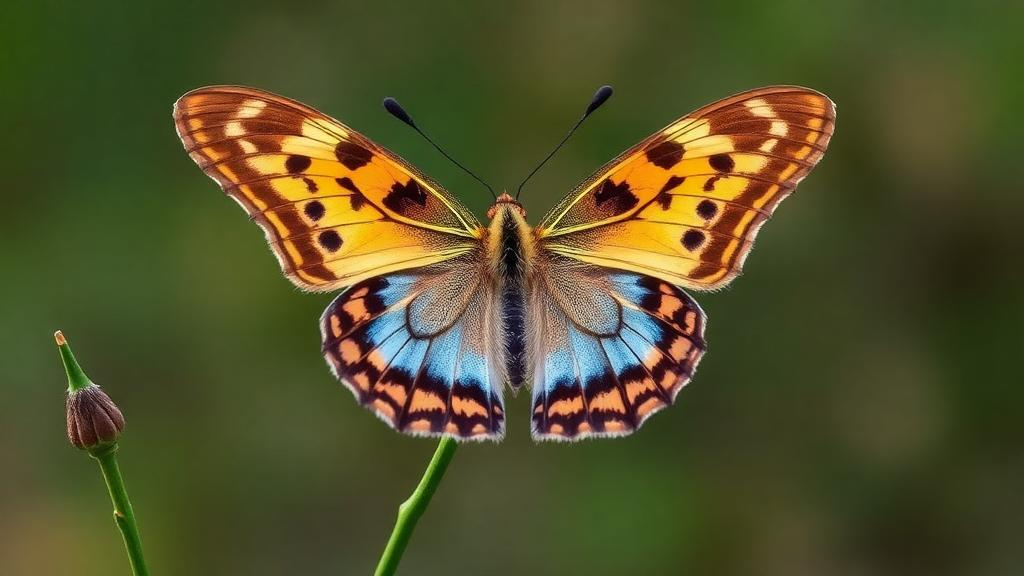
Deep in the high meadows of Europe’s mountain ranges lives a small, unassuming butterfly that has quietly been keeping a record of the ice ages. The large ringlet, Erebia euryale, is a specialist of montane and subalpine grasslands, flitting along forest edges and alpenrose heaths from the Alps to the Carpathians. A new study published in Nota Lepidopterologica has now sequenced mitochondrial DNA from populations across this vast range, and the results reveal a far more turbulent history than the butterfly’s delicate appearance suggests. Instead of a single unified species spreading over the mountains, the researchers found five deeply divided genetic lineages, shaped by repeated glacial cycles that split populations apart and forced them into isolated refuges at the edges of towering ice sheets.
The genus Erebia, whose members are among the most intensively studied alpine insects in the Holarctic, most likely originated in Asia and colonised Europe roughly 17 to 23 million years ago. It diversified into dozens of species during the Miocene and Pliocene, and then underwent a rapid burst of intraspecific differentiation driven by the Pleistocene glacial cycles. The large ringlet is one of the most variable species in the genus, with sixteen morphological subspecies described, five of which are endemic to the Alps. Their territories are separated by intergradation zones so narrow that gene flow between neighbouring forms is evidently extremely restricted, a hallmark of long isolation.
Previous molecular work had painted a confusing picture. Allozyme studies identified two lineages in the Alps, matching the subspecies adyte and isarica, plus one lineage in the Pyrenees and another in the Carpathians and Balkans. But a mitochondrial study suggested that the subspecies ocellaris and isarica were closer to the Carpathian syrmia than to each other, and two poorly known southern Alpine subspecies, pseudoadyte and kunzi, had never been sampled at all. The number of genetic lineages in the Alps therefore ranged anywhere from two to five depending on which data one trusted. To resolve the confusion, the team sequenced 1,496 base pairs of the mitochondrial COI gene, covering both the standard DNA barcode region and the less commonly used 3-prime section of the gene, in sixteen Alpine and Jurassian populations, and combined the new sequences with published data from the Pyrenees, Cantabria, the Carpathians and the Sudetes.
The resulting dataset of 158 individuals contained fifty-three haplotypes defined by fifty-one variable sites. The haplotype network resolved into five clusters, labelled A through E, and these clusters turned out to be largely congruent with the morphological delineation of subspecies. Remarkably, ninety-eight percent of the haplotypes were private to a single subspecies and eighty-eight percent to a single population, evidence of profound genetic isolation despite the proximity of some ranges. The 3-prime section of COI proved far more discriminating than the barcode region alone, revealing three clades that the standard barcode fragment had left hidden. The analysis confirmed that pseudoadyte and kunzi are genuine, distinct lineages rather than mere look-alikes of adyte and ocellaris, and that the morphologically intermediate western form of kunzi is genetically inseparable from the eastern one, vindicating its original assignment.
The study also settled the contested status of isarica and ocellaris. Earlier work had declared them genetically identical, but the new data showed that these two subspecies share only a single common haplotype, from which each has evolved its own private mutations. The shared haplotype becomes more frequent as one approaches the wide hybrid zone where the two forms meet, a pattern consistent with secondary contact after independent differentiation. Intriguingly, isarica itself split into two genetically distinct sub-lineages, one corresponding to western and northern Alpine populations and the other to eastern Alpine ones, meaning the Alps actually harbour six mitochondrial lineages, four of which had gone unrecognised until now.
To reconstruct where these lineages survived the last ice age, the researchers overlaid the current distributions onto the six broadly recognised categories of potential refugia during the Würm glaciation. When the great glaciers filled the main valleys, habitable conditions persisted in unglaciated lower mountains at the western and eastern edges of the Alps, on the sun-exposed, wind-sheltered slopes along the southern Alpine border, and in pockets along the lobed northern ice front. Each subspecies mapped neatly onto one of these compartments. Pseudoadyte, for example, occupies a territory sharply bounded by the Adda and Adige valleys, exactly matching a single refugial compartment, while kunzi clings to the relict foothills between Val d’Adige and Valcellina. The valleys that dissect the southern Alpine fringe, carved ever deeper by repeated glacial erosion, acted as barriers that fragmented the butterfly into the three lineages adyte, pseudoadyte and kunzi, which now show pairwise genetic divergences of up to 1.15 percent, consistent with long-term isolation within their current borders.
The deepest story, however, lies in the broader geography of the lineages. The clusters sort into three groups: a southern Alpine group, a circum-Pannonian group uniting Carpathian butterflies with those of the northern and eastern Alps, and a western extra-Alpine group. This structure implies an ancient Alpine-Carpathian disjunction, with the common ancestor most plausibly resident in the Carpathians, a hint reinforced by the close genetic affinity between the Carpathian samples and the outgroup species Erebia ligea. During severe cold phases the ancestors retreated to the Pannonian plain, where pollen evidence indicates taiga-like forests and even patches of temperate woodland persisted even at the glacial maximum. When the climate ameliorated, they colonised both the Alps and the Carpathians. A second such retreat and re-expansion then split the circum-Pannonian group into the Carpathian subspecies euryale and syrmia on one side and the Alpine ocellaris, eastern isarica and western isarica on the other.
Dating these events proved subtle. Bayesian molecular dating, calibrated against the roughly 3.5-million-year split between E. euryale and its nearest relative, placed the diversification of the present subspecies between about 0.75 and 2 million years ago. But the geological constraints tell a tighter story: only the most severe glacial phases, beginning with marine isotope stage 22 around 870,000 to 880,000 years ago, drove eastern Alpine glaciers down into the main valleys and expelled subalpine organisms into refugial isolation. The first Alpine-Carpathian split therefore cannot be much older than a million years, and the southern Alpine differentiation of adyte, pseudoadyte and kunzi must predate the Alpine-Pyrenean disjunction, placing it at least as far back as marine isotope stage 10. The star-like haplotype network of the Pyrenean and Jurassian butterflies, typical of a recent expansion after a bottleneck, marks them as a comparatively young divergence, separated from their Alpine relatives no later than the Riss glaciation.
Not every question is closed. Allozyme data place the Pyrenean lineage closer to the northern than to the southern Alps, conflicting with the mitochondrial signal that ties it to the southern Alpine adyte group, a mismatch that only genome-wide nuclear data will be able to arbitrate. The authors also note that Wolbachia infections, known to occur in E. euryale, could in principle have influenced the mitochondrial patterns, and that nuclear genomic data would address this possibility directly. A striking morphological detail offers independent support for the deep splits: the three southern Alpine subspecies share white-pupilled eyespots on the forewing upperside, a trait that appears to be a shared derived character marking the basal division of the species’ history. For a butterfly that most hikers barely notice, Erebia euryale has turned out to be a remarkable archive of Quaternary climate history, one whose pages were written by advancing and retreating ice.
Subject of Research: Phylogeography and Pleistocene diversification of the large ringlet butterfly Erebia euryale based on mitochondrial COI sequences
Article Title: Mitochondrial DNA-based phylogeography of the large ringlet Erebia euryale (Esper, 1805) suggests recurrent Alpine-Carpathian disjunctions during Pleistocene ( Nymphalidae , Satyrinae )
Article References: Cupedo, F., & Doorenweerd, C. (2022). Mitochondrial DNA-based phylogeography of the large ringlet Erebia euryale (Esper, 1805) suggests recurrent Alpine-Carpathian disjunctions during Pleistocene (Nymphalidae, Satyrinae). Nota Lepidopterologica, 45, 65-86. https://doi.org/10.3897/nl.45.68138
Image Credits: AI Generated
DOI: 10.3897/nl.45.68138
Keywords: Erebia euryale, phylogeography, mitochondrial DNA, COI, Alps, Carpathians, Pleistocene, glacial refugia, butterflies, Nymphalidae, subspecies, haplotype network
Cite Scienmag News
Gavin Prescott. (October 19, 2026). Ice Age Rhythms Split One Butterfly into Six Hidden Lineages Across the Alps and Carpathians. Scienmag. https://scienmag.com/ice-age-rhythms-split-one-butterfly-into-six-hidden-lineages-across-the-alps-and-carpathians/
Gavin Prescott. "Ice Age Rhythms Split One Butterfly into Six Hidden Lineages Across the Alps and Carpathians." Scienmag, 19 October 2026, https://scienmag.com/ice-age-rhythms-split-one-butterfly-into-six-hidden-lineages-across-the-alps-and-carpathians/. Accessed 19 October 2026.
Gavin Prescott. "Ice Age Rhythms Split One Butterfly into Six Hidden Lineages Across the Alps and Carpathians." Scienmag. October 19, 2026. https://scienmag.com/ice-age-rhythms-split-one-butterfly-into-six-hidden-lineages-across-the-alps-and-carpathians/


