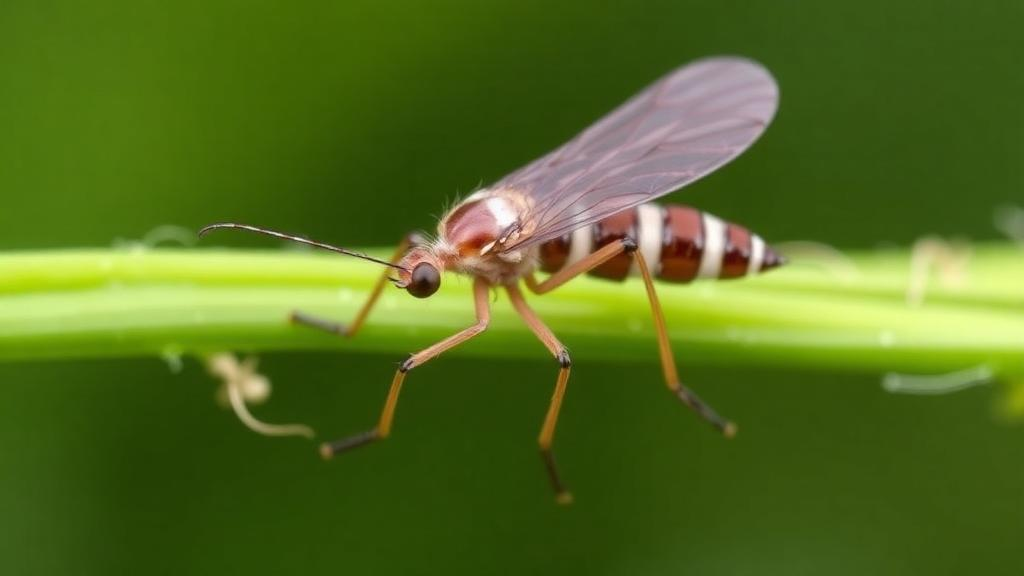
In the world of freshwater insects, some of the most revealing stories are written not in fur or feathers but in the banded strands of giant chromosomes inside salivary glands. A new study published in Comparative Cytogenetics has taken a fresh look at one of the rarest members of a group of nearly identical midge species, Chironomus sp. prope agilis, and found that its populations across the Urals, Western Siberia and northern Kazakhstan are remarkably uniform at the chromosomal level. The finding, based on decades of field collection and careful microscopy, suggests that this enigmatic species occupies a far narrower geographic range than most of its close relatives and maintains one of the lowest levels of chromosomal polymorphism ever recorded in its species group.
Chironomids, commonly known as non-biting midges, have long served as a model system for studying how chromosome structure evolves in natural populations. The larvae of many species possess polytene chromosomes, oversized strands created when DNA is replicated repeatedly without cell division, producing hundreds of aligned copies that display characteristic dark and light bands. These bands act like a bar code that cytogeneticists can read under a microscope. When a segment of a chromosome flips in orientation, an event called an inversion, the altered banding pattern becomes visible in larvae that carry one normal and one inverted copy. Because such inversions can be scored directly in thousands of larvae, chironomids allow researchers to track genetic variation across landscapes with a precision that DNA sequencing of a few individuals often cannot match.
The species at the center of the new study belongs to the Chironomus plumosus group, a set of sibling species so similar in appearance that they can only be told apart reliably by their karyotypes and enzyme profiles. Chironomus sp. prope agilis was formally described in 1991 from a single population near the settlement of Yurgamish in the Urals, distinguished primarily by its chromosome architecture. Its closest relative, Chironomus agilis, differs mainly in the size of the centromeric heterochromatin, the dense DNA-packed regions flanking the chromosome centers, which are of medium size in Ch. agilis but strikingly enlarged in Chironomus sp. prope agilis. The two species also differ in which banding sequence dominates one chromosomal arm. Isozyme analyses from around the time of the original description confirmed that the genetic distances separating this species from other members of the plumosus group are comparable to those typically observed between sibling species of chironomids.
Despite being described more than three decades ago, Chironomus sp. prope agilis has remained almost a ghost on the Eurasian map. In more than thirty years of surveying over 200 chironomid populations across the continent, the researchers behind the new study encountered it in only eight natural populations: five in Russia, distributed across the Urals, the Novosibirsk region and the Altai territory, and three more in the Altai area, plus one population at Karasor Lake in Kazakhstan. Only five of these sites yielded enough larvae, more than ten specimens, to permit quantitative analysis of inversion polymorphism. The sample sizes ranged from a single larva at one Altai lake to 80 larvae from the type locality near Yurgamish and 64 larvae from the Kazakh site, a reminder of just how scarce this insect is even where it does occur.
The karyotype itself carries unmistakable signatures. Like all other members of the plumosus group, Chironomus sp. prope agilis belongs to the so-called thummi cytocomplex, with a haploid chromosome number of four and an arm combination of AB, CD, EF and G. Chromosomes I and II are metacentric, chromosome III is submetacentric and chromosome IV is telocentric. Two nucleoli, the dense factories of ribosomal RNA, sit on arm G, one near the centromere and the other near the telomere, and the homologous copies of arm G frequently remain unconjugated at their ends in these nucleolar regions. The species also carries three Balbiani rings, gigantic puffs of actively transcribed DNA that mark genes being expressed at extraordinarily high levels; two of these sit on arm G and one on arm B. Together, the huge centromeric regions and the twin nucleoli make this species instantly recognizable to a trained eye.
One of the study’s technical contributions is a revised and extended map of the species’ banding sequences. The researchers used the established Keyl and Maximova mapping systems, which divide each chromosomal arm into numbered sections and subdivisions, allowing banding patterns to be described as strings of section coordinates. For arm E, two mapping versions are presented, reflecting an unresolved question about whether the original 1962 mapping of the reference species Ch. plumosus or a later revision better represents the ancestral arrangement. Notably, the team provided the first-ever mapping of a banding sequence designated p’ag2B3, bringing the total number of known banding sequences in the species’ pool to ten. Each sequence name encodes its geography and history: the prefix p’ marks Palearctic sequences and h’ marks Holarctic ones, followed by the species abbreviation, the arm letter and a serial number reflecting the order of discovery.
A surprising conclusion emerged from comparing these sequences with those of Ch. agilis. In every chromosomal arm except B and C, the main banding sequences of the two species are identical, and the sequence once thought to be unique to Chironomus sp. prope agilis in arm C has since turned up, at least once, in the pool of Ch. agilis as well. In other words, none of the species’ main banding sequences are actually exclusive to it, which means that karyologically the two species are even closer than previously assumed. The decisive difference that keeps them separate as species remains the size of their centromeric heterochromatin, a subtle but apparently stable cytological boundary.
When the researchers quantified polymorphism, the picture was one of extraordinary genetic uniformity. All eight studied populations were either monomorphic or showed only very low levels of chromosomal variation, with between 4.4 and 8.7 percent of larvae heterozygous for inversions and only 0.03 to 0.09 heterozygous inversions per larva. The three inversions detected, all in chromosome I, were short rearrangements too small to form the classic inversion loops seen in paired chromosomes, appearing instead as small unpaired stretches that could easily be missed without a careful scan of the entire banding pattern. Two of the three inversions were each found in only a single larva, while the third, p’ag2A2, appeared at low frequency in several populations. Beyond inversions, the team documented one reciprocal translocation, a wholesale exchange of chromosome segments, in the Kazakh population, a single larva carrying an extra B-chromosome in the Urals sample, and variation in the expression of Balbiani rings on arm G, with up to 54 percent of larvae at one Altai lake showing heterozygosity in how prominently these transcription puffs developed.
Compared with its relatives, Chironomus sp. prope agilis stands out as the most chromosomally monomorphic species in the plumosus group apart from the poorly sampled Chironomus bonus. Cytogenetic distances between its populations ranged from zero to just 0.008, indicating that even populations separated by hundreds of kilometers, from the southern Urals to the Altai foothills and northern Kazakhstan, share essentially the same chromosomal makeup. Whether this uniformity reflects a recent range expansion, strong natural selection favoring particular gene arrangements, or simply small effective population sizes at the edge of the species’ ecological tolerance remains an open question, and the authors stress that firmer conclusions will require more populations and more ecological data.
That ecological dimension may prove to be the most intriguing part of the story. Although no detailed measurements of water chemistry exist for the sites where the species has been found, a striking pattern is apparent: most of the lakes are saline. Two of the Altai water bodies bear the Russian name Gor’koe, meaning bitter, a label traditionally given to salt lakes in the region, and Karasor Lake in Kazakhstan is a confirmed saline water body. This hints that Chironomus sp. prope agilis may be a specialist of brackish and saline habitats, a niche that could explain both its scarcity in general surveys and its restricted range, currently defined as the Urals, southern Western Siberia and northern Kazakhstan. For a lineage whose chromosomes have been quietly recording its history for decades, the giant chromosomes of this rare midge suggest a species eking out a living in a narrow band of salty waters, genetically uniform but far from boring.
Subject of Research: Chromosomal polymorphism and distribution of the rare chironomid midge Chironomus sp. prope agilis in Eurasian populations
Article Title: Chromosomal polymorphism in natural populations of Chironomus sp. prope agilis Kiknadze, Siirin, Filippova et al., 1991 ( Diptera , Chironomidae )
Article References: Golygina, V. V. (2022). Chromosomal polymorphism in natural populations of Chironomus sp. prope agilis Kiknadze, Siirin, Filippova et al., 1991 (Diptera, Chironomidae). Comparative Cytogenetics, 16(4), 243-252. https://doi.org/10.3897/compcytogen.v16.i4.95659
Image Credits: AI Generated
DOI: 10.3897/compcytogen.v16.i4.95659
Keywords: Chironomus sp. prope agilis, chromosomal polymorphism, polytene chromosomes, banding sequences, inversions, sibling species, Chironomidae, karyotype, B-chromosome, saline lakes, Urals, Western Siberia
Cite Scienmag News
Gavin Prescott. (October 19, 2026). Hidden Giant Chromosomes Reveal a Rare Midge Living at the Edge of Its Range. Scienmag. https://scienmag.com/hidden-giant-chromosomes-reveal-a-rare-midge-living-at-the-edge-of-its-range/
Gavin Prescott. "Hidden Giant Chromosomes Reveal a Rare Midge Living at the Edge of Its Range." Scienmag, 19 October 2026, https://scienmag.com/hidden-giant-chromosomes-reveal-a-rare-midge-living-at-the-edge-of-its-range/. Accessed 19 October 2026.
Gavin Prescott. "Hidden Giant Chromosomes Reveal a Rare Midge Living at the Edge of Its Range." Scienmag. October 19, 2026. https://scienmag.com/hidden-giant-chromosomes-reveal-a-rare-midge-living-at-the-edge-of-its-range/