


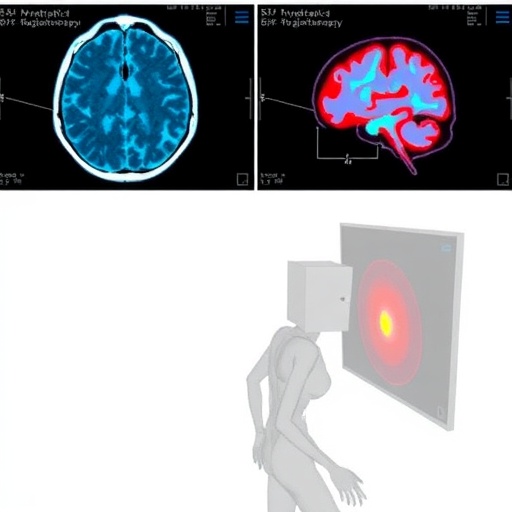
In the rapidly evolving field of oncology, cutting-edge technologies continue to push the boundaries of cancer treatment, offering hope to patients facing some of the most daunting diagnoses. Among these innovations, stereotactic radiotherapy has emerged as a beacon of precision and effectiveness, particularly in the management of metastatic brain tumors originating from primary lung cancer. Recent research spearheaded by Zhu and colleagues delves into the efficacy and safety profile of HyperArc stereotactic radiotherapy, a novel radiotherapeutic approach, showcasing promising results that could redefine treatment paradigms.
Brain metastases remain a significant clinical challenge, especially in patients with primary lung cancer, which accounts for a substantial proportion of metastatic brain tumors. The prognosis for these patients has historically been poor, compounded by the limited ability of conventional therapies to target and eradicate metastatic lesions without substantial collateral damage to healthy brain tissue. HyperArc stereotactic radiotherapy offers a compelling advancement by employing an innovative combination of automated treatment planning and high-precision radiation delivery systems, designed to maximize tumor control while minimizing adverse effects.
The core technology underlying HyperArc lies in its sophisticated use of volumetric modulated arc therapy (VMAT) combined with noncoplanar beam arrangements. This configuration allows radiation oncologists to sculpt dose distributions around complex tumor geometries with unparalleled conformity. By enabling the precise deposition of high-dose radiation to the tumor while sparing surrounding normal brain tissue, HyperArc represents a paradigm shift in stereotactic radiosurgery (SRS) technology. The research by Zhu et al. meticulously evaluates the therapeutic outcomes achievable through this method, providing comprehensive data on its effectiveness and tolerability.
Crucially, the study involves a detailed assessment of treatment parameters, including target volume coverage and dose gradients, ensuring that HyperArc can achieve optimal dosimetry in clinical settings. Such meticulous attention to physical dosimetry parameters is essential in the context of brain metastases, where even millimeter-scale inaccuracies can lead to significant neurological deficits or insufficient tumor control. The study’s findings indicate that HyperArc consistently achieves steep dose falloff rates, thereby preserving critical brain structures adjacent to tumor sites.
Beyond dosimetric excellence, the study also explores clinical endpoints such as local tumor control rates, progression-free survival, and overall survival in patients treated with HyperArc stereotactic radiotherapy. The results highlight a marked improvement over traditional stereotactic approaches, indicating not only enhanced tumor eradication but also a favorable safety profile that mitigates treatment-related neurotoxicity. Notably, the precision of HyperArc allows for effective delivery of ablative doses in shorter treatment sessions, thus improving patient convenience and throughput in busy oncology centers.
Safety considerations form a pivotal part of the evaluation, with the authors reporting a low incidence of adverse events commonly associated with brain radiotherapy, such as radiation necrosis or cognitive decline. This outcome is attributed to the advanced targeting capabilities of HyperArc, which minimize high-dose exposure to healthy brain regions responsible for critical functions. The data lends credence to the hypothesis that technological innovations like HyperArc not only improve oncologic outcomes but also enhance quality of life for patients with challenging metastatic brain lesions.
The operational efficiency of HyperArc is another feature underscored in the research. The automation in treatment planning reduces manual intervention, thereby decreasing planning times and potential human errors. Moreover, the noncoplanar beam delivery, orchestrated through precise robotic movements, improves dose conformity and mitigates risks of overdose to structures such as the optic pathway, brainstem, and hippocampus, which are vital for vision, autonomic function, and memory respectively.
The study also touches upon patient selection criteria, emphasizing that HyperArc stereotactic radiotherapy is particularly beneficial for patients with limited brain metastases, typically up to four lesions, and whose systemic disease can be concurrently managed with systemic therapies. This aligns with emerging oncologic strategies that adopt a multimodal approach integrating local and systemic treatments to optimize patient outcomes.
Further dissecting the patient outcomes, the research stratifies responses based on lesion size, number, and location, providing nuanced insights into the radiobiological factors influencing therapeutic success. Small to medium-sized metastases located away from eloquent brain areas demonstrated the most pronounced response rates, validating HyperArc’s precision targeting capabilities. This detailed stratification assists clinicians in personalized treatment planning, ensuring that HyperArc is deployed where its technological advantages yield the greatest clinical benefit.
Importantly, the authors discuss the implications of HyperArc’s capabilities for retreatment scenarios. Given that patients with brain metastases often require multiple rounds of radiation due to disease progression or new lesion emergence, the ability to deliver highly conformal doses repeatedly without cumulative toxicity is a significant advantage. The safety profile documented in the study suggests that HyperArc could become a preferred modality in salvage stereotactic radiotherapy, potentially prolonging survival intervals while preserving neurological function.
In terms of future research directions, the paper advocates for ongoing clinical trials to further delineate HyperArc’s role across diverse oncological contexts, including its integration with immunotherapies and targeted systemic agents. The synergy between precise radiotherapy and systemic treatments could potentially amplify therapeutic efficacy, especially in the era of personalized medicine, where molecular and genetic profiling increasingly dictate individualized care pathways.
Furthermore, the technological advancements exemplified by HyperArc catalyze an important conversation around the integration of artificial intelligence (AI) in radiotherapy. The automation of planning algorithms and delivery optimizations stands at the intersection of AI and clinical oncology, promising continuous improvements in treatment accuracy, adaptability, and patient-specific customizations that could redefine the standard of care in neuro-oncology.
The transformative potential of HyperArc also extends beyond lung cancer brain metastases. While this study focuses on this particular patient subset, the underlying technology is broadly applicable to various brain tumors, including primary gliomas and metastases from other systemic malignancies. Its utility in pediatric populations, where minimizing neurocognitive sequelae is paramount, represents another exciting frontier for clinical investigation.
The psychosocial impact of advanced therapies like HyperArc cannot be overstated. As treatments become more effective and less debilitating, patients experience improved quality of life, reduced hospital visits, and increased functional independence. This shift not only benefits patients but also alleviates caregiver burdens, highlighting the broader societal impact of technological innovation in cancer care.
In conclusion, the comprehensive evaluation presented by Zhu et al. positions HyperArc stereotactic radiotherapy as a groundbreaking tool in the fight against lung cancer brain metastases. Its combination of precision, efficiency, and safety exemplifies the future of radiotherapeutic interventions. As continued research validates and expands its applications, HyperArc stands poised to become a cornerstone in multidisciplinary neuro-oncology, offering renewed hope where few options previously existed.
Zhu, Y., Chen, Z., Zhu, L. et al. Evaluation of the efficacy and safety of HyperArc stereotactic radiotherapy for the treatment of lung cancer brain metastasis.
Med Oncol 42, 408 (2025). https://doi.org/10.1007/s12032-025-02970-4
Cite Scienmag News
Nathaniel Bowman. (August 6, 2025). HyperArc Stereotactic Radiotherapy: Lung Brain Metastasis Evaluation. Scienmag. https://scienmag.com/hyperarc-stereotactic-radiotherapy-lung-brain-metastasis-evaluation/
Nathaniel Bowman. "HyperArc Stereotactic Radiotherapy: Lung Brain Metastasis Evaluation." Scienmag, 6 August 2025, https://scienmag.com/hyperarc-stereotactic-radiotherapy-lung-brain-metastasis-evaluation/. Accessed 5 September 2026.
Nathaniel Bowman. "HyperArc Stereotactic Radiotherapy: Lung Brain Metastasis Evaluation." Scienmag. August 6, 2025. https://scienmag.com/hyperarc-stereotactic-radiotherapy-lung-brain-metastasis-evaluation/


