


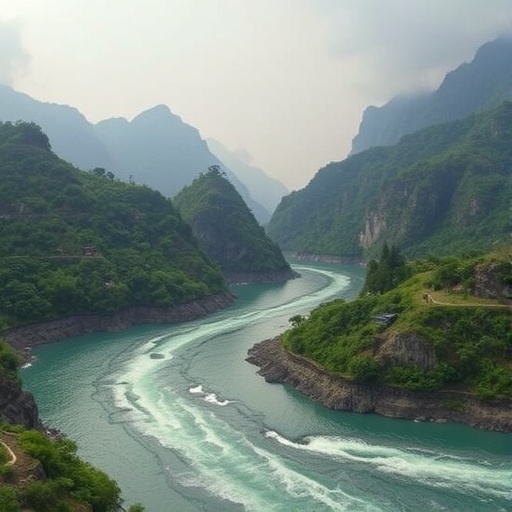
In the global narrative of clean energy, solar and wind power frequently take center stage, captivating headlines and policy debates alike. However, nestled within the verdant landscapes and intricate river systems of Southeast Asia, hydropower emerges as a formidable and often underappreciated champion in the quest for sustainability. A groundbreaking study, published on August 4, 2025, in the renowned journal Carbon Research, reveals compelling evidence that hydropower is not merely a peripheral component of the regional energy portfolio but rather a pivotal mechanism driving significant reductions in carbon emissions and fostering a sustainable development trajectory.
Spearheaded by Dr. Rinaldi Idroes from the School of Mathematics and Applied Sciences at Universitas Syiah Kuala in Banda Aceh, Indonesia, the research presents a rigorous empirical investigation spanning two decades of intricate energy consumption and economic growth data across multiple Southeast Asian nations. Employing robust econometric frameworks—specifically the Autoregressive Distributed Lag (ARDL) model, Vector Error Correction Model (VECM), alongside the Dumitrescu-Hurlin causality tests—the study meticulously dissects the dynamic relationships between hydropower utilization and carbon dioxide emissions, elucidating previously unexplored causal mechanisms.
The statistical models applied leverage both short-term fluctuations and long-run equilibria, providing unprecedented granularity in understanding how shifts toward renewable energy usages impact carbon outputs. Notably, the study uncovers a strong, inverse correlation between hydropower consumption and CO₂ emissions, substantiating the assertion that an uptick in hydropower deployment precipitates a measurable, sustained decline in fossil fuel-derived carbon footprints. This relationship is bidirectional—meaning that as environmental policies steer countries to prioritize decarbonization, investments in hydropower infrastructure correspondingly accelerate, reinforcing a virtuous feedback loop.
Moreover, the analysis highlights capital formation, interpreted as investments channeled into infrastructure and green technology sectors, as a critical co-factor that amplifies the emissions reduction effect. In contrast, the data illuminate that unchecked economic expansion, particularly when reliant on fossil fuels and accompanied by intensifying labor demands and agricultural land conversions, exacerbates carbon releases. Such findings underscore the nuanced interplay between economic growth paradigms and environmental outcomes—penetrating beyond simplistic growth-versus-environment dichotomies.
Dr. Idroes articulates a transformative vision for Southeast Asia, emphasizing that the region’s riverine wealth and precipitation patterns provide an abundant and renewable energy resource that remains underutilized relative to its potential climate benefits. The research advocates for a strategic pivot towards hydropower integration, augmented by complementary renewables and stringent energy efficiency protocols, to decouple economic development from carbon emissions effectively. This paradigm shift is particularly critical as Southeast Asia faces escalating climate vulnerabilities, including altered monsoon cycles, rising sea levels, and agricultural disruptions.
The study’s rigorous impulse response analysis further authenticates the temporal persistence of hydropower’s positive impact on carbon metrics. A significant surge in hydropower consumption initiates a continuous downward trend in CO₂ emissions that extends well beyond immediate periods, signaling durable environmental benefits. In effect, hydropower is framed not solely as an energy alternative but as a molecular mechanism within the broader geomorphic and economic fabric capable of influencing carbon pathways substantively over decadal scales.
This research also shines a spotlight on Universitas Syiah Kuala, positioning the Indonesian institution as a burgeoning hub of applied sustainability science in the Southeast Asian context. By deploying sophisticated data modeling techniques and anchoring investigations within the specific geographic and socio-economic contours of the region, the university is advancing a new generation of climate research that holds both regional specificity and global pertinence.
Beyond technical findings, the study serves as a clarion call to policymakers: the pathway to a sustainable future is illuminated by bold investments in clean infrastructure, the judicious phasing out of fossil fuel incentives, and the fostering of green innovation ecosystems. The synthesis of these elements can drive not only environmental resilience but also energy security, social equity, and long-term economic vitality.
The implications extend beyond Southeast Asia’s borders, offering a replicable blueprint for similarly endowed regions challenged by balancing rapid economic development and environmental stewardship. Hydropower, when embedded within integrated energy strategies, emerges as a linchpin technology capable of catalyzing deep decarbonization while underpinning stable economic trajectories.
In sum, this seminal work recasts hydropower from a quiet energy source to a dynamic agent of climate action, investment attraction, and sustainable growth. It elucidates complex causative mechanisms and suggests pragmatic policy levers that stakeholders can wield to harness local natural capital for global climate benefits. The message is clear and resonant: harnessing the river’s energy is not just a technical undertaking but a profound opportunity for sustainable transformation.
As nations in Southeast Asia stand at a crossroads of rapid urbanization and escalating climate risk, embracing hydropower could be the strategic fulcrum to tip the scales towards a resilient, low-carbon future. Dr. Idroes’ data-driven roadmap empowers governments and communities with the insights necessary to move decisively from aspiration to action—making the rush of mountain rivers the soundtrack of climate progress.
Cite Scienmag News
Sloane Callahan. (October 2, 2025). Hydropower’s Impact: New Study Highlights Its Role in Cooling Southeast Asia’s Carbon Emissions. Scienmag. https://scienmag.com/hydropowers-impact-new-study-highlights-its-role-in-cooling-southeast-asias-carbon-emissions/
Sloane Callahan. "Hydropower’s Impact: New Study Highlights Its Role in Cooling Southeast Asia’s Carbon Emissions." Scienmag, 2 October 2025, https://scienmag.com/hydropowers-impact-new-study-highlights-its-role-in-cooling-southeast-asias-carbon-emissions/. Accessed 3 September 2026.
Sloane Callahan. "Hydropower’s Impact: New Study Highlights Its Role in Cooling Southeast Asia’s Carbon Emissions." Scienmag. October 2, 2025. https://scienmag.com/hydropowers-impact-new-study-highlights-its-role-in-cooling-southeast-asias-carbon-emissions/


