


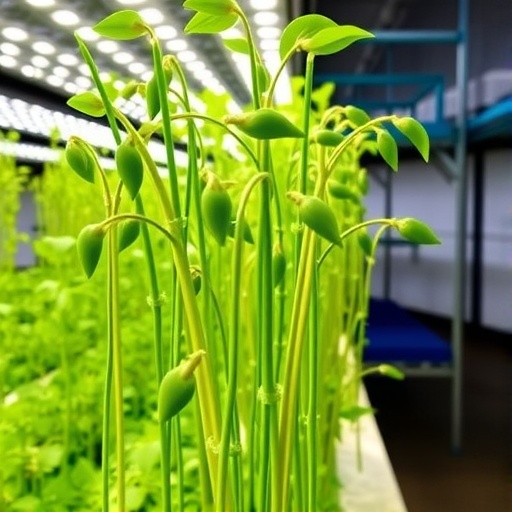
In the realm of controlled-environment agriculture, artificial light-type plant factories have emerged as a technological vanguard, promising year-round production of diverse crops regardless of climatic constraints. These sophisticated systems manipulate environmental variables—ranging from photoperiod and spectral quality of light, temperature regimes, humidity levels, carbon dioxide enrichment, to precise nutrient solution management—to maintain optimal growth conditions. Their controlled nature not only guarantees consistent yields but also contributes to the reduction of pesticide application and mitigates the deleterious impacts of climate variability on crop productivity.
Despite these advances, leguminous plants like edamame (immature soybeans) have historically posed a significant challenge to indoor cultivation within these environments. The complexity originates from their extended growth cycles, sensitivity in flowering and pod development phases, and the inherent rapid post-harvest degeneration, complicating storage and distribution logistics. This intractability has confined edamame production largely to seasonal outdoor cultivation, limiting availability and elevating supply instability.
Addressing these challenges, a joint research initiative spearheaded by Professor Toshio Sano of Hosei University and Associate Professor Wataru Yamori of The University of Tokyo has made a groundbreaking breakthrough. Building upon their prior success in hydroponic tomato cultivation under light-emitting diode (LED) systems, the team focused on refining techniques to facilitate stable edamame growth in artificial light environments. Their innovative findings, now published in the renowned journal Scientific Reports (Volume 15), delineate a sustainable methodology that not only enables year-round edamame production but also surpasses field cultivation yields in both quantity and quality.
Central to their research was the comparative evaluation of three hydroponic cultivation methods: Nutrient Film Technique (NFT), Rock Wool Culture (ROC), and Mist Culture (MIST). NFT, characterized by a thin continuous flow of nutrient solution over the plant roots, emerged as the superior approach. Plants cultivated using NFT exhibited enhanced vigor, including robust stem architecture, healthier foliar development, and increased total biomass, outperforming both other hydroponic treatments and conventional open-field counterparts.
Yield metrics further underscored NFT’s advantages. This technique significantly amplified pod count and seed number, culminating in overall yields greater than those obtained through traditional farming methods. This surpassing of former assumptions about the impracticality of legume cultivation in artificial light plant factories underscores the potential of NFT systems to transform edamame production paradigms fundamentally.
Quality assessments revealed that NFT-grown edamame outperformed field-grown specimens in several nutritional dimensions. Most notably, sucrose concentrations were elevated, imparting a sweeter taste profile appreciated by consumers. While free amino acid content displayed marginal declines, the levels of isoflavones—bioactive phytochemicals lauded for their antioxidative and health-promoting properties—were significantly enhanced. The researchers posited that continuous exposure to LEDs might stimulate specific metabolic pathways, boosting the biosynthesis of these compounds beyond traditional cultivation capacities.
Taken holistically, the integration of these factors—higher yield, superior sugar content, and elevated nutraceutical levels—positions NFT hydroponics as an optimal strategy for edamame production. Importantly, the approach is inherently adaptable to vertical, multi-tiered farming architectures, ideal for densely populated urban environments where arable land is limited. Vertical stacking facilitates maximized spatial efficiency and scalability, facilitating intensified production without expanding the physical footprint of cultivation facilities.
The implications of this research extend well beyond urban or terrestrial agriculture. Professor Sano highlights the transformative potential of this innovation, envisioning edamame cultivation in unconventional and extreme environments such as arid deserts or even extraterrestrial habitats. As a high-protein, nutrient-dense crop that can thrive outside traditional agricultural constraints, edamame holds promise as a critical component of food security strategies for long-duration space missions and colonization efforts.
This pioneering success dismantles the longstanding paradigm that legumes with their complex physiological demands are unsuitable for artificial light plant factories. It ushers in a new era of resilient, climate-independent food production systems that can reliably deliver high-quality crops anywhere—ushering in solutions to pressing global challenges such as food scarcity, urbanization pressures, and climate unpredictability.
By integrating sophisticated hydroponic techniques with precise LED lighting regimens tailored for metabolic optimization, this research not only advances the frontiers of agricultural biotechnology but also sets a precedent for future studies targeting other leguminous and high-value crops. The capacity to synchronize physiological development stages of plants with engineered light spectra and nutrient solutions heralds a future where agriculture transcends geography and seasonality.
This world-first demonstration that edamame can be grown “delicious anytime, anywhere” marks a seminal milestone towards sustainable urban food systems. It embodies a significant leap in our ability to engineer plant factories that serve multifaceted objectives: ensuring nutritional quality, maximizing yield, conserving resources, and stabilizing food supplies globally.
As population growth continues unabated alongside mounting pressures from climate change, innovations like this signal the essential evolution of crop production methodologies. Controlled-environment agriculture, empowered by hydroponic versatility and LED lighting technology, stands at the forefront of the next green revolution—one capable of furnishing nutritious foods like edamame at any place and time, empowering human health and survival in the 21st century and beyond.
News Publication Date: 12-Sep-2025
Web References: https://doi.org/10.1038/s41598-025-17131-w
References:
Takano T., Wakabayashi Y., Wada S., Sano T., Kawabata S., Yamori W. (2025). Sustainable Edamame production in an artificial light plant factory with improved yield and quality. Scientific Reports, Volume 15. DOI: 10.1038/s41598-025-17131-w
Cite Scienmag News
Alan Morgan. (November 12, 2025). Hydroponic LED Plant Factories Revolutionize Sustainable Year-Round Edamame Cultivation. Scienmag. https://scienmag.com/hydroponic-led-plant-factories-revolutionize-sustainable-year-round-edamame-cultivation/
Alan Morgan. "Hydroponic LED Plant Factories Revolutionize Sustainable Year-Round Edamame Cultivation." Scienmag, 12 November 2025, https://scienmag.com/hydroponic-led-plant-factories-revolutionize-sustainable-year-round-edamame-cultivation/. Accessed 3 September 2026.
Alan Morgan. "Hydroponic LED Plant Factories Revolutionize Sustainable Year-Round Edamame Cultivation." Scienmag. November 12, 2025. https://scienmag.com/hydroponic-led-plant-factories-revolutionize-sustainable-year-round-edamame-cultivation/


