


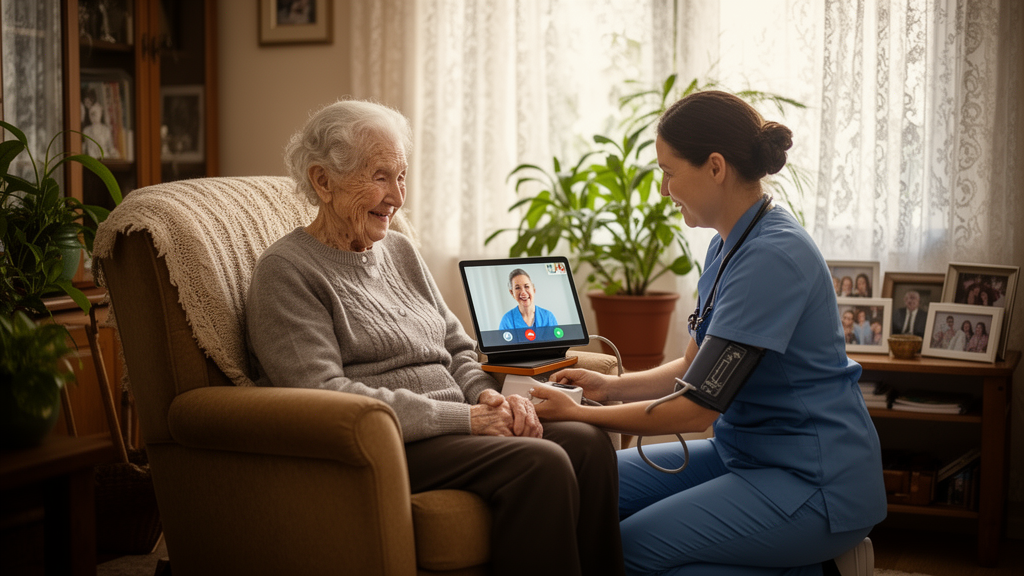
For millions of older adults, the difference between aging safely at home and spending the rest of life in a nursing home can hinge on details that only reveal themselves inside the patient’s own living room: a loose grab bar, a forgotten pill bottle, a caregiver quietly drowning in responsibilities. A new evaluation from the Department of Veterans Affairs suggests that a clever hybrid of in-person presence and remote clinical expertise can capture those details and act on them, even for patients living far beyond the traditional reach of a home-visit program. The findings, published in the Journal of General Internal Medicine, point to a striking reduction in the one-year risk of nursing home placement among high-risk older adults who received the intervention.
The program, known as TeleGRACE, was designed to solve a stubborn logistics problem. The VA’s Geriatric Resources for Assessment and Care of Elders, or VA-GRACE, is a multidisciplinary home-based geriatric management model that has been running since 2010 and has delivered measurable savings: in prior work it was associated with 7.1 percent fewer emergency department visits, 14.8 percent fewer 30-day readmissions, and 28.5 percent fewer bed-days of care, saving one VA hospital roughly $200,000 per year after program costs. But VA-GRACE home visits were limited to patients within a 20-mile drive of the medical center, and home visits themselves are the component shown to reduce mortality and nursing home placement. Older patients also struggle with pure telehealth: in earlier studies, 27 percent were unable to use video visits at all, and 82 percent required assistance to complete them.
TeleGRACE’s technical solution is elegantly simple. Instead of sending the entire clinical team to the patient’s home, or asking a frail older adult to operate video technology alone, the program sends a telehealth technician to the patient’s home with the equipment and the skills to connect remotely. On the other end of the connection, VA-GRACE dyads—nurse practitioners paired with social workers—participate from the medical center. The content of the hybrid-virtual visit is identical to an in-person home visit: a physical examination, medication reconciliation, geriatric syndrome screening, and psychosocial assessment using 12 standard assessment tools and protocols. The dyads then present cases at weekly multidisciplinary team rounds that include a geriatrician, a psychologist, and a pharmacist, producing a comprehensive care plan shared with the patient’s primary care provider through the electronic medical record.
The model extends the program’s reach from 20 miles to 60 miles, and the follow-up structure is deliberately intensive. The telehealth technician returns to the patient’s home for a second hybrid-virtual visit to ensure that patients and caregivers understand and agree with the care plan. Routine telephone communication between patients and dyads takes place monthly and as needed, and follow-up hybrid-virtual visits are conducted after any emergency department visit or hospital admission. Patients remain in the program until the dyads determine that VA-GRACE support is no longer needed, until they leave community settings, until they or their caregivers request discharge, or until death.
To evaluate whether this adaptation actually worked, the team at the Richard L. Roudebush VA Medical Center in Indianapolis ran a quality improvement project with an observational cohort design from October 2021 to December 2024. Eligible patients were community-dwelling adults at least 70 years old with a geriatric syndrome, discharged from a VA inpatient admission or emergency department visit, and living within 60 miles of the facility. Patients with Care Assessment Need scores estimating a 90-day hospitalization risk at or above the 95th percentile were prioritized. In the end, 76 patients received at least one TeleGRACE visit, while 319 eligible patients received usual care because they could not be reached, refused enrollment, or canceled visits and could not be rescheduled.
Because patients who enroll in such a program may differ systematically from those who do not, the researchers used propensity score analysis to adjust for confounding. The propensity score is the probability of receiving TeleGRACE given each patient’s baseline characteristics, estimated here with logistic regression that achieved a C-statistic of 0.765. The team applied three weighting approaches: inverse probability weighting, which estimates the average treatment effect across the whole population; overlap weighting, which bounds weights between 0 and 1 and emphasizes patients with substantial propensity score overlap; and matching weighting, which similarly down-weights extreme scores. Standardized differences of 0.10 or less indicated adequate balance of measured covariates between groups after weighting.
The process-of-care results were dramatic. Within 90 days of consult placement, TeleGRACE patients were far more likely than usual care patients to receive concrete clinical services: 78.7 percent received assistive devices such as hospital beds, grab bars, or pocket talkers, compared with 18.9 percent of usual care patients, a difference that was highly statistically significant. TeleGRACE patients were also more likely to see a primary care pharmacist, receive outpatient physical therapy and occupational therapy, obtain podiatry visits, apply for Home Improvements and Structural Alterations grants, and receive home physical therapy consultations. Most TeleGRACE patients were seen within the first three months after enrollment, and the median duration of enrollment was 228 days.
The headline outcome was nursing home placement. In the inverse probability weighted analysis, the one-year risk of long-term nursing home placement was 80 percent lower among TeleGRACE patients than among usual care patients, with a hazard ratio of 0.20 and a 95 percent confidence interval of 0.07 to 0.53. In unadjusted terms, only 2.6 percent of TeleGRACE patients were placed in a long-term care facility within a year, versus 11.3 percent of usual care patients. A Kaplan-Meier survival analysis showed that the risk curves for the two groups were similar during the first six months after consultation but diverged thereafter, with usual care patients experiencing more placements. Importantly, the nursing home finding held up across all three propensity weighting approaches, a robustness check that strengthens the inference considerably.
Not every result favored the intervention. The risk of emergency department visits was higher among TeleGRACE patients, both at 90 days and at one year in the inverse probability weighted analysis, though the hazard ratios for ED use lost statistical significance under overlap and matching weighting. The authors interpret the elevated ED use cautiously, noting it is consistent with other studies and likely reflects providers identifying issues that require attention—precisely what a comprehensive home assessment is designed to do. No differences between groups emerged for hospitalizations or mortality at either 90 days or one year, and the groups were similar in the number of non-home days spent in institutional settings within 90 days and within one year of discharge.
The authors are careful about what these results can and cannot establish. The program was implemented at a VA facility that has been providing VA-GRACE for fifteen years, so results may not generalize to sites without home-visit-based geriatric management or to other geographic regions. The long-term nursing home outcome was obtained from chart review and VA community care data, meaning placements not paid for by the VA and not documented in charts could have been missed. The study may have had limited power to detect differences between groups, and no formal cost analysis was conducted, though the authors note that the primary expense is staffing while potential savings from avoided long-term care placement can be considerable. Still, the central conclusion is provocative: a hybrid-virtual home visit model, with a technician in the living room and a full geriatric team on the screen, may improve care and outcomes for high-risk, community-dwelling older persons. Future studies are needed to confirm whether this model reduces nursing home placement—but if confirmed, the implications for how aging societies deliver care at home could be profound.
Subject of Research: A quality improvement evaluation of the TeleGRACE program at a Veterans Affairs medical center found that hybrid-virtual home visits, pairing an in-home telehealth technician with a remote geriatric care team, were associated with a sharply lower one-year risk of nursing home placement among high-risk older adults.
Article Title: Evaluation of Hybrid-Virtual Home Visits for Comprehensive Geriatric Management: A Quality Improvement Project
Article References: Bravata, D. M., Perkins, A. J., Schwartzkopf, A. L., Myers, L. J., Zhang, Y., Damush, T. M., Preddie, A. K., Myers, J., Montagnini, M., & Schubert, C. C. (2026). Evaluation of Hybrid-Virtual Home Visits for Comprehensive Geriatric Management: A Quality Improvement Project. Journal of General Internal Medicine. https://doi.org/10.1007/s11606-026-10580-7
Image Credits: AI Generated
DOI: 10.1007/s11606-026-10580-7
Keywords: geriatrics, telehealth, nursing home placement, veterans health, hybrid-virtual care, Evaluation, Hybrid-Virtual, Home, Visits, Comprehensive, Geriatric, Management
Cite Scienmag News
Beatrice Stafford. (October 17, 2026). Hybrid-Virtual Home Visits May Keep Frail Older Adults Out of Nursing Homes. Scienmag. https://scienmag.com/hybrid-virtual-home-visits-may-keep-frail-older-adults-out-of-nursing-homes/
Beatrice Stafford. "Hybrid-Virtual Home Visits May Keep Frail Older Adults Out of Nursing Homes." Scienmag, 17 October 2026, https://scienmag.com/hybrid-virtual-home-visits-may-keep-frail-older-adults-out-of-nursing-homes/. Accessed 17 October 2026.
Beatrice Stafford. "Hybrid-Virtual Home Visits May Keep Frail Older Adults Out of Nursing Homes." Scienmag. October 17, 2026. https://scienmag.com/hybrid-virtual-home-visits-may-keep-frail-older-adults-out-of-nursing-homes/


