


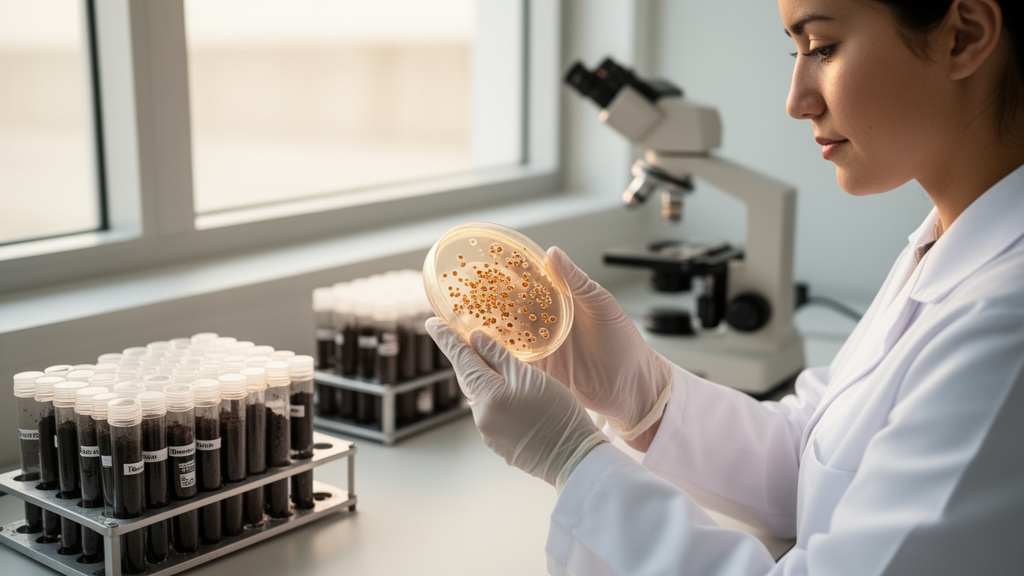
In a study published in the journal Neotropical Biology and Conservation, a team working at the University of Brasília reported the biochemical and physiological profiling of 312 bacterial strains isolated from soils across the Federal District of Brazil, in the country's Midwest region. Aerobic endospore-forming bacteria, abbreviated AEFB, are a sprawling assemblage of Bacillus and related genera within the phylum Firmicutes. Their defining talent is the production of dormant, extraordinarily resistant spores that can germinate within seconds once external conditions turn favourable.
That resilience, combined with enormous genetic and metabolic diversity, has made them fixtures of health, environmental and biotechnological research — from antibiotic production and plant-growth promotion to toxins aimed at insects and nematodes. It has also made them a taxonomic headache: phenotypic and genotypic heterogeneity within the group has long frustrated efforts to draw clean species boundaries. The Brazilian team approached the problem with a polyphasic strategy, the modern standard in bacterial taxonomy that combines classical phenotypic testing with molecular data, most notably 16S rRNA gene sequencing.
In the present study, the researchers ran 30 biochemical and physiological tests on all 312 SDF strains, probing substrate utilisation and transformation as well as growth under challenging conditions. The test panel covered citrate and propionate utilisation, tolerance of 7 and 10 percent sodium chloride, growth in the presence of lysozyme, growth at 45 and 65 degrees Celsius, growth at pH 5.7, and anaerobiosis, alongside enzyme assays for catalase, oxidase, haemolysin and nitrate reductase, hydrolysis of casein, gelatin, esculin and starch, amino acid decomposition reactions, acid production from six carbohydrates, and the Voges-Proskauer test. Every assay was performed in duplicate across two independent experiments and anchored by positive and negative control strains drawn from the Coleção de Culturas do Gênero Bacillus e Gêneros Correlatos at Fiocruz in Rio de Janeiro.
To make sense of the resulting matrix of positives and negatives, the team turned to correlation-based clustering. Each strain's response to each test was encoded as a binary variable — one for positive, zero for negative — and Pearson correlation coefficients were used to cluster both strains and tests, generating heatmaps that expose patterns at a glance. Strains falling into the same clade respond similarly across the test panel; strains in distant clades diverge.
The approach also flags atypical individuals, a property that proved decisive when a handful of strains behaved in ways their species labels would not predict. The taxonomic backbone of the study came from nearly full-length 16S rRNA gene sequences, amplified with the classic 27F and 1492R primers, bidirectionally Sanger-sequenced, filtered for quality and assigned by BLAST and Classifier. Of the 312 strains, 246 yielded usable taxonomic assignments.
Applying the conventional thresholds of roughly 96 percent similarity for genera and 97 percent or above for species, the analysis resolved 238 strains — 96.74 percent — into six genera: four within the family Bacillaceae and two within Paenibacillaceae. Bacillus dominated overwhelmingly, with 207 strains or 84.14 percent of the classified set, followed by Paenibacillus with 14 strains, Lysinibacillus with seven, Brevibacillus with six, and single isolates each of Terribacillus and Rummeliibacillus. The authors note this skew is unsurprising, since their isolation procedure deliberately favoured non-fastidious spore-formers while excluding strict anaerobes and Gram-negative cells.
At the species level, 224 strains could be assigned, and the composition is telling. The B. pumilus subgroup led with 83 strains, or 37.05 percent of species-level assignments, followed by the B. cereus group with 48 strains at 21.42 percent and the B. megaterium group with 35 strains at 15.62 percent. Smaller contingents included other members of the B. subtilis complex, B. simplex, B. clausii, B. subterraneus, and single isolates of eight rarer species including B. australimaris, B. luciferensis and B. senegalensis.
Outside Bacillus, the collection held Lysinibacillus sphaericus, L. xylanilyticus, L. fusiformis and Terribacillus goriensis, plus twelve Paenibacillus and five Brevibacillus strains. Ten strains, showing only 90 to 95 percent 16S rRNA similarity to known taxa, could not be classified even to genus — a reminder that the sequencing tool, for all its power, has hard limits. Those limits matter most inside the two most intensively studied subdivisions of the genus.
The B. cereus group, which includes B. cereus sensu stricto, B. anthracis, B. thuringiensis and several close relatives, is so homogeneous that standard biochemical methods and even phylogenetically informative target genes struggle to separate its members. B. megaterium and B. aryabhattai illustrate the problem from another angle: they share 99.7 percent 16S rRNA identity while their genomes are less than 70 percent identical. The authors are explicit that their species-level assignments are preliminary inferences, capable of pinning strains to a genus and narrowing identity to one or a few candidate species, but not of resolving them definitively.
Within the 48 SDF strains belonging to the B. cereus group, the heatmap analysis still yielded biologically meaningful signals. All 48 were catalase-positive, a trait the authors describe as characteristic of this group of sporulating prokaryotes. Twenty-five strains, or 52.08 percent, were oxidase-positive — a variability consistent with known inconsistency of the traditional colourimetric assay in this genus.
Half the strains, 24 of 48, grew anaerobically below the air interface of agar tubes, a property conserved across aerobic endospore-formers. Most members metabolised D-glucose, L-arabinose and D-xylose, consistent with an intact Embden-Meyerhof-Parnas pathway coupled to the Krebs cycle. Yet five strains — one B. thuringiensis and four B. cereus sensu stricto — failed to use glucose at all, a rare phenotype among rod-shaped AEFB.
More striking still, three B. cereus strains and one B. anthracis strain fermented D-mannitol, a sugar that is typically negative for the B. cereus group and positive for other groups, and the clustering algorithm gathered these four atypical isolates together at the extremes of the strain ordering, exactly as the method is designed to do. Haemolysin production added further nuance to the picture. Three B. cereus strains, one B. anthracis strain and three B. thuringiensis strains showed no haemolytic activity, while, conversely, three strains classified as B. anthracis were haemolysin-positive — a reversal of the usual expectation that most B. anthracis strains are neither motile nor haemolytic.
One B. thuringiensis isolate, SDF0030, produces a typical parasporal crystal, the classical feature distinguishing that species from B. cereus sensu stricto. The authors point out that the traits most often used to separate these three species hinge on large plasmids, and they flag future investigation of the extrachromosomal profiles of these strains as a route to understanding their evolutionary relationships. The B. subtilis complex accounted for 95 strains, or 42.41 percent of species-level assignments, dominated by the B. pumilus subgroup with 61 B. pumilus, 16 B. safensis and six B. altitudinis isolates, plus smaller numbers of B. amyloliquefaciens, B. velezensis, B. subtilis sensu stricto and B. tequilensis.
Their phenotypic heatmap broadly corroborated the traits described in Bergey's Manual of Systematic Bacteriology. Seventeen strains fell outside Bacillaceae entirely, in the family Paenibacillaceae: twelve Paenibacillus, including seven P. alvei, and five Brevibacillus, four of them B. laterosporus. Notably, the Paenibacillus isolates stained weakly or even Gram-negative despite the genus's structurally Gram-positive cell walls, a known quirk of young cells in this lineage.
The authors conclude that the 30-test panel, while insufficient on its own for definitive species identification of large environmental collections, forms part of the minimum standards for characterising new AEFB species and, combined with genome sequencing already in progress, will underpin robust classification — and open the door to responsible exploitation of the collection's biotechnological potential, from biocontrol agents to bioactive metabolite production.
Subject of Research: Biochemical, physiological and molecular characterisation of aerobic endospore-forming bacteria isolated from Brazilian soils
Article Title: Biochemical, physiological, and molecular characterisation of a large collection of aerobic endospore-forming bacteria isolated from Brazilian soils
Article References: Rosa Martins, P. H., Rabinovitch, L., de Orem, J. C., Silva, W. M. C., de Araujo Mesquita, F., de Magalhães, M. I. A., de Andrade Cavalcante, D., Vivoni, A. M., de Oliveira, E. J., de Lima, V. C. P., Brito, J. T., & De-Souza, M. T. (2023). Biochemical, physiological, and molecular characterisation of a large collection of aerobic endospore-forming bacteria isolated from Brazilian soils. Neotropical Biology and Conservation, 18(1), 53-72. https://doi.org/10.3897/neotropical.18.e86548
Image Credits: AI Generated
DOI: 10.3897/neotropical.18.e86548
Keywords: aerobic endospore-forming bacteria, Bacillus, 16S rRNA sequencing, Brazilian soils, bacterial taxonomy, Bacillus cereus group, Bacillus subtilis complex, Paenibacillaceae, phenotypic profiling, heatmaps, biotechnology, endospores
Cite Scienmag News
Morgan Morrow. (October 27, 2026). Hundreds of spore-forming bacteria from Brazilian soils mapped in landmark phenotypic survey. Scienmag. https://scienmag.com/hundreds-of-spore-forming-bacteria-from-brazilian-soils-mapped-in-landmark-phenotypic-survey/
Morgan Morrow. "Hundreds of spore-forming bacteria from Brazilian soils mapped in landmark phenotypic survey." Scienmag, 27 October 2026, https://scienmag.com/hundreds-of-spore-forming-bacteria-from-brazilian-soils-mapped-in-landmark-phenotypic-survey/. Accessed 27 October 2026.
Morgan Morrow. "Hundreds of spore-forming bacteria from Brazilian soils mapped in landmark phenotypic survey." Scienmag. October 27, 2026. https://scienmag.com/hundreds-of-spore-forming-bacteria-from-brazilian-soils-mapped-in-landmark-phenotypic-survey/


