


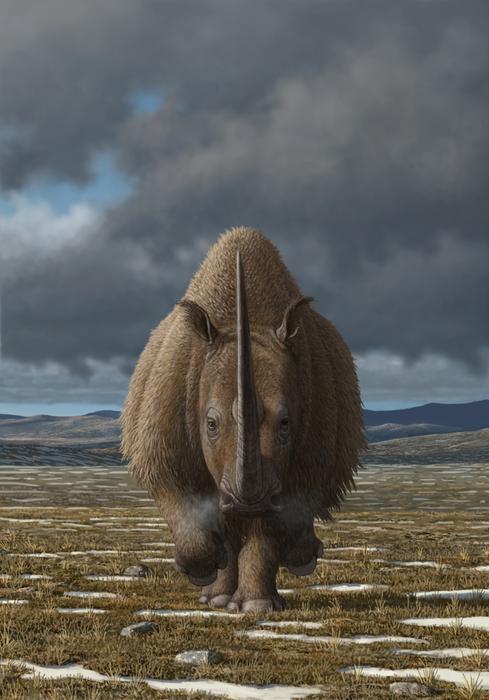
Researchers have discovered sustained hunting by humans prevented the woolly rhinoceros from accessing favourable habitats as Earth warmed following the Last Ice Age.

Credit: Mauricio Anton
Researchers have discovered sustained hunting by humans prevented the woolly rhinoceros from accessing favourable habitats as Earth warmed following the Last Ice Age.
An international team of researchers, led by scientists from the University of Adelaide and University of Copenhagen, used computer modelling to make the discovery, shedding light on an aeons-old mystery.
“Using computer models, fossils and ancient DNA, we traced 52,000 years of population history of the woolly rhinoceros across Eurasia at a resolution not previously considered possible,” said lead author Associate Professor Damien Fordham, from the University of Adelaide’s Environment Institute.
“This showed that from 30,000 years ago, a combination of cooling temperatures and low but sustained hunting by humans caused the woolly rhinoceros to contract its distribution southward, trapping it in a scattering of isolated and rapidly deteriorating habitats at the end of the Last Ice Age.
“As Earth thawed and temperatures rose, populations of woolly rhinoceros were unable to colonise important new habitats opening up in the north of Eurasia, causing them to destabilise and crash, bringing about their extinction.”
An iconic species of megafauna, the woolly rhinoceros had thick skin and long fur, and it once roamed the mammoth step of northern and central Eurasia, before its extinction around 10,000 years ago.
This recent discovery, published in PNAS, contradicts previous research that found humans had no role in the extinction of the woolly rhinoceros – despite the animal co-occurring with humans for tens of thousands of years prior to its extinction.
“The demographic responses revealed by our analysis were at a much higher resolution to those captured in previous genetic studies,” said Professor Eline Lorenzen, from the University of Copenhagen’s Globe Institute.
“This allowed us to pinpoint important interactions that woolly rhinoceroses had with humans and document how these changed through space and time. One of these largely overlooked interactions was persistent low levels of hunting by humans, probably for food.”
Humans pose a similar environmental threat today. Populations of large animals have been pushed into fragmented and suboptimal habitat ranges due to over hunting and human land-use change.
There were 61 species of large terrestrial herbivores – weighing more than one tonne – alive in the late Pleistocene, and only eight of these exist today. Five of those surviving species are rhinoceroses.
“Our findings reveal how climate change and human activities can lead to megafauna extinctions,” said Professor David Nogues-Bravo, from the University of Copenhagen, who was a co-author of this study.
“This understanding is crucial for developing conservation strategies to protect currently threatened species, like vulnerable rhinos in Africa and Asia. By studying past extinctions, we can provide valuable lessons for safeguarding Earth’s remaining large animals.”
Journal
Proceedings of the National Academy of Sciences
Method of Research
Data/statistical analysis
Subject of Research
Animals
Article Title
52,000 years of woolly rhinoceros population dynamics reveal extinction mechanisms
Article Publication Date
4-Jun-2024
COI Statement
The authors declare no competing interest.
Cite Scienmag News
Drew Townsend. (June 4, 2024). Human activity contributed to woolly rhinoceros’ extinction. Scienmag. https://scienmag.com/human-activity-contributed-to-woolly-rhinoceros-extinction/
Drew Townsend. "Human activity contributed to woolly rhinoceros’ extinction." Scienmag, 4 June 2024, https://scienmag.com/human-activity-contributed-to-woolly-rhinoceros-extinction/. Accessed 7 September 2026.
Drew Townsend. "Human activity contributed to woolly rhinoceros’ extinction." Scienmag. June 4, 2024. https://scienmag.com/human-activity-contributed-to-woolly-rhinoceros-extinction/

