

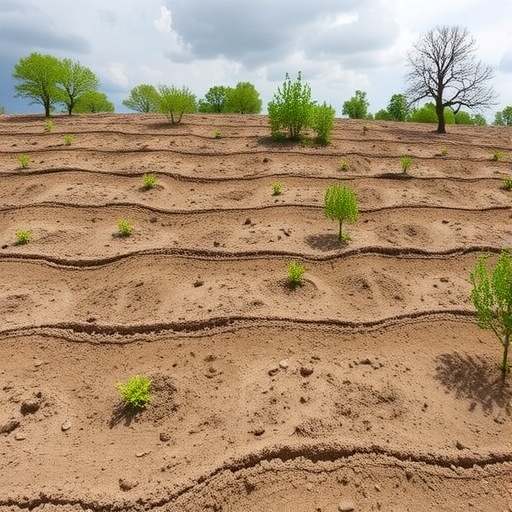
A recent groundbreaking study published in Nature Communications has unveiled alarming insights into how human-induced climate change is intensifying the severity and frequency of compound dry-hot extremes in soil conditions, with profound consequences for global vegetation productivity. This research offers a stark forecast of future ecological resilience as it exposes a rapidly deteriorating synergy between drought and heat stress, phenomena that are no longer isolated but increasingly intertwined and magnified by anthropogenic activities.
Historically, studies have examined droughts and heatwaves as separate environmental disturbances, often focusing on their individual impacts on plant health and productivity. However, this new research disrupts that paradigm by highlighting the compound nature of these events, where dry and hot extremes co-occur and interact in the soil environment, leading to a cascade of ecological effects that cannot be fully understood when these stressors are analyzed independently. This compounded stress alters soil moisture dynamics, nutrient availability, and microbial activity, thereby critically impairing plant functioning and carbon sequestration potential.
The authors employed sophisticated climate models and soil-vegetation-atmosphere coupling simulations to dissect the mechanisms driving these compound extremes. Their approach integrated fine-scale meteorological data with land surface modeling to assess how increases in global temperature and altered precipitation patterns, both products of human-induced climate change, are jointly influencing soil conditions across various biomes. The modeling revealed that the frequency of simultaneous dry and hot spells in soil is not only rising but doing so at an accelerating rate, exceeding previous projections that considered these factors in isolation.
One of the most concerning findings relates to the nonlinear amplification effects of compound extremes on vegetation stress. When soils experience concurrent moisture deficits and heat surges, plants face a critical physiological tipping point: stomatal closure triggered by heat stress severely limits photosynthesis, while drought restricts water uptake, exacerbating cellular damage. This dual stress dramatically reduces the efficiency of photosynthetic carbon fixation, stunting growth and leaving plants vulnerable to mortality. The study’s results indicate that ecosystem productivity losses attributed to these compound soil extremes can exceed losses from individual stress events by over 50%.
The spatial distribution of these escalating compound extremes is uneven but pervasive, with semi-arid and Mediterranean regions identified as particularly vulnerable hotspots. These areas, already prone to water scarcity, face a dangerous synergy that undermines agricultural yields, natural vegetation health, and ecosystem services. The accelerating degradation of soil moisture combined with rising temperatures threatens to shift vegetation composition toward drought-resistant but lower-productivity species, fundamentally altering ecosystem dynamics and carbon cycling feedbacks integral to climate regulation.
Notably, the researchers emphasize the critical role of anthropogenic emissions in driving these trends. By analyzing historical data alongside future emission scenarios, they illustrate that the magnitude of compound soil dry-hot events is directly correlated with greenhouse gas concentration trajectories. This establishes a clear link between human activity—industrial emissions, deforestation, land-use change—and the worsening conditions in soil ecosystems. Mitigation efforts aimed at curbing carbon emissions, therefore, constitute one of the most effective pathways to attenuate the increasing harshness of these compound extremes.
The implications of this study extend beyond ecological processes to global food security. Crop production systems rely on stable soil moisture and temperature regimes, and the sharp rise in compound extremes foreshadows significant yield variability and losses in major agricultural zones. The research warns that without adaptive management strategies—such as drought-resilient crop varieties, improved irrigation efficiency, and soil conservation practices—the vulnerability of global food supply chains will be dramatically heightened, particularly in regions already facing socio-economic challenges.
Importantly, the study illuminates the feedback loops through which degraded vegetation productivity feeds back into climate systems. Reduced vegetation growth limits carbon uptake, weakening one of the planet’s natural defenses against continued atmospheric CO2 accumulation. As compound soil extremes intensify vegetation stress, this feedback may accelerate climate change itself, making mitigation efforts both more urgent and more complex due to these reinforcing cycles.
Methodologically, this research marks a significant advancement owing to its integration of high-resolution soil moisture data with weather extreme analyses, moving beyond surface temperature metrics that have dominated prior work. This soil-focused lens allows for a more mechanistic understanding of how root-zone water deficits combined with thermal stress shape plant responses. Additionally, by incorporating multiple climate model ensembles and observational datasets, the findings offer robust projections that effectively represent a range of possible futures under different emission pathways.
Ecologists and climate scientists alike have praised the study for its comprehensive approach and its ability to translate complex compound event dynamics into actionable insights. The paper calls for increased investment in monitoring networks capable of capturing soil moisture and temperature extremes at relevant spatial and temporal scales. This data is pivotal for refining predictive models, validating simulation outputs, and ultimately guiding adaptation interventions targeted at the ecosystem and agricultural sector resilience.
Furthermore, the study underscores the urgent need for interdisciplinary collaboration spanning climatology, soil science, plant physiology, and socio-economic disciplines to develop holistic strategies to combat the emerging threats from compound dry-hot extremes. By harmonizing efforts across these domains, policy-makers can better align climate mitigation with land management and agricultural development, maximizing both environmental and human well-being outcomes.
In the broader context of global environmental change, this research highlights a pressing facet that has been under-investigated until now—the interplay of multiple stressors within the soil system—which can trigger disproportionate impacts on vegetation health and atmospheric carbon dynamics. It serves as a clarion call to reexamine current climate risk assessments and integrate compound extreme phenomena as a standard dimension in ecological vulnerability and adaptation analyses.
The timing of this publication is particularly poignant as it aligns with growing worldwide interests in climate resilience and sustainability frameworks. Its insights inform emerging international dialogues on adaptation financing and ecosystem-based approaches that safeguard both biodiversity and human livelihoods in a warming world.
Ultimately, this new understanding of anthropogenically-driven compound dry-hot soil extremes reshapes the landscape of climate impact science. It compels us to confront a future where simultaneous environmental disruptions can cascade through ecosystems and societies with intensified effects, demanding urgent actions to mitigate emissions, bolster ecosystem resilience, and protect global food security amid an increasingly volatile climate.
Subject of Research: Anthropogenically amplified compound dry-hot extremes in soil and their impacts on vegetation productivity.
Article Title: Anthropogenically-driven escalating impact of soil-based compound dry-hot extremes on vegetation productivity.
Article References:
Liang, Y., Wang, J., Hao, Z. et al. Anthropogenically-driven escalating impact of soil-based compound dry-hot extremes on vegetation productivity. Nat Commun (2026). https://doi.org/10.1038/s41467-026-68878-3
Image Credits: AI Generated


