


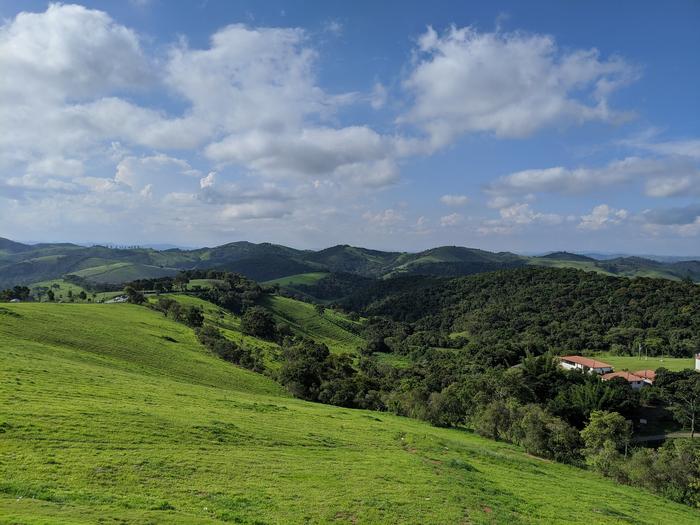
CORVALLIS, Ore. – Using trees as a cost-effective tool against climate change is more complicated than simply planting large numbers of them, an international collaboration that includes an Oregon State University scientist has shown.

Credit: Jacob Bukoski, Oregon State
CORVALLIS, Ore. – Using trees as a cost-effective tool against climate change is more complicated than simply planting large numbers of them, an international collaboration that includes an Oregon State University scientist has shown.
Jacob Bukoski of the OSU College of Forestry and seven other researchers synthesized data from thousands of reforestation sites in 130 countries and found that roughly half the time it’s better just to let nature take its course.
Findings of the study led by Conservation International were published today in Nature Climate Change.
“Trees can play a role in climate change mitigation, for multiple reasons,” Bukoski said. “It’s pretty easy to understand that forests pull carbon dioxide from the atmosphere and store it, and trees are something pretty much everyone can get behind – we have seen multiple bipartisan acts for tree planting introduced in Congress. This study brings a nuanced perspective to the whole ‘should we plant trees to solve climate change’ debate.”
Bukoski notes that expanding forests globally has been widely proposed as a key tactic against climate change since forests sequester atmospheric carbon dioxide in their biomass and soils. Harvested timber also stores carbon in the form of wood products.
There are two basic approaches to forest expansion, Bukoski said.
“Generally speaking, we can let forests regenerate on their own, which is slow but cheap, or take a more active approach and plant them, which speeds up growth but is more expensive,” he said. “Our study compares these two approaches across reforestable landscapes in low- and middle-income countries, identifying where naturally regenerating or planting forests is likely to make more sense.”
Using machine learning and regression models, the scientists found that natural regeneration would be most cost effective over a 30-year period for 46% of the areas studied, and planting would be most cost effective for 54%.
They also determined that using a combination of the two approaches across all areas would be 44% better than natural regeneration alone and 39% better than planting by itself.
“If your objective is to sequester carbon as quickly and as cheaply as possible, the best option is a mix of both naturally regenerating forests and planting forests.” Bukoski said.
The study suggests that natural regeneration is especially cost effective relative to plantation forestry in much of western Mexico, the Andean region, the Southern Cone of South America, West and Central Africa, India, Southern China, Malaysia and Indonesia.
Conversely, plantations are preferable to natural regeneration in much of the Caribbean, Central America, Brazil, northern China, mainland Southeast Asia, the Philippines and North, East and Southern Africa.
“Which method is more cost effective in a given location is a function of multiple factors, including opportunity cost, relative carbon accumulation and harvest rates, and relative implementation costs,” Bukoski said.
Other scientists in the collaboration were Jonah Busch and Bronson Griscom of Conservation International, Susan Cook-Patton of The Nature Conservancy, David Kaczan of the World Bank, Yuanyuan Yi of Peking University, Jeff Vincent of Duke University and Matthew Potts of the University of California, Berkeley.
The authors stress that reforestation is a complement to, not a replacement for, reducing emissions from fossil fuels. Achieving the entire mitigation potential of reforestation over 30 years would amount to less than eight months of global greenhouse gas emissions, they note.
The authors add that carbon is just one consideration when growing trees. Biodiversity, demand for wood products, support of local livelihoods, and non-carbon biophysical effects must also be considered when deciding where and how to reforest landscapes.
But they also point out that their findings suggest reforestation offers far more potential low-cost climate abatement than has been previously estimated.
Journal
Nature Climate Change
Method of Research
Data/statistical analysis
Subject of Research
Not applicable
Article Title
Tree planting vs. natural regeneration
Article Publication Date
24-Jul-2024
Cite Scienmag News
Sloane Callahan. (July 24, 2024). How well does tree planting work in climate change fight? It depends, OSU research shows. Scienmag. https://scienmag.com/how-well-does-tree-planting-work-in-climate-change-fight-it-depends-osu-research-shows/
Sloane Callahan. "How well does tree planting work in climate change fight? It depends, OSU research shows." Scienmag, 24 July 2024, https://scienmag.com/how-well-does-tree-planting-work-in-climate-change-fight-it-depends-osu-research-shows/. Accessed 14 September 2026.
Sloane Callahan. "How well does tree planting work in climate change fight? It depends, OSU research shows." Scienmag. July 24, 2024. https://scienmag.com/how-well-does-tree-planting-work-in-climate-change-fight-it-depends-osu-research-shows/

