


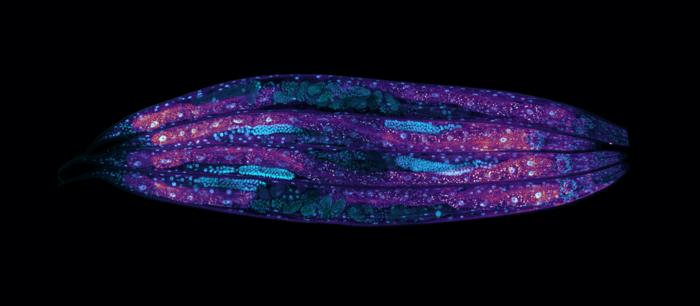
Why do some people live for longer than others? The genes in our DNA sequence are important, helping avoid disease or maintain general health, but differences in our genome sequence alone explain less than 30% of the natural variance of human life expectancy.

Credit: Jeremy Vicencio, Nadia Halidi/Centro de Regulación Genómica
Why do some people live for longer than others? The genes in our DNA sequence are important, helping avoid disease or maintain general health, but differences in our genome sequence alone explain less than 30% of the natural variance of human life expectancy.
Exploring how ageing is influenced at the molecular level could shed light on lifespan variation, but generating data at the speed, scale and quality necessary to study this in humans is unfeasible. Instead, researchers turn to worms (Caenorhabditis elegans). Humans share a lot of biology with these small creatures, who also have a large, natural variation in lifespan.
Researchers at the Centre for Genomic Regulation (CRG) observed thousands of genetically identical worms living in a controlled environment. Even when diet, temperature and exposure to predators and pathogens are the same for all worms, many individuals continue to live for a longer or shorter period of time than the average.
The study traced the primary source of this variation to changes in the mRNA content in germline cells (those involved in reproduction) and somatic cells (the cells forming the body). The mRNA balance between the two types of cells is disrupted, or ‘decouples’, over time, causing ageing to run faster in some individuals than others. The findings are published today in the journal Cell.
The study also found that the magnitude and speed of the decoupling process is influenced by a group of at least 40 different genes. These genes play many different roles in the body ranging from metabolism to the neuroendocrine system. However, the study is first to show they all interact to make some individuals live longer than others.
Knocking down some of the genes extended a worm’s lifespan, while knocking down others shortened it. The findings suggest a surprising possibility: the natural differences seen in ageing worms might reflect randomness in the activity of many different genes, making it look as if individuals have been exposed to knockdowns of many different genes.
“Whether a worm lives to day 8 or day 20 is down to seemingly random differences in the activity of these genes. Some worms appear to be simply lucky, in that they have the right mix of genes activated at the right time,” says Dr. Matthias Eder, first author of the paper and researcher at the Centre for Genomic Regulation.
Knocking down three genes – aexr-1, nlp-28, and mak-1 – had a particularly dramatic effect on lifespan variance, reducing the range from around 8 days to just 4. Rather than prolonging the lives of all individuals uniformly, removing any one of these genes drastically increased the life expectancy of worms on the low end of the spectrum, while the life expectancies of the longest-lived worms remained more or less unchanged.
The researchers observed the same effects on healthspan, the period of life spent healthy, rather than simply how long an individual is physically alive. The researchers measured this by studying how long the worms maintain vigorous movement. Knocking down just one of the genes was enough to disproportionately improving healthy ageing in worms on the low end of the healthspan spectrum.
“This isn’t about creating immortal worms, but rather making ageing a more equitable process than it currently is – a fairer game for all. In a way we’ve doing what doctors do, which is take worms that would die sooner than their peers and make them healthier, helping them live closer to their maximum potential life expectancy. But we’re doing it by targeting basic biological mechanisms of aging, not just treating sick individuals. It’s essentially making a population more homogeneous and more long lived to boot,” says Dr. Nick Stroustrup, senior author of the study and Group Leader at the Centre for Genomic Regulation.
The study doesn’t address why knocking down the genes doesn’t seem to negatively affect the worm’s health. “Several genes could interact to provide built-in redundancy after a certain age. It could also be that the genes aren’t needed for individuals living in benign, safe conditions where the worms are kept in the lab. In the harsh environment of the wild, these genes might be more critical for survival. These are just some of the working theories,” says Dr. Eder.
The researchers made their findings by developing a method which measures RNA molecules in different cells and tissues, combining it with the ‘Lifespan Machine’, a device which follows the entire lives of thousands of nematodes at once. The worms live in a petri dish housed inside the machine under the watchful eye of a scanner. The device images nematodes once per hour, gathering lots of data about their behaviour. The researchers have plans to build a similar machine to study the molecular causes of ageing in mice, which have a biology that more closely resembles that of humans.
Journal
Cell
Method of Research
Experimental study
Subject of Research
Animals
Article Title
Systematic mapping of organism-scale generegulatory networks in aging using population asynchrony
Article Publication Date
21-Jun-2024
Cite Scienmag News
Beatrice Stafford. (June 23, 2024). How to make ageing a ‘fairer game’ for all wormkind. Scienmag. https://scienmag.com/how-to-make-ageing-a-fairer-game-for-all-wormkind/
Beatrice Stafford. "How to make ageing a ‘fairer game’ for all wormkind." Scienmag, 23 June 2024, https://scienmag.com/how-to-make-ageing-a-fairer-game-for-all-wormkind/. Accessed 4 September 2026.
Beatrice Stafford. "How to make ageing a ‘fairer game’ for all wormkind." Scienmag. June 23, 2024. https://scienmag.com/how-to-make-ageing-a-fairer-game-for-all-wormkind/

