


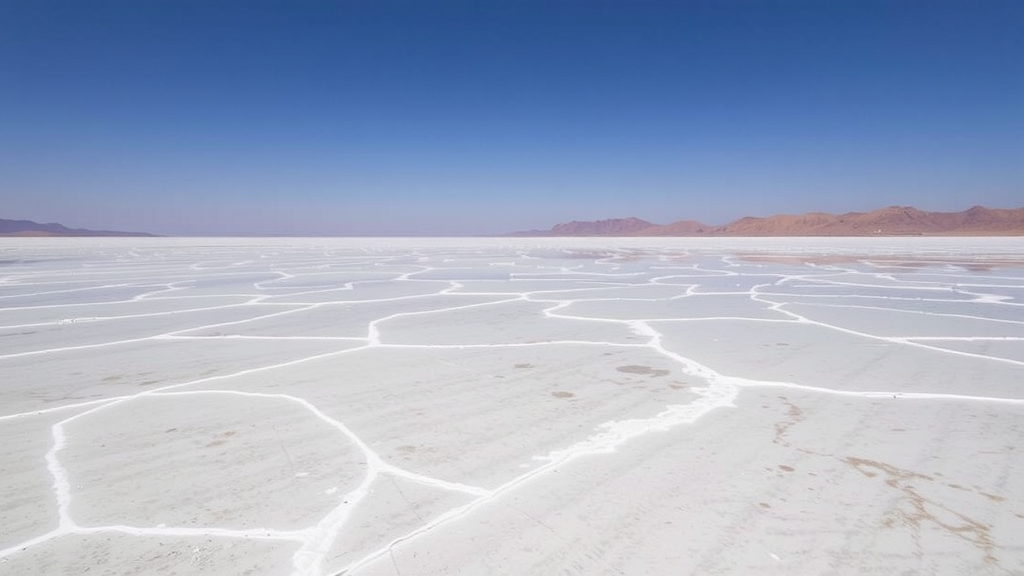
The gleaming salt crusts that stretch inland from the Arabian Gulf coast of Abu Dhabi have quietly shaped modern geology for more than half a century, and a sweeping new review published in Environmental Earth Sciences argues that they deserve even greater attention. The paper, led by Mostafa R. Abukhadra of United Arab Emirates University and colleagues, synthesizes decades of sedimentological, hydrogeochemical, microbiological and radiogeochemical research into a unified framework for understanding sabkha systems across the United Arab Emirates. Far from being inert salt pans, the authors conclude, these evaporative flats are highly reactive hydrogeochemical reactors whose lateral facies belts, stratified brines and microbial communities record processes that geologists rely on to interpret some of the world’s most important oil reservoirs.
Sabkhas form under arid to hyper-arid climates where evaporation persistently exceeds rainfall and groundwater lies close enough to the surface for capillary rise to deliver moisture into the evaporation zone. The review distinguishes two dominant types in the UAE. Coastal sabkhas, exemplified by the Abu Dhabi shoreline, sit within supratidal to marginal intertidal zones and are sustained by episodic marine flooding, tidal pumping, lagoonal exchange and saline groundwater circulation. Inland sabkhas, such as the vast Sabkha Matti that extends roughly 150 kilometres from western Abu Dhabi into Saudi Arabia, occupy continental depressions and interdune corridors where groundwater discharge and intense evaporation dominate, with little direct marine input. Both settings share the same fundamental process chain: capillary ascent, evaporative concentration, evaporite crystallization and early cementation, yet their differing hydrologic connectivity produces distinct brine chemistries and mineral assemblages.
The geological setting of the UAE gives these systems unusual scientific richness. The Abu Dhabi coastal plain is an exceptionally low-gradient carbonate ramp where offshore shoals, barrier islands and restricted lagoons dampen wave energy and allow broad tidal flats to prograde seaward. Facies belts trace an orderly progression from subtidal carbonate shoals through lagoons and tidal channels into a shoreline-parallel belt of polygonal microbial mats and finally onto supratidal sabkha plains. Because these belts are preserved as vertically stacked Holocene packages, geologists can walk laterally across modern environments and read the same succession downward in cores. This direct process-to-product linkage is why the Abu Dhabi sabkhas became the type analogue for ancient carbonate–evaporite reservoir–seal systems across the Arabian Plate, including the Upper Jurassic Arab Formation.
The Mussafah Channel, a man-made canal cut through the coastal plain, has proven especially instructive. Its walls expose a well-constrained Holocene succession in which Pleistocene aeolian deposits are overlain by lagoonal and tidal-channel carbonates, microbial mat facies and supratidal sediments overprinted by evaporite mineralization. The stacking records a post-glacial marine transgression followed by regression and progressive sabkha development, providing a high-resolution template for reconstructing facies architecture and early diagenesis in subsurface reservoirs. Quantitative comparisons between modern surfaces and shallow subsurface successions have shown that many environmentally diagnostic structures, from microbial polygons to halite crust morphologies, retain recognizable signatures during early burial, strengthening confidence in facies-based analog applications.
One of the most celebrated contributions of the UAE sabkhas lies in addressing the long-standing Dolomite Problem: the puzzle of how abundant dolomite forms at low temperatures when laboratory experiments struggle to precipitate it. Cryo-scanning electron microscopy has revealed authigenic dolomite crystals nucleating within the extracellular polymeric substances of Abu Dhabi microbial mats, and laboratory studies with sulfate-reducing bacteria isolated from the sabkha have reproduced poorly ordered Ca-dolomite and very high-Mg calcite under simulated pore-water conditions. These findings establish microbial mats as geochemical micro-reactors that locally modify pH, alkalinity and magnesium-to-calcium ratios, demonstrating that low-temperature dolomitization in evaporitic settings is fundamentally microbially mediated rather than a simple consequence of evaporation.
The hydrogeochemistry of the coastal sabkha is equally counterintuitive. Water-budget and mass-balance analyses show that most water entering the shallow sabkha aquifer is meteoric, derived from infrequent but efficiently infiltrating rainfall, whereas more than 95 percent of the dissolved solutes ascend from continental brines in underlying Tertiary formations. This decoupling between water sources and solute sources explains why marine-like evaporite assemblages develop even where modern marine flooding is sporadic. The characteristic mineral sequence of carbonate, gypsum and anhydrite, then halite, reflects recurrent concentration–reset cycles driven by evaporation, flooding and brine–sediment interaction rather than a single linear evaporation path. Density contrasts between concentrated near-surface brines and dilute underlying groundwater even drive free convection, first documented at field scale in the Abu Dhabi aquifer, redistributing solutes and shaping cementation patterns.
The review also brings radiogeochemistry into the framework. Natural radioelement distributions prove strongly facies-dependent: potassium-40 and thorium-232 track detrital inputs of K-bearing silicates, clays and heavy minerals inherited from desert dunes and the ophiolite-dominated Hajar Mountains, while uranium behaves far more dynamically, migrating as uranyl–carbonate complexes in oxidizing alkaline brines and immobilizing in reducing microbial mat microenvironments. Radium, by contrast, can be trapped through substitution into the abundant gypsum and anhydrite that pervade sabkha soils, making sulfate horizons potential radiogeochemical sinks. The authors argue that robust environmental baselines therefore require sampling stratified by facies and depth rather than treating sabkhas as uniform salt flats.
On the question of critical elements, particularly lithium, the synthesis is deliberately cautious. Lithium remains in solution through early evaporation and concentrates mainly in late-stage, bittern-like residual brines enriched in magnesium, potassium, bromine and boron. Whether UAE sabkhas reach that stage depends on hydrologic restriction, residence time and flushing frequency, and the reviewers note that facies-resolved lithium datasets for UAE sabkhas are effectively absent from the open literature. Regional benchmarks, including lithium concentrations of roughly 0.2 to 0.3 milligrams per litre measured in Arabian Gulf desalination brines, and the persistent technical obstacle posed by high magnesium-to-lithium ratios in direct extraction technologies, all counsel against assuming inherent high-grade enrichment. The authors instead propose a staged screening strategy: vertical porewater profiling across representative facies, quantification of lithium alongside its chemical companions, seasonal repetition to capture evaporation and flooding cycles, and integration with techno-economic and environmental assessments before any resource claims are made.
Finally, the review elevates the sabkhas to geoheritage priorities. Abu Dhabi Sabkha is listed on UNESCO’s World Heritage Tentative List, recognized for the completeness of its roughly 7,000-year-old system, where subtidal lagoon muds, intertidal microbial mats and supratidal gypsum and anhydrite nodules co-occur within a single locality. Yet the scientific archive is disappearing fast: studies estimate that of about 150 kilometres of coastal sabkha present in the 1960s, only around 36 percent remained by the early 2010s, lost to industrial and urban encroachment. The reviewers call for protected reference zones, controlled access and integration of research with public interpretation, framing the sabkhas not as wasteland but as irreplaceable outdoor laboratories. From reservoir calibration and lithium screening to radon baselines and geotechnical risk in sulfate-cemented soils, they conclude, the fate of these reactive evaporitic systems now matters far beyond the shorelines of the southern Gulf.
Subject of Research: Integrated sedimentology, hydrogeochemistry, geomicrobiology and resource potential of UAE sabkha carbonate–evaporite systems
Article Title: Sabkha systems of the United Arab Emirates as integrated carbonate–evaporite laboratories: facies architecture, brine evolution, critical-element potential, and geoheritage significance
Article References: Abukhadra, M. R., Al-zharani, M., Allam, A. A., Hamdan, M. A., Szűcs, P., & Eid, M. H. (2026). Sabkha systems of the United Arab Emirates as integrated carbonate–evaporite laboratories: facies architecture, brine evolution, critical-element potential, and geoheritage significance. Environmental Earth Sciences, 85(16), Article 411. https://doi.org/10.1007/s12665-026-13146-2
Image Credits: AI Generated
DOI: 10.1007/s12665-026-13146-2
Keywords: sabkha, United Arab Emirates, evaporites, carbonate sedimentology, brine geochemistry, dolomite, microbial mats, lithium, radioactivity, Abu Dhabi, geoheritage, reservoir analogue
Cite Scienmag News
Violet Maxwell. (September 25, 2026). How the UAE’s Salt Flats Became the World’s Most Important Natural Laboratory for Evaporite Science. Scienmag. https://scienmag.com/how-the-uaes-salt-flats-became-the-worlds-most-important-natural-laboratory-for-evaporite-science/
Violet Maxwell. "How the UAE’s Salt Flats Became the World’s Most Important Natural Laboratory for Evaporite Science." Scienmag, 25 September 2026, https://scienmag.com/how-the-uaes-salt-flats-became-the-worlds-most-important-natural-laboratory-for-evaporite-science/. Accessed 5 October 2026.
Violet Maxwell. "How the UAE’s Salt Flats Became the World’s Most Important Natural Laboratory for Evaporite Science." Scienmag. September 25, 2026. https://scienmag.com/how-the-uaes-salt-flats-became-the-worlds-most-important-natural-laboratory-for-evaporite-science/


