


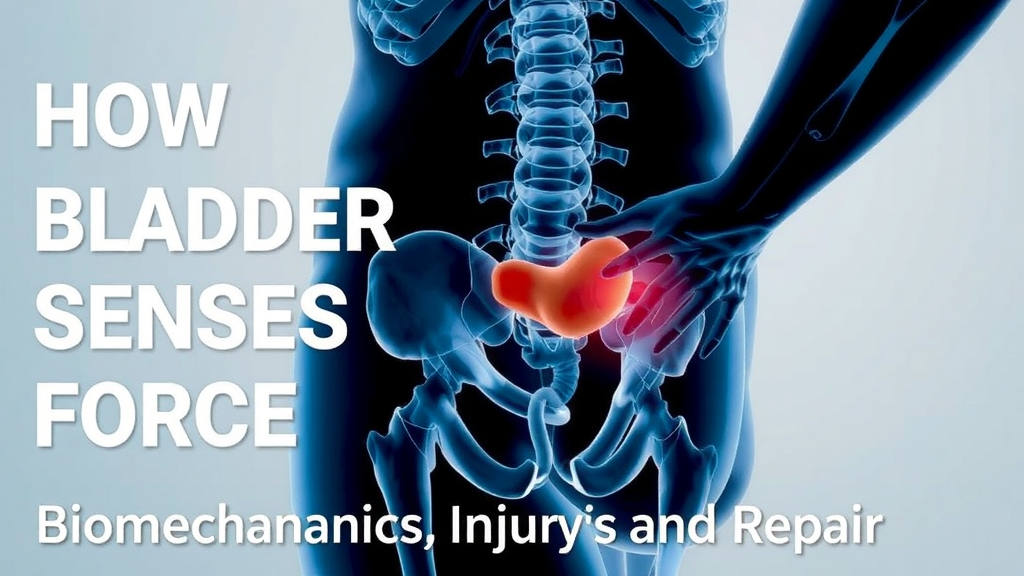
The urinary bladder is one of the most mechanically dynamic organs in the human body, and a major new review in Nature Reviews Urology argues that this mechanical identity has been chronically underappreciated in both research and clinical practice. Led by Jiawei Chen, Yuanzhuo Chen, Xingpeng Di and colleagues at West China Hospital of Sichuan University, the comprehensive analysis synthesizes decades of evidence showing that the bladder’s cyclical filling and emptying generates a rich repertoire of mechanical stimuli, including stretch, hydrostatic pressure and shear stress, that actively regulate sensation, contraction and tissue remodeling. Far from being a passive reservoir, the authors contend, the bladder is a mechanosensitive organ whose health depends on maintaining a delicate biomechanical homeostasis, one that is disrupted in common conditions such as bladder outlet obstruction, overactive bladder, interstitial cystitis and fibrosis.
The review begins with the fundamental biomechanics of the organ. During filling, the bladder wall must expand dramatically while keeping internal pressures low, a property known as high compliance that depends on the viscoelastic behavior of its layered structure: a barrier-forming urothelium, a collagen-rich lamina propria and the detrusor smooth muscle. Classical studies dating back to the 1970s established that the bladder wall exhibits time-dependent, viscoelastic responses to loading, with passive properties governed largely by collagen and elastin in the extracellular matrix and active properties determined by smooth muscle tone. During voiding, coordinated detrusor contraction generates the pressures needed to expel urine, while urine flow itself imposes shear stress on the urothelial surface. Each fill-void cycle therefore exposes bladder cells to repeated, rhythmic deformation, and the review emphasizes that this mechanical rhythm is not merely background noise but a regulatory signal that shapes organ development, sensation and repair throughout life.
How do bladder cells actually detect these forces? The authors catalog an expanding arsenal of mechanosensors. Chief among them are mechanosensitive ion channels, most notably the Piezo family. PIEZO2 in sensory neurons and urothelial cells has been shown to coordinate the urination reflex, while PIEZO1 in the urothelium mediates stretch-evoked calcium influx and ATP release, and its expression rises after partial bladder outlet obstruction. Transient receptor potential channels, including TRPV1, TRPV4, TRPM3 and TRPM8, contribute to stretch sensing, inflammation-associated hypersensitivity and afferent signaling, and several TRP-targeted drugs are already in clinical development for bladder disorders. Beyond ion channels, the review highlights integrins, the transmembrane receptors that link cells to the extracellular matrix and transmit force through focal adhesion kinase; muscarinic acetylcholine receptors, which modulate stretch-induced responses in the urothelium and smooth muscle; and purinergic receptors, which sense the ATP released mechanically from urothelial cells and translate it into afferent nerve activation and detrusor responses.
Downstream of these sensors lies the machinery of mechanotransduction, the intracellular pathways that convert mechanical cues into biochemical decisions. The review details how physiological stretch activates integrin-FAK signaling to drive controlled proliferation of urothelial and smooth muscle cells, supporting tissue maintenance and wound healing, while hydrostatic pressure stimulates DNA synthesis through PI3K/Akt pathways. The Hippo-YAP/TAZ axis emerges as a central hub: mechanical strain and matrix stiffness promote nuclear translocation of YAP, which cooperates with Smad3 to drive pathological smooth muscle proliferation in fibrosis progression. Rho GTPase signaling, actomyosin contractility and ERK1/2 pathways further link force sensing to gene expression, extracellular matrix synthesis and cell fate. In health, these pathways maintain homeostasis; in disease, their dysregulation becomes a driver of injury.
The pathological consequences of mechanical overload are illustrated most vividly by bladder outlet obstruction, a condition commonly caused by benign prostatic hyperplasia. Obstruction elevates both stretch forces and hydrostatic pressures during storage and voiding, and the review traces the resulting cascade: urothelial dysfunction and barrier disruption, release of inflammatory mediators and ATP, recruitment and polarization of macrophages, mast cell activation, and a progressive transition from inflammation to fibrosis. Elevated pressures have been shown to activate Piezo1 and exacerbate bladder fibrosis, while PIEZO2 is downregulated in the detrusor of men with obstruction, correlating with urinary retention and reduced compliance. Fibrotic remodeling stiffens the bladder wall, and this increased matrix stiffness feeds back through mechanosensitive pathways, including YAP/Smad3 signaling, to perpetuate smooth muscle proliferation and further stiffening, a vicious cycle the authors describe as biomechanical memory embedded in the tissue.
Inflammation and immunity are also framed in mechanical terms. Recent work shows that Piezo1 modulates macrophage polarization and stiffness sensing, that YAP-mediated mechanotransduction tunes the macrophage inflammatory response, and that mechanical communication between fibroblasts, immune cells and smooth muscle orchestrates fibrosis progression. The review argues that mechanotransduction is not confined to structural cells but extends to the immune compartment, positioning mechanical cues as regulators of the inflammatory milieu that determines whether an injured bladder heals or scars. Epithelial-mesenchymal transition, in which urothelial cells acquire fibroblast-like, collagen-producing phenotypes, is likewise promoted by elevated storage and voiding pressure cycles and by TGF-beta signaling intertwined with Rho kinase pathways.
On the therapeutic front, the review is cautiously optimistic but candid about the early stage of the field. Existing drugs already intersect with mechanosensitive biology: antimuscarinics reduce stretch-evoked ATP release from the bladder mucosa, TRP channel antagonists such as TRPM8 blockers and TRPV1-targeting agents show efficacy in overactive bladder and pain models, and purinergic P2X3 antagonists like gefapixant, approved for chronic cough, exemplify the druggability of mechanosensory receptors. Novel agents are pushing further, including bladder-selective M3 antagonists, M3 positive allosteric modulators for underactive bladder, and Piezo1 modulators ranging from the activator Yoda1 to inhibitors such as GsMTx4. Preclinical studies suggest that targeting Piezo1, integrin pathways or YAP signaling can mitigate obstruction-induced and neurogenic bladder fibrosis, and even tetrahedral framework nucleic acids have shown antifibrotic effects by modulating macrophage polarization. Yet the authors stress that no mechanotransduction-targeted therapy has yet been validated specifically for bladder injury, and that drugs aimed at mechanosensitive ion channels and integrins represent the most promising frontier for future investigation.
Beyond pharmacology, the review points to engineering approaches that could reshape bladder repair. Biomechanical modeling with four-dimensional reconstruction of bladder filling, computational fluid dynamics of urethral flow, and flexible implantable sensors for pressure monitoring are refining how researchers quantify the organ’s mechanical environment. Regenerative medicine strategies, including bladder acellular matrix scaffolds, must account for the fact that scaffold stiffness and architecture directly influence cell behavior through the same mechanotransduction pathways the review describes. Urinary ATP is emerging as a dynamic biomarker of detrusor overactivity and interstitial cystitis severity, offering a translational readout of mechanosensory activity that could guide diagnosis and treatment monitoring.
The overarching message is a reframing of bladder disease as, in substantial part, a mechanobiological disorder. Abnormal mechanical environments are both indicators and drivers of bladder pathology, and understanding the differential mechanosensation and transduction pathways that distinguish physiological adaptation from pathological remodeling is essential for developing therapies that promote genuine repair rather than symptomatic suppression. As the population ages and conditions such as benign prostatic hyperplasia, overactive bladder and neurogenic bladder dysfunction grow more prevalent, the mechanobiology of the bladder may prove to be one of urology’s most consequential frontiers, transforming how clinicians think about an organ they have long treated primarily as a plumbing problem.
Subject of Research: Biomechanical regulation of bladder injury and repair through mechanosensors and mechanotransduction pathways
Article Title: Biomechanical regulation of bladder injury and repair
Article References: Chen, J., Chen, Y., Di, X., Zeng, X., Shen, S., Lin, L., Li, Y., Liao, B., Shen, H., Peng, L., Jin, T., & Luo, D. (2026). Biomechanical regulation of bladder injury and repair. Nature Reviews Urology. https://doi.org/10.1038/s41585-026-01185-0
Image Credits: AI Generated
DOI: 10.1038/s41585-026-01185-0
Keywords: bladder, mechanotransduction, Piezo1, bladder outlet obstruction, fibrosis, urothelium, mechanosensitive ion channels, integrins, TRP channels, purinergic signaling, overactive bladder, YAP signaling
Cite Scienmag News
Ophelia Keating. (September 20, 2026). How the Bladder Senses Force: Biomechanics of Injury and Repair. Scienmag. https://scienmag.com/how-the-bladder-senses-force-biomechanics-of-injury-and-repair/
Ophelia Keating. "How the Bladder Senses Force: Biomechanics of Injury and Repair." Scienmag, 20 September 2026, https://scienmag.com/how-the-bladder-senses-force-biomechanics-of-injury-and-repair/. Accessed 5 October 2026.
Ophelia Keating. "How the Bladder Senses Force: Biomechanics of Injury and Repair." Scienmag. September 20, 2026. https://scienmag.com/how-the-bladder-senses-force-biomechanics-of-injury-and-repair/


