


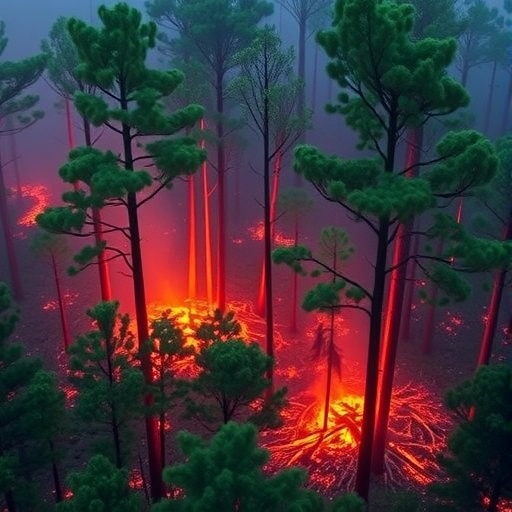
Recent research has brought to light the critical impacts of selective logging on forest flammability in the Brazilian Amazon, showcasing complex dynamics within one of the planet’s most vital ecosystems. The study, titled “Experimental assessment of forest flammability after selective logging in the Brazilian Amazon,” investigates the aftereffects of selective logging practices and raises important questions about forest management in the face of climate change.
In the Brazilian Amazon, the balance between ecological preservation and economic exploitation is a delicate dance, fraught with consequences for biodiversity and carbon storage. Selective logging, generally considered a less harmful method compared to clear-cutting, has been under scrutiny due to its potential to alter natural forest dynamics. The researchers employed a scientific approach to document how these practices affect the likelihood of forest fires, which can lead to significant environmental degradation and negative feedback loops in climate systems.
The methodology employed in the study provides insight into the experimental design used to assess flammability. By employing controlled burns in various selective logging scenarios, the team collected valuable data on the quantity and quality of biomass that contributes to fire intensity. This methodological rigor ensures that the findings are not merely anecdotal but are rather grounded in replicable scientific inquiry.
A particularly notable finding from the study highlights the interplay between the types of trees removed during selective logging and the subsequent changes in forest composition. The results suggest that the removal of certain species can facilitate the dominance of flammable materials, enhancing the risk of ignition during dry seasons. This finding is particularly critical when considering the rising temperatures and shifting rainfall patterns attributed to climate change, which inherently affect fire behavior.
Additionally, the research emphasizes the role of forest structure and microclimates that can either suppress or exacerbate fire conditions. Changes in canopy cover due to logging can alter humidity levels and underbrush conditions, potentially leading to an increase in fire susceptibility. Understanding these intricate socio-ecological dynamics is essential for implementing effective conservation strategies and mitigating risks associated with wildfires.
The implications of this research extend beyond the immediate environmental concerns. Forest fires are a significant source of greenhouse gas emissions, leading to climate feedback loops that exacerbate global warming. As such, the findings call for a reassessment of selective logging practices in the Amazon basin to ensure they maintain the ecological integrity of these vital forests while balancing economic needs.
This study also opens up avenues for future research, encouraging further exploration of the long-term effects of selective logging on forest ecosystems. As the Amazon faces unprecedented threats from deforestation and climate change, understanding these dynamics becomes imperative. Researchers may need to investigate the role of different logging techniques and their influence on wildlife habitats, carbon sequestration, and overall forest health.
Public policy implications cannot be overlooked—there is a pressing need for frameworks that integrate ecological findings into forest management strategies. This study advocates for adaptive management approaches that consider ecological resilience while also addressing socio-economic realities in forest-dependent communities. Policymakers must engage local stakeholders in the dialogue, ensuring that conservation efforts are both scientifically informed and culturally sensitive.
Moreover, the findings underscore the urgency of international collaboration in addressing deforestation and forest management practices. Global markets often drive logging activities without considering ecological ramifications. Therefore, international bodies and local governments must engage in responsible trade practices that protect at-risk forests while promoting sustainable livelihoods for local communities.
As awareness increases, there have been emerging movements pushing for the restoration and conservation of degraded forest areas. The results of this study serve as a reminder that forest ecosystems are not only providers of resources but also play a crucial role in upholding planetary health. By prioritizing preservation efforts informed by scientific research, it becomes possible to maintain the critical functions of these ecosystems.
In summary, the comprehensive assessment of forest flammability following selective logging practices unveils complex ecological interrelationships and highlights urgent matters facing the Brazilian Amazon. With the combined threat of climate change and human economic activities, these findings pave the way for informed decision-making strategies concerning forest management. Collaboration between scientists, policymakers, and local communities will be essential in shaping the future of these vital ecosystems.
As the study reveals, careful consideration of logging techniques and their consequences for forest health is pivotal for maintaining ecological balance. Moving forward, it is crucial to foster public understanding and support for sustainable practices that safeguard the Amazon’s rich biodiversity while also protecting the environment from the scourge of wildfires.
In essence, the research carried out by Machado and colleagues signals an urgent call to action. It invites stakeholders across various sectors to recognize their interconnected roles in shaping the future of the Amazon and suggests that knowledge can be a powerful tool in promoting both conservation and sustainable development.
Cite Scienmag News
Violet Maxwell. (August 24, 2025). How Selective Logging Affects Amazon Forest Flammability. Scienmag. https://scienmag.com/how-selective-logging-affects-amazon-forest-flammability/
Violet Maxwell. "How Selective Logging Affects Amazon Forest Flammability." Scienmag, 24 August 2025, https://scienmag.com/how-selective-logging-affects-amazon-forest-flammability/. Accessed 6 September 2026.
Violet Maxwell. "How Selective Logging Affects Amazon Forest Flammability." Scienmag. August 24, 2025. https://scienmag.com/how-selective-logging-affects-amazon-forest-flammability/


