

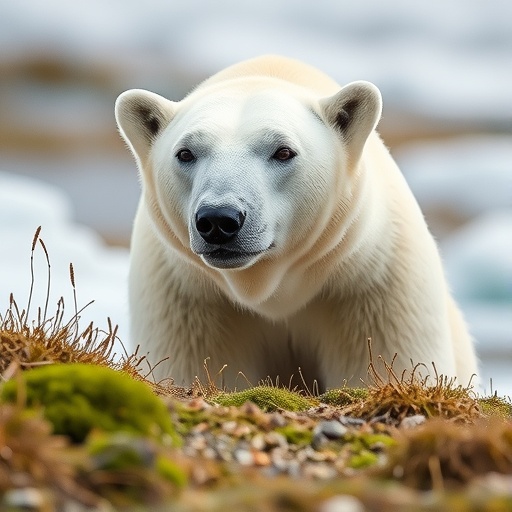
In the fragile and rapidly transforming Arctic ecosystem, safeguarding biodiversity presents an unprecedented challenge to conservationists worldwide. A recent collaborative study by the University of Alberta and the San Diego Zoo Wildlife Alliance (SDZWA) proposes a groundbreaking conservation strategy: the use of polar bears as an “umbrella species” to delineate marine protected areas (MPAs) in the western Hudson Bay region. This innovative approach harnesses extensive tracking data to effectively prioritize regions critical for preservation, offering a beacon of hope in the management of Arctic marine biodiversity.
Defining protection zones in marine environments has historically been complicated by limited knowledge about the precise spatial distribution of marine organisms. The recent research, published in Arctic Science, leverages two decades of telemetry data from 355 polar bears. Through sophisticated spatial analyses, the scientists identified a high-use zone near Cape Churchill, Manitoba, which represents a vital habitat combining feeding and denning sites. This spatially explicit data not only informs policymakers but also embodies a dynamic framework to underpin future marine conservation efforts in the Arctic.
Dr. Andrew Derocher of the University of Alberta and Dr. Nicholas Pilfold from SDZWA emphasize that polar bears serve as a practical surrogate species due to their highly documented ecological requirements, vast home ranges, and sensitivity to environmental disturbances. This designation as an umbrella species implies that by protecting polar bear habitats, conservation efforts inherently sustain the broader ecological networks and species assemblages that depend on these critical areas. This concept has pivotal implications for ecosystem-based management in climate-vulnerable regions.
Polar bears are apex predators in the Arctic, and their hunting behaviors generate cascading effects throughout the ecosystem. Their leftover kills, for instance, act as essential nutrient sources for scavengers such as Arctic foxes, wolves, ravens, and gulls. The intricate trophic interactions underscore the bears’ role in maintaining ecological equilibrium. Thus, ensuring the protection of their habitat goes beyond a single-species approach, extending benefits across multiple trophic levels and enhancing overall biodiversity resilience.
The study capitalizes on the accumulation of extensive telemetry datasets, revealing fine-scale habitat utilization patterns that were previously elusive. By incorporating such large-scale movement ecology data into conservation planning, the researchers advocate for dynamic MPAs that can adapt to temporal environmental shifts, such as seasonal ice cover changes and prey availability fluctuations, factors critical in the Arctic’s highly variable and changing conditions.
Manitoba’s recent governmental commitment, led by Premier Wab Kinew, to fund the exploration of a national marine conservation area in western Hudson Bay aligns strategically with this research. This political momentum bolsters the potential for science-driven policymaking that integrates species-specific data with ecosystem-wide conservation objectives, fostering a collaborative model between researchers, indigenous communities, and governmental bodies.
Climate change remains an overarching threat, exacerbating sea ice loss and thereby constricting polar bears’ marine habitats. While this study acknowledges the inevitability of habitat contraction due to warming trends, it underscores that identifying critical habitats based on current data provides a vital foundation for adaptive management strategies. This approach ensures that conservation areas are established with robust biologically informed baselines, enhancing long-term ecological viability.
An additional facet of this research is the advocacy for “dynamic” MPAs. Unlike static zones, dynamic protected areas can shift spatially and temporally in response to environmental and ecological cues. Such flexibility is essential in the Arctic, where rapidly altering sea ice conditions and ecological parameters demand nimble and responsive conservation frameworks capable of safeguarding both resident and migratory species under climate uncertainties.
The use of polar bears as umbrella species exemplifies an integration of conservation biology, spatial ecology, and climate science. It encapsulates a multidisciplinary method that transcends traditional species protection, recognizing the interdependencies within ecosystems. The study charts a course for future conservation methodologies that are simultaneously species-centric and ecosystem-aware, fostering sustainability in regions increasingly susceptible to anthropogenic pressures.
By centralizing polar bear habitats in marine conservation planning, this research sets a precedent for leveraging charismatic megafauna to guide broader ecological protection. The polar bear’s role extends beyond symbolic representation; it becomes a practical, data-driven tool through which marine biodiversity can be effectively managed. This strategy harnesses the power of technological advancements in wildlife tracking to inform policy and engages public and political stakeholders by highlighting an emblematic species.
The researchers also highlight that the additive impacts of industrial activity, such as shipping and resource exploration, compound the challenges posed by climate change. As industrial pressures expand northwards, informed spatial planning that integrates species distribution data is crucial to mitigating disturbance and preserving the functional integrity of marine ecosystems. The design of marine protected areas underpinned by polar bear data thus becomes a blueprint for sustainable Arctic development.
In conclusion, the identification of a high-use polar bear habitat as a candidate for marine protection in western Hudson Bay embodies a paradigm shift in Arctic conservation. It embraces empirical data collection, ecological interconnectedness, and climate adaptability. The findings mark a significant stride towards safeguarding Arctic biodiversity, ensuring that conservation initiatives are grounded in rigorous science and poised to confront the realities of a warming world.
Subject of Research: Animals
Article Title: Polar bears as an umbrella species for identifying a dynamic marine protected area in Hudson Bay
News Publication Date: 25-Mar-2026
Web References: http://dx.doi.org/10.1139/as-2025-0077
References: Arctic Science
Keywords: Arctic ecosystems, Conservation ecology, Wildlife management, Climate change, Animals, Carnivores, Predators, Vertebrates, Megafauna, Endangered species, Bears, Arctic ice


