


or many plants, more branches means more fruit. But what causes a plant to grow branches? New research from the University of California, Davis shows how plants break down the hormone strigolactone, which suppresses branching, to become more “bushy.” Understanding how strigolactone is regulated could have big implications for many crop plants.

Credit: Nitzan Shabek/UC Davis
or many plants, more branches means more fruit. But what causes a plant to grow branches? New research from the University of California, Davis shows how plants break down the hormone strigolactone, which suppresses branching, to become more “bushy.” Understanding how strigolactone is regulated could have big implications for many crop plants.
The study was published August 1 in Nature Communications.
“Being able to manipulate strigolactone could also have implications beyond plant architecture, including on a plant’s resilience to drought and pathogens,” said senior author Nitzan Shabek, an associate professor in the UC Davis Department of Plant Biology who specializes in biochemistry and structural biology.
Strigolactone’s hormonal role was discovered only in 2008, and Shabek describes it as “the new kid on the block” for plant hormone research. In addition to regulating branching behavior, strigolactone also promotes beneficial interactions belowground between mycorrhizal fungi and plant roots, and helps plants respond to stresses such as drought and high salinity.
Though scientists know a lot about how plants synthesize strigolactones and other hormones, very little is known about how plants break them down. Recent research has suggested that enzymes called carboxylesterases, which exist in all kingdoms of life, including humans, might be involved in degrading strigolactone. Plants produce more than 20 types of carboxylesterases, but only two forms in particular, CXE15 and CX20, have been linked to strigolactone. However, this link was only speculative, and Shabek’s team wanted to know more about how this degradation works.
“Our lab is interested in mechanisms, meaning we don’t want to just know that a car can drive, we want to know how it’s driving; what’s going on inside the engine,” said Shabek.
Deciphering an enzyme’s engine
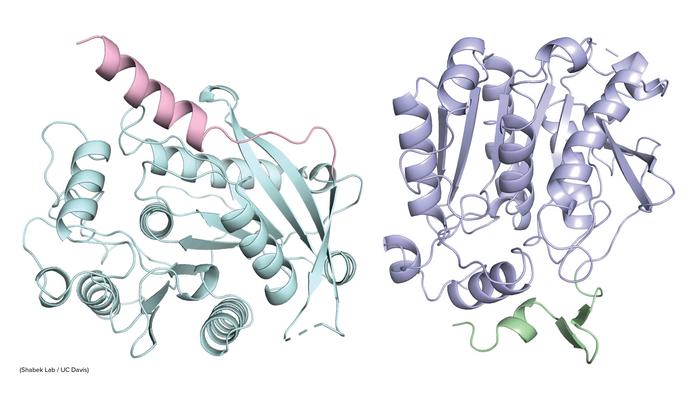
To investigate whether CXE15 and CX20 really are involved in strigolactone regulation, the researchers began by building 3D models of the enzymes’ molecular structure. This work was kickstarted by undergraduate researcher Linyi Yan, who grew and purified the carboxylesterase proteins in the lab.
That student-led project very quickly became something bigger, Shabek said.
Postdoctoral fellow Malathy Palayam used x-ray crystallography and computer simulations to solve the enzymes’ three-dimensional atomic structure, and performed biochemical experiments to compare how the two enzymes might degrade the hormone.
These experiments showed that CXE15 was much more efficient at breaking down strigolactone than CXE20, which binds to strigolactone but does not degrade it effectively. Their 3D models revealed something new: that a specific region of CXE15 actually allowed the enzyme to change its shape.
“CXE15 is a very effective enzyme—it can completely destroy the strigolactone molecule in milliseconds,” said Shabek. “When we zoomed in, we realized that there is a dynamic area in the enzyme’s structure which is required for it to function in this way.”
A dynamic enzyme
By examining CXE15’s structure, Shabek and his collaborators identified specific amino acids that allow the enzyme to dynamically bind to strigolactone. Then, to confirm that these amino acids were indeed responsible for the enzyme’s efficiency, they genetically engineered a mutant version of the enzyme with an altered dynamic region. The mutant version showed a reduced capacity to degrade strigolactone both in vitro and when the team tested it in Nicotiana benthamiana plants.
Shabek says the next steps will be to investigate how carboxylesterase enzymes are produced in different plant tissues, like roots and stems.
“In this study we were really interested in elucidating these enzymes’ mechanism and structure, but future studies can begin investigating how they affect plant growth and development,” Shabek said.
Additional authors on the study are: Ugrappa Nagalakshmi, Amelia K. Gilio and Savithramma Dinesh-Kumar, UC Davis; David Cornu and Francois-Didier Boyer, Universite Paris-Saclay, France.
The work was supported by the National Science Foundation and the U.S. Department of Energy.
Journal
Nature Communications
Method of Research
Experimental study
Article Title
Structural insights into strigolactone catabolism by carboxylesterases reveal a conserved conformational regulation.
Article Publication Date
1-Aug-2024
COI Statement
None declared.
Cite Scienmag News
Drew Townsend. (August 6, 2024). How plants become bushy, or not. Scienmag. https://scienmag.com/how-plants-become-bushy-or-not/
Drew Townsend. "How plants become bushy, or not." Scienmag, 6 August 2024, https://scienmag.com/how-plants-become-bushy-or-not/. Accessed 3 September 2026.
Drew Townsend. "How plants become bushy, or not." Scienmag. August 6, 2024. https://scienmag.com/how-plants-become-bushy-or-not/

