


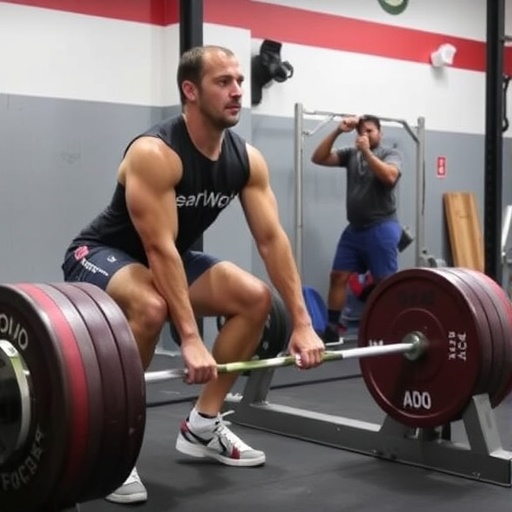
In the high-stakes realm of Olympic weightlifting, where victory can hinge on the slimmest of margins, every nuance of equipment performance warrants scrutiny. A single one-kilogram plate added or removed can distinguish a gold from a silver medal finish, pushing elite athletes and coaches to meticulously optimize every factor at their disposal. One subtle but critically influential characteristic under investigation is the “whip” of the barbell—the dynamic bending and oscillatory behavior experienced during explosive lifts.
Joshua Langlois, a dedicated graduate researcher at Pennsylvania State University, is poised to illuminate this area of study. As part of the 190th Meeting of the Acoustical Society of America, Langlois will present his pioneering research on the vibrational properties of Olympic barbells. His findings promise to deepen our understanding of how barbells’ physical dynamics might be leveraged to enhance athletic performance during competition.
The essence of the barbell’s whip resides in its ability to flex and rebound under rapid, powerful movements, such as the clean and jerk or the snatch. Langlois explains that weightlifters strategically exploit these oscillations: by synchronizing upward force with the bar’s natural vibrations, lifters can effectively add acceleration to the loaded weight. This delicate timing demands immense skill and can amplify the lifter’s efficiency during the critical phase of moving the barbell overhead.
Despite stringent regulations governing barbell specifications—including weight, diameter, and length—considerable variation exists across brands due to differing manufacturing processes. Variations in the steel alloys used, coating types, and especially the design and connection of the sleeve (the component holding the weight plates) create diverse mechanical responses during lifts. These factors collectively modulate a barbell’s vibrational modes, affecting the subtle whip characteristic vital to athletes.
Langlois’ research employs sophisticated modal analysis techniques to identify and contrast the vibrational signatures of multiple barbell models subjected to varying load conditions. By systematically testing the same barbell under incremental weights and juxtaposing multiple barbells under identical loads, the study aims to unravel how material properties and geometrical configurations influence performance-critical vibrations.
A surprising revelation from Langlois’ analysis is the outsized impact of sleeve geometry on vibrational behavior compared to the intrinsic material composition of the bar itself. The sleeves’ design alters the boundary conditions and dynamic response of the entire barbell system, thereby exerting a more profound effect on the modes of vibration than previously acknowledged. This insight shifts focus toward optimizing connection mechanics as a key factor in barbell design.
Although these exploratory findings chart new territory, they open crucial avenues for further research into how vibrational characteristics translate into measurable performance advantages during competition. Understanding these mechanics could lead to new standards and innovations in barbell manufacturing, tailoring equipment to maximize athletic output.
Langlois’ work confronts fundamental questions: How significant is the variation between barbells in terms of influencing lifter performance? What attributes define an optimally performing barbell? Access to advanced vibro-acoustic measurement tools and experimental setups will facilitate quantifying these parameters with precision.
The implications of this research are multifaceted. Beyond immediate application in elite weightlifting, insights into dynamic equipment behavior resonate across biomechanics, material science, and sports engineering. Optimizing equipment through vibration analysis could serve as a blueprint for innovation in other athletic disciplines reliant on specialized gear.
This research underscores the increasingly interdisciplinary nature of sports science, where understanding the physics of equipment dovetails with athlete physiology and training methodologies. Langlois’ investigations exemplify how careful scientific inquiry into seemingly subtle equipment properties can yield impactful breakthroughs with competitive ramifications.
As the 190th Meeting of the Acoustical Society of America unfolds, Langlois’ presentation will contribute to a vibrant discourse on acoustics applied in novel domains. His work not only enhances fundamental acoustical science but also bridges it with practical, real-world applications in Olympic sport.
In sum, the dynamic “whip” of a barbell is not merely an arcane curiosity but a pivotal factor in elite weightlifting performance. Through rigorous modal vibration analysis, researchers like Langlois are advancing our ability to harness these mechanics, promising to refine standards and elevate the boundaries of human lifting capability in the years ahead.
News Publication Date: May 13, 2026
Web References:
https://acoustics.org/asa-press-room/
https://acoustics.org/lay-language-papers/
https://acousticalsociety.org/
Keywords
Olympic weightlifting, barbell vibrations, whip, modal analysis, sports engineering, biomechanical acoustics, dynamic loading, material properties, sleeve geometry, athletic performance, oscillatory motion, Acoustical Society of America
Cite Scienmag News
Bethany Barker. (May 13, 2026). How Olympic Weightlifting Harnesses the Barbell’s ‘Whip’ for Peak Performance #ASA190. Scienmag. https://scienmag.com/how-olympic-weightlifting-harnesses-the-barbells-whip-for-peak-performance-asa190/
Bethany Barker. "How Olympic Weightlifting Harnesses the Barbell’s ‘Whip’ for Peak Performance #ASA190." Scienmag, 13 May 2026, https://scienmag.com/how-olympic-weightlifting-harnesses-the-barbells-whip-for-peak-performance-asa190/. Accessed 3 September 2026.
Bethany Barker. "How Olympic Weightlifting Harnesses the Barbell’s ‘Whip’ for Peak Performance #ASA190." Scienmag. May 13, 2026. https://scienmag.com/how-olympic-weightlifting-harnesses-the-barbells-whip-for-peak-performance-asa190/


