


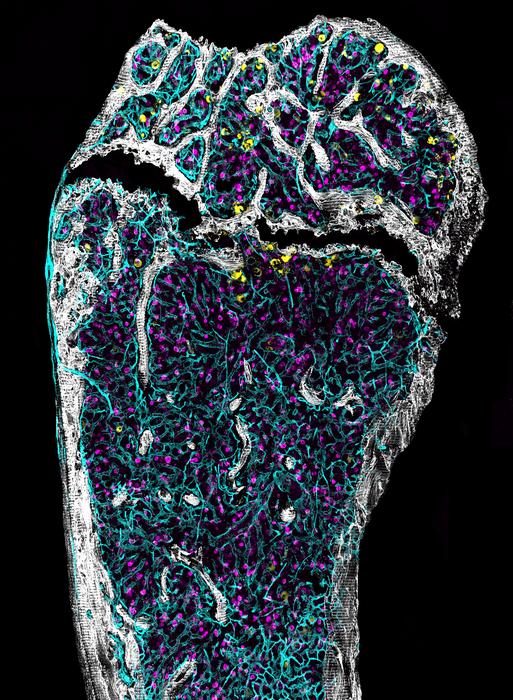
Our bone marrow—the fatty, jelly-like substance inside our bones—is an unseen powerhouse quietly producing 500 billion new blood cells every day. That process is driven by hematopoietic stem cells that generate all of the various types of blood cells in our bodies and regenerating themselves to keep the entire assembly line of blood production operating smoothly.

Credit: The Jackson Laboratory
Our bone marrow—the fatty, jelly-like substance inside our bones—is an unseen powerhouse quietly producing 500 billion new blood cells every day. That process is driven by hematopoietic stem cells that generate all of the various types of blood cells in our bodies and regenerating themselves to keep the entire assembly line of blood production operating smoothly.
As with any complex system, hematopoietic stem cells lose functionality as they age—and, in the process, contribute to the risk of serious diseases, including blood cancers. We know that the risk of developing aging-associated diseases is different among different individuals. Surprisingly, however, little is known about whether hematopoietic stem cells age differently between individuals.
“If you take a room full of 50-year-olds, some will be completely gray-haired, others will be salt-and-pepper, and a few will not have any gray hairs at all,” said Jennifer Trowbridge, Dattels Family Endowed Chair and professor at the Jackson Laboratory. “Logically, you’d expect to see the same kind of variation in the function of hematopoietic stem cells—but until now, nobody has studied that directly.”
For good reason: Because these hematopoietic stem cells are so rare, researchers typically pool all of these stem cells together, studying them in aggregate. In a paper published in Blood, Trowbridge and colleagues studied hematopoietic stem cells at the single cell level in nine individual, genetically identical middle-aged mice – offering the first close look at how subtle changes in the bone marrow microenvironment ages hematopoietic stem cells across individual mice.
Trowbridge and team found that despite the mice being all the same age, the hematopoietic stem cells in the bone marrow of these individual mice aged differently. But that’s not all. The team could predict the function of the hematopoietic stem cells based on the activity of two growth factors that are also present in humans.
The two growth factors – Kitl and Igf1 – are produced by mesenchymal stromal cells (MSC) that surround the stem cells in the bone marrow microenvironment. By profiling the RNA transcriptome in these MSCs across individual mice, Trowbridge found that the decline of these growth factors correlated with age-associated molecular programs in hematopoietic stem cells.
“The amount of the growth factors that are being produced directly correlates to the declining function of the stem cells – and we found markedly more variation in hematopoietic stem cells than in other cells in the bone marrow,” Trowbridge said. “This is really a snapshot of the aging process at work, at the cellular level.” “
In humans, who are genetically diverse and have varying lifestyles, variations in hematopoietic stem cell aging are likely to be even greater than in carefully controlled animal models, explained Trowbridge. While the current study didn’t explore whether cellular aging of the stem cells directly triggers adverse health outcomes, it’s likely that such variations play a role in a wide range of health outcomes for both mice and humans.
Journal
Blood
Method of Research
Experimental study
Subject of Research
Animals
Article Title
Variation in Mesenchymal KITL/SCF and IGF1 Expression at Middle Age Underlies Steady-State Hematopoietic Stem Cell Aging
Article Publication Date
10-Apr-2024
Cite Scienmag News
Nathaniel Bowman. (June 23, 2024). How old is your bone marrow? Scienmag. https://scienmag.com/how-old-is-your-bone-marrow/
Nathaniel Bowman. "How old is your bone marrow?" Scienmag, 23 June 2024, https://scienmag.com/how-old-is-your-bone-marrow/. Accessed 4 September 2026.
Nathaniel Bowman. "How old is your bone marrow?" Scienmag. June 23, 2024. https://scienmag.com/how-old-is-your-bone-marrow/

