


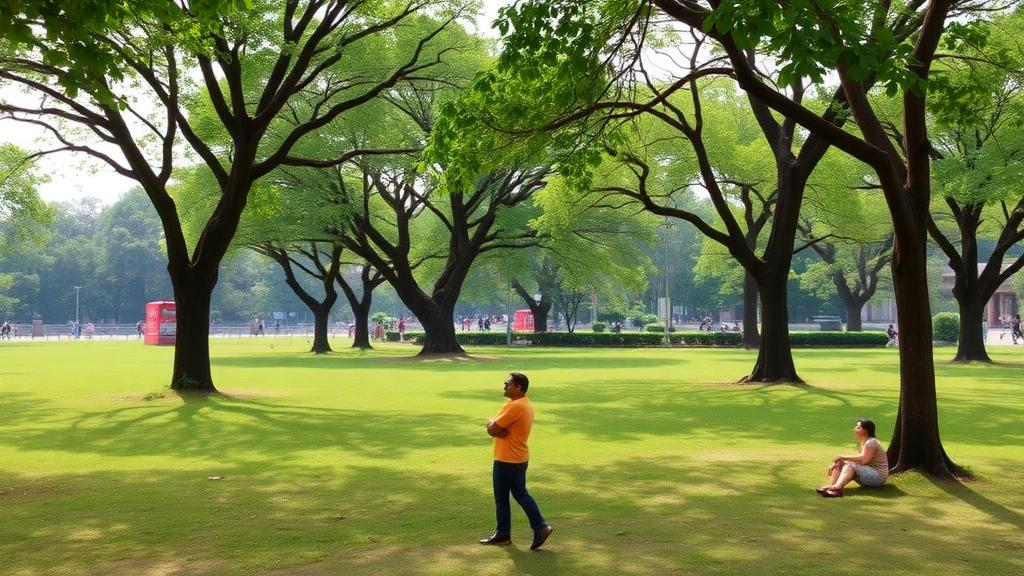
In the crowded heart of Jashore, a mid-sized city in southwestern Bangladesh, a ten-acre patch of green has quietly become one of the town’s most valuable assets. A new study published in the open-access journal Heliyon has, for the first time, put hard numbers on what Jashore Pouro Park delivers to its visitors, combining visitor surveys, seasonal water-quality monitoring, and an economic valuation technique known as the individual travel cost method. The headline figure is striking: the park generates an estimated annual recreational value of roughly 1.66 million Bangladeshi Taka, equivalent to about 15,000 US dollars, from just under 11,000 recorded visits per year. While that may sound modest by global standards, the study’s real significance lies in its integrated approach, which links what visitors perceive and pay with what the park’s ponds and greenery actually deliver.
The research team, led by Afra Tanjim Shammi, Prosun Kumar Ghosh, and Md Rony Golder, surveyed 561 adult park users between April 2021 and March 2022. Respondents were recruited on-site across three seasons using a standardized intercept procedure, with only one adult interviewed per visiting group to reduce selection bias. The visitor profile was distinctly urban and educated: 96.3 percent came from urban areas, 95.4 percent were local residents, and more than 86 percent held a bachelor’s degree or higher. Nearly 60 percent of respondents were aged 26 to 35, and just over half were employed. Household incomes clustered in the 30,001 to 50,000 Taka range, with a mean of about 45,684 Taka per month. This demographic picture suggests the park primarily serves a socio-economically stable, middle-aged urban population seeking respite from city life, a pattern consistent with other Bangladeshi urban parks.
Why do people come? The answer, overwhelmingly, is fresh air and relaxation, cited by 57.9 percent of respondents, followed by children’s play at 28.9 percent. Facility ratings were generally positive but pointed to room for improvement. Sports facilities were rated moderate by nearly 90 percent of visitors, walking paths were rated moderate or excellent by all but a handful, and solid waste management and security each earned moderate-to-excellent marks from virtually everyone surveyed. These perceptions matter because they capture the cultural ecosystem services that urban green spaces provide, benefits that are notoriously difficult to quantify but that underpin public support for maintaining parks in rapidly urbanizing cities.
When asked about the park’s environmental services, visitors showed a clear hierarchy of awareness. Nearly all respondents agreed that the park improves air quality, regulates the local climate, provides habitat for plants and birds, offers aesthetic and scenic value, and contributes oxygen-related benefits. These are the visible, directly experienced services that people encounter every time they walk beneath the trees. In contrast, recognition dropped sharply for less tangible functions: perceived contributions to water purification, pest regulation, and spiritual or religious value were low, with many respondents expressing uncertainty or no opinion. The authors interpret this gap not as evidence that such services are absent, but as a sign that the public underestimates indirect ecosystem processes, a finding that argues for stronger environmental education alongside biophysical monitoring.
The study also ventured into the park’s two ponds, collecting 90 surface-water samples across summer, monsoon, and winter to assess whether the water bodies meet Bangladesh’s recreational water-quality standards. Most parameters told a reassuring story. Total dissolved solids stayed well below the 1,000 milligrams per liter guideline, salinity remained low except for seasonal winter peaks, and pH values largely fell within the acceptable range of 6 to 9. Dissolved oxygen generally met the minimum threshold of 5 milligrams per liter, though one monsoon reading dipped slightly below it, and a single summer biochemical oxygen demand measurement in Pond 1 marginally exceeded the 3 milligrams per liter limit. These were localized, seasonal excursions rather than chronic failures.
The standout problem was chemical oxygen demand, or COD, a measure of the total oxidizable organic and inorganic matter in water. Bangladesh’s Environmental Conservation Rules set a guideline of no more than 10 milligrams per liter for recreational waters, but the park’s ponds recorded values ranging from roughly 100 to 590 milligrams per liter, with the most extreme readings in Pond 1 during the monsoon. The authors attribute this surge to rainfall-driven runoff carrying domestic wastewater, organic debris, and urban pollutants into the ponds, compounded by the resuspension of organically enriched bottom sediments under hydraulic disturbance. Because the sampling design involved only two ponds with spatial subsamples rather than independent replicates, the results are descriptive and site-specific, but the seasonal pattern is a clear warning sign for park managers.
To translate visitation into monetary value, the researchers turned to the individual travel cost method, a revealed-preference technique that treats the money and effort visitors spend reaching a site as a proxy for what the site’s recreational benefits are worth to them. Because the number of annual visits is a non-negative count, ordinary linear regression was inappropriate. A Poisson model was tried first but suffered severe overdispersion, with a dispersion ratio of nearly 55, meaning the variance in visitation far exceeded the mean. The team therefore adopted a negative-binomial regression, which explicitly models that extra variability. Model comparison statistics strongly favored this choice: the negative-binomial specification improved the log likelihood from about minus 12,905 to minus 2,396 and slashed the Akaike information criterion from over 25,800 to roughly 4,807.
The econometric results followed economic theory closely. Travel cost carried a significant negative coefficient, meaning that as the expense of reaching the park rose, visitation fell. Household income, by contrast, was positively and significantly associated with visit frequency, while expenditure, age, gender, and education showed no independent effects once other variables were controlled. From the travel-cost coefficient of minus 0.006436, the researchers calculated a consumer surplus of 155.38 Taka per visit, with a 95 percent confidence interval of 118.06 to 192.70 Taka. Multiplying this by the estimated 10,689 annual visits, derived from 15 days of entrance-gate counts per season extrapolated across the year, yielded the headline annual recreational value of approximately 1.66 million Taka. A sensitivity analysis spanning plausible visitation ranges and the confidence interval for consumer surplus bounded the aggregate value between 1.16 and 2.22 million Taka per year.
The authors are candid about their limitations. The exact day-by-day visitor count series was not retained in the archived dataset, so the annual visitation estimate rests on seasonal summaries rather than a fully reconstructable record, and the aggregate value is presented as a deterministic sensitivity range rather than a formal confidence interval. Travel time was not monetized separately because most visitors were local, and the questionnaire, while pilot-tested and carefully administered, did not undergo formal psychometric validation. An exact response rate could not be calculated because refusals were not systematically logged. These caveats do not undermine the central findings, but they do mean the figures should be read as a well-grounded baseline for one site rather than a universal benchmark.
What elevates the study beyond a single park’s accounting is its proposed path forward. The authors sketch the concept of an Entry Charge Index, a composite tool that would combine normalized water-quality indicators, facility and service ratings, and an affordability component derived from visitor socio-economics to help park authorities set transparent, evidence-based fee tiers. Applied across multiple parks, such a framework could transform scattered site assessments into a comparable national picture of what urban green spaces are worth. For a country where unplanned urbanization is eroding green cover at an alarming pace, demonstrating that even a modest neighborhood park delivers measurable ecological, social, and economic returns is a powerful argument for protecting what remains. Jashore Pouro Park, it turns out, is worth far more than the sum of its ponds and pathways, and now there are numbers to prove it.
Subject of Research: Economic valuation of ecosystem services and recreational water quality in an urban park in Jashore, Bangladesh
Article Title: Assessing environmental services and recreational value of Jashore Pouro Park in Jashore district of Bangladesh
Article References: Shammi, A. T., Ghosh, P. K., & Golder, M. R. (2026). Assessing environmental services and recreational value of Jashore Pouro Park in Jashore district of Bangladesh. Heliyon, 12(15), Article e45497. https://doi.org/10.1016/j.heliyon.2026.e45497
Image Credits: AI Generated
DOI: 10.1016/j.heliyon.2026.e45497
Keywords: urban parks, ecosystem services, travel cost method, recreational value, water quality, Bangladesh, Jashore, consumer surplus, negative binomial regression, monsoon pollution, urban green space, cultural ecosystem services
Cite Scienmag News
Drew Townsend. (October 1, 2026). How Much Is a City Park Worth? A Bangladeshi Study Puts a Price on Green Space. Scienmag. https://scienmag.com/how-much-is-a-city-park-worth-a-bangladeshi-study-puts-a-price-on-green-space/
Drew Townsend. "How Much Is a City Park Worth? A Bangladeshi Study Puts a Price on Green Space." Scienmag, 1 October 2026, https://scienmag.com/how-much-is-a-city-park-worth-a-bangladeshi-study-puts-a-price-on-green-space/. Accessed 5 October 2026.
Drew Townsend. "How Much Is a City Park Worth? A Bangladeshi Study Puts a Price on Green Space." Scienmag. October 1, 2026. https://scienmag.com/how-much-is-a-city-park-worth-a-bangladeshi-study-puts-a-price-on-green-space/


