

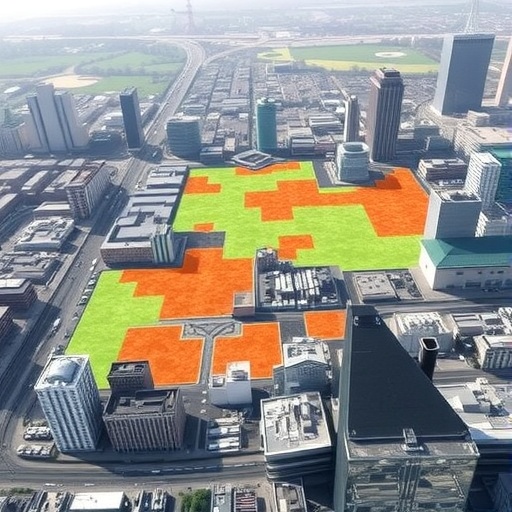
As the 21st century progresses, the intricate relationship between land use and air quality has emerged as a pivotal subject in environmental science and urban planning. Recent research underscores the profound impacts that urbanization, urban vegetation, and agriculture exert on atmospheric conditions, ultimately shaping the health and sustainability of human populations. These land use changes, driven largely by economic development, population growth, and shifting agricultural practices, have generated complex air quality dynamics that demand thorough investigation. The combined study of these factors reveals how spatial and temporal patterns of land transformation can alter the concentration, composition, and distribution of airborne pollutants.
Urbanization stands out as a dominant driver of land use change, fundamentally reshaping landscapes by converting natural or agricultural lands into dense built environments. This transition impacts air quality through multiple mechanisms. The proliferation of impervious surfaces reduces natural land cover, thwarting the natural processes of pollutant absorption and atmospheric cleansing typically facilitated by vegetation and soil. Moreover, urban areas generate significant anthropogenic emissions, including nitrogen oxides (NOx), volatile organic compounds (VOCs), particulate matter (PM), and greenhouse gases, through vehicular traffic, industrial activity, and energy consumption. These emissions not only degrade local air quality but also contribute to regional atmospheric chemistry alterations that propagate secondary pollutant formation, such as ozone.
Amid urban expansion, the role of urban vegetation is increasingly recognized as a mitigating force against air pollution. Trees, green spaces, and other vegetation serve as natural filters by intercepting particulate matter on leaf surfaces and absorbing gaseous pollutants through stomata. The physiological processes of photosynthesis and transpiration also influence microclimates, potentially modulating temperature-driven photochemical reactions that exacerbate ozone formation. However, the effectiveness of urban vegetation as an air quality intervention is nuanced and depends on species selection, canopy density, spatial arrangement, and maintenance practices. Certain tree species emit biogenic VOCs that can paradoxically elevate ozone levels, emphasizing the necessity for carefully tailored green infrastructure planning.
Agricultural land use, while less conspicuous in densely populated urban centers, equally affects air quality through a distinct set of pathways. The emission of ammonia (NH3) from fertilizer application and livestock waste contributes to the formation of secondary particulate matter, specifically ammonium nitrate and ammonium sulfate aerosols. These fine particles have detrimental health effects and impact visibility and climate radiative forcing. Agricultural activities also release methane (CH4) and nitrous oxide (N2O), potent greenhouse gases influencing atmospheric chemistry and climate feedback loops. Additionally, the physical disturbance of soil surfaces can raise dust and other particulates, complicating local air quality scenarios in rural-urban interface zones.
The interplay between urbanization, urban vegetation, and agricultural practices often produces synergistic or antagonistic effects on air pollution patterns. This complexity necessitates an integrative modeling approach that combines land use change projections with atmospheric chemistry transport simulations. State-of-the-art models incorporate spatially explicit land cover data, emission inventories, meteorological inputs, and chemical transport dynamics to predict future scenarios of pollutant concentrations. Integrating satellite observations and ground-based monitoring enhances model validation, enabling urban planners and policymakers to understand the ramifications of development strategies on air quality comprehensively.
Recent empirical studies highlight that rapid urban sprawl without proportional investment in green spaces exacerbates pollution hotspots and lowers urban air quality resilience. Conversely, cities implementing cohesive urban forest expansion and optimized green corridors witness measurable improvements in pollutant removal and microclimate regulation. Evidence points to the adoption of multifunctional urban vegetation strategies that maximize ecosystem services while minimizing unintended consequences such as allergenic pollen production or biogenic VOC emissions. These findings inspire innovative green infrastructure designs, incorporating diverse plant species and multilayered vegetation structures to bolster air purification efficacy.
Agricultural management techniques also hold promise in mitigating air quality degradation. Precision fertilization, optimized manure handling, and conservation tillage reduce ammonia volatilization and particulate matter generation. Transitioning towards agroecological practices that enhance soil health and biodiversity can further lower greenhouse gas emissions and stabilize local microclimates. Encouraging crop selection and rotation patterns that minimize chemical inputs complements these efforts by indirectly curtailing atmospheric pollutant precursors. These improvements require policy frameworks supporting sustainable farming incentives and integrated landscape management, particularly crucial in peri-urban zones undergoing intense land use flux.
Understanding the temporal dynamics of land use impacts on air quality is critical. Seasonal variations in vegetation phenology, agricultural cycles, and meteorological conditions influence pollutant emission rates and atmospheric residence times. For example, during growing seasons, enhanced photosynthetic activity boosts pollutant uptake but may also increase biogenic VOC emissions, affecting ozone chemistry differently at various times of day. Similarly, wintertime heating emissions combined with stagnant atmospheric conditions can aggravate smog formation in urbanized regions. This seasonally driven feedback underscores the need for adaptive management strategies responsive to evolving environmental contexts.
The socio-economic implications of air quality alterations linked to land use changes are profound. Exposure to elevated levels of fine particulate matter, ozone, and other pollutants directly correlates with respiratory and cardiovascular morbidity, impacting public health systems and workforce productivity. Vulnerable populations residing in low-income or marginalized urban neighborhoods often bear disproportionate pollution burdens, exacerbating social inequalities. Urban planning decisions must therefore integrate air quality considerations alongside housing, transportation, and economic development objectives to promote equitable and sustainable urban growth.
Technological advances in data acquisition and analytics are reshaping air quality research related to land use dynamics. High-resolution remote sensing platforms enable detailed mapping of land cover transformations and vegetation health, while machine learning techniques facilitate pattern recognition and predictive analytics. Urban sensor networks and mobile monitoring units generate real-time air quality data streams that, when integrated with modeling tools, provide actionable insights for city managers and environmental agencies. These innovations empower more precise targeting of interventions and real-time evaluation of policy efficacy.
Climate change adds another layer of complexity to the relationship between land use and air quality. Rising temperatures, altered precipitation patterns, and shifting vegetation regimes influence both pollutant emissions and atmospheric chemical processes. Urban heat islands intensify thermal inversions that trap pollutants near the surface, worsening air quality. At the same time, climate-driven stress on vegetation could reduce its pollution mitigation capacity. Anticipating these interactions requires coupled climate-land use-air quality modeling to guide resilient urban and agricultural landscape designs under future environmental scenarios.
In response to these challenges, integrated urban sustainability frameworks increasingly emphasize the synergistic management of land use and air quality. Strategies such as compact city development, green infrastructure networks, sustainable transportation systems, and urban agriculture are promoted to harmonize human activity with atmospheric health. Cross-sectoral collaboration among urban planners, ecologists, atmospheric scientists, public health experts, and policymakers is vital to enact holistic solutions that optimize air quality benefits while supporting socio-economic vitality.
Looking forward, continuous monitoring, robust scientific inquiry, and innovative policy implementation will be essential to address the evolving impact of land use changes on air quality. Incorporating citizen science initiatives and fostering community engagement further enhance societal understanding and commitment to air quality improvement. Ultimately, designing cities and landscapes with balanced land use configurations that respect ecological processes offers the most promising path toward healthier air and more sustainable urban futures globally.
Subject of Research: The influence of land use changes, specifically urbanization, urban vegetation, and agriculture, on air quality and atmospheric pollutant dynamics.
Article Title: Effect of land use changes on air quality: impacts of urbanization, urban vegetation, and agriculture
Article References: Badia, A., Segura-Barrero, R., Ventura, S. et al. Effect of land use changes on air quality: impacts of urbanization, urban vegetation, and agriculture. npj Urban Sustain (2025). https://doi.org/10.1038/s42949-025-00303-y
Image Credits: AI Generated


