


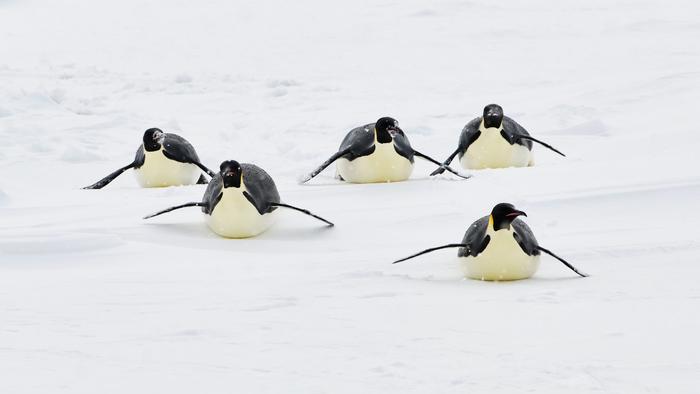
The Weddell Sea is the largest marginal sea in the Southern Ocean and a veritable hotspot of life. Here, seals and emperor penguins have their young. The swarms of krill, which graze on microalgae under ice floes, attract fish, whales and seabirds. On the seafloor, millions of icefish spawn, while underwater gardens full of glass sponges, sea anemones and sea squirts thrive, some reaching a level of biodiversity comparable to that of tropical reefs.

Credit: Alfred Wegener Institute / Mario Hoppmann
The Weddell Sea is the largest marginal sea in the Southern Ocean and a veritable hotspot of life. Here, seals and emperor penguins have their young. The swarms of krill, which graze on microalgae under ice floes, attract fish, whales and seabirds. On the seafloor, millions of icefish spawn, while underwater gardens full of glass sponges, sea anemones and sea squirts thrive, some reaching a level of biodiversity comparable to that of tropical reefs.
Eleven institutes from eight countries have joined in the Weddell Sea Observatory of Biodiversity and Ecosystem Change (WOBEC). Over the next three years, participating researchers will determine the current state of the biotic community in the Weddell Sea, as a reference for a long-term monitoring of the ecosystem in the transforming Southern Ocean. WOBEC is one of 33 projects in the European Union’s flagship programme BiodivMon, under the aegis of Biodiversa+, the European Biodiversity Partnership. The programme will commence in April with a Kick-off Meeting in Tallinn, Estonia. National partners have allocated WOBEC 1.9 million euros in financial backing. The Alfred Wegener Institute, Helmholtz Centre for Polar and Marine Research (AWI) is supported by the Federal Ministry of Education and Research and also makes a substantial contribution of its own.
“The Weddell Sea constitutes a largely untouched, and therefore extremely valuable, habitat. Not only does it have a high aesthetic value; it is also characterised by unique biodiversity. This biological diversity is also the source of important ecosystem services, like the storage of carbon in the deep sea through ice algae and the remains of plankton sinking to the bottom,” explains Dr Hauke Flores, a marine biologist at the Alfred Wegener Institute and coordinator of the EU project. “However, climate change has long-since spread to the southern polar region: In the past few years, we’ve witnessed an unexpectedly rapid decline in sea ice. We don’t know how, or if, the region’s organisms can adapt to the changed environmental conditions. In order to assess this aspect, we need to first gain a better grasp of the ecosystem’s status quo and urgently need to begin systematic data collection.”
The project’s focus is on observing potential long-term changes in biodiversity in the eastern Weddell Sea. Although countries like Germany, Norway and South Africa have been conducting research in the region for decades, systematic studies on its massive ecosystem are lacking. In fact, there is a substantial gap: According to Hauke Flores, for thousands of kilometres to the east and west of WOBEC’s target area, there have been no long-term observations of the marine biodiversity.
An expedition with the icebreaker Polarstern along the Prime Meridian and into the southern Weddell Sea, coordinated by the University of Rostock, is planned for 2026. During their journey, the researchers plan to explore the Maud Rise seamount and build on previous investigations of the benthic biotic communities at Cape Norvegia, to the west of Germany’s Neumayer Station III.
In addition to collecting valuable new data, the experts will dig through their archives and make previously unreleased and hard-to-find results available in publicly accessible databases. “On the basis of historical and current data alike our goal is to create a strategy for long-term environmental monitoring in the Weddell Sea with the aid of autonomous observatories, satellite-based remote sensing, and ship-based sampling,” says Hauke Flores. Stakeholders from the political, business and nature conservation communities will be involved in the process, which will also take place in close collaboration with the Commission for the Conservation of Antarctic Marine Living Resources (CCAMLR).
For many years now, the EU and other CCAMLR members have advocated the protection of large areas of the Weddell Sea. Thanks in part to the AWI’s expertise, a protection concept was developed and initially submitted to CCAMLR in 2016. “The proposed Marine Protected Area currently consists of two regions in the western and eastern Weddell Sea, parts of which are within WOBEC’s target area,” explains Dr Katharina Teschke, a marine ecologist and head of the MPA project at AWI. The planned MPA is the outcome of an approach that considers the entire ecosystem and is based on the precautionary principle. “The objective is to preserve a still-untouched marine region as a refuge for cold-adapted species, where, as Earth continues to warm, they can hopefully adapt to the changed environmental conditions undisturbed,” says Katharina Teschke.
“So far, the proposal for a new Marine Protected Area has failed to pass because the vote has to be unanimous, and the current geopolitical situation makes CCAMLR negotiations even tougher. However, the ratification of the Agreement under the United Nations Convention on the Law of the Sea on the Conservation and Sustainable Use of Marine Biological Diversity of Areas beyond National Jurisdiction (BBNJ Treaty) last year is a promising development,” says Katharina Teschke. “It’s a positive signal that could help stimulate the process of declaring a Marine Protected Area in the Weddell Sea under CCAMLR. WOBEC will give us the opportunity to create a science-based strategy for assessing biodiversity within the Marine Protected Area and its future changes.”
Cite Scienmag News
Margaret Porter. (June 11, 2024). How is the dramatic decline in sea ice affecting biodiversity? Scienmag. https://scienmag.com/how-is-the-dramatic-decline-in-sea-ice-affecting-biodiversity/
Margaret Porter. "How is the dramatic decline in sea ice affecting biodiversity?" Scienmag, 11 June 2024, https://scienmag.com/how-is-the-dramatic-decline-in-sea-ice-affecting-biodiversity/. Accessed 3 September 2026.
Margaret Porter. "How is the dramatic decline in sea ice affecting biodiversity?" Scienmag. June 11, 2024. https://scienmag.com/how-is-the-dramatic-decline-in-sea-ice-affecting-biodiversity/

