


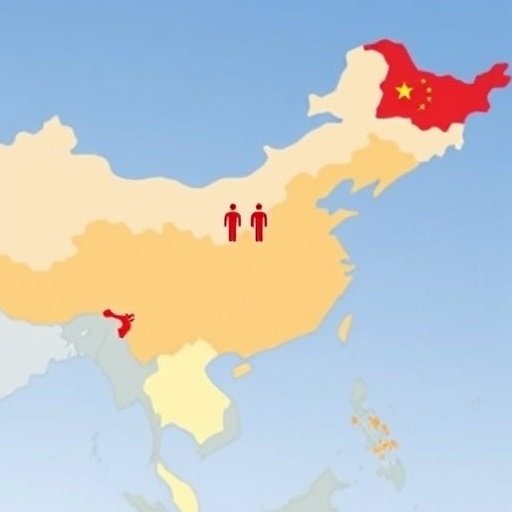
In a groundbreaking study recently published in BMC Psychology, researchers have unveiled new insights into the intricate relationship between intergroup contact and the formation of Chinese National Community Identity. The research deploys a sophisticated moderated mediation model to dissect how interactions across different social groups influence national identity, shedding light on the psychological mechanisms that foster unity within diverse populations. This cutting-edge work stands at the intersection of social psychology and nationalism studies, providing a nuanced understanding of how personal and contextual factors combine to shape individual and collective identities in modern China.
Intergroup contact theory, a cornerstone of social psychology, posits that direct interactions between members of different social groups can reduce prejudice and foster more harmonious relations. However, the extension of this theory into the realm of national identity formation requires a tailored analytical approach, especially in a culturally rich and politically complex context such as China. This study leverages advanced statistical methods to explore not only the direct effects of intergroup contact but also the conditions under which these effects are strengthened or weakened, marking a significant evolution in how social cohesion is scientifically understood.
The moderated mediation model at the heart of the research accounts for multiple layers of influence. By investigating mediating psychological processes—such as feelings of belonging, trust, and perceived social support—and examining moderators like perceived cultural threat and intergroup anxiety, the study captures the dynamic interplay that determines the strength of Chinese National Community Identity. Essentially, the model illuminates how positive contact can translate into stronger national identification, but only under specific psychological and social conditions.
Central to the research is the concept of Chinese National Community Identity, a collective self-concept entailing a psychological sense of belonging to the nation as a unified social entity. Understanding the psychological underpinnings of this identity is critical in a rapidly changing society where urbanization, migration, and globalization intersect. The study situates national identity as both an outcome and a driver of social cohesion, emphasizing how everyday social interactions can either consolidate or fragment the national fabric.
The researchers conducted extensive surveys across diverse demographic groups in China, integrating quantitative measures of intergroup contact frequency and quality, psychological mediators, and identity strength. By employing structural equation modeling, they traced the pathways through which intergroup encounters influence national community identification. These data-driven approaches provide robust evidence for the critical role of social contact in forging a shared national identity.
One remarkable finding is that intergroup contact’s impact on national identity is not monolithic. The presence of moderating variables like intergroup anxiety reveals that in scenarios where individuals experience heightened social tension or fear of cultural displacement, the beneficial effects of contact diminish considerably. This discovery underscores the necessity of mitigating anxiety and negative expectations to fully harness the integrative potential of intergroup interactions.
Moreover, the study highlights the importance of perceived social support as a mediating factor. When individuals feel supported by their wider social networks, positive intergroup experiences are more likely to be internalized, reinforcing their sense of belonging to the national community. This revelation suggests that policies fostering social support structures could amplify the integrative effects of intergroup contact.
The complexity of the moderated mediation model also reveals how cultural threat perceptions can interfere with identity formation processes. Participants who perceived their cultural worldview or traditions as being under threat were less inclined to translate positive intergroup experiences into a stronger national identity. This insight points to the delicate balance policymakers must maintain between promoting cultural pride and fostering national unity.
The implications of these findings extend beyond academic circles. In practical terms, the research offers valuable guidance for initiatives aimed at reducing ethnic and social divisions within China’s vast, heterogeneous population. By identifying psychological barriers and facilitators to national identification, the study provides actionable knowledge for educational programs, community-building efforts, and governmental campaigns designed to cultivate social harmony.
Furthermore, the study contributes to a growing international literature that examines how intergroup dynamics intersect with nationalism in multicultural societies. While much of the existing research centers on Western contexts, this work enriches our understanding by foregrounding a non-Western, collectivist society with unique historical and sociopolitical characteristics. Such comparative perspectives are vital for developing universal theories of social identity formation.
In methodological terms, the research exemplifies the power of combining traditional social psychological theories with contemporary statistical modeling to unravel complex social phenomena. The use of moderated mediation analysis allows researchers to go beyond surface-level associations and probe the conditional processes that shape identity. This approach can serve as a model for future studies seeking to explore multifaceted social constructs in depth.
The publication’s timing is particularly relevant given the global rise of nationalist movements and the increasing importance of social integration policies in diverse societies. Understanding how contact between groups influences national identity can inform responses to societal polarization, xenophobia, and fragmentation not only in China but worldwide. The nuanced findings advocate for interventions that are sensitive to emotional and cognitive mediators of identity, rather than one-size-fits-all solutions.
The study’s authors also call for further research to explore longitudinal effects and to examine how technological mediated contact impacts identity formation in the digital age. As virtual interactions become ubiquitous, the mechanisms by which intergroup contact influences national identification could shift, necessitating updated theoretical frameworks and empirical strategies.
Critics might argue that the model’s complexity could limit its practical applicability or that divergent findings in different sociocultural contexts could challenge its generalizability. Nevertheless, this pioneering work sets a firm foundation for subsequent research to refine and validate the moderated mediation framework across various populations and nations.
In conclusion, this meticulously conducted research adds a vital piece to the puzzle of how social contact weaves the threads of national identity. It confirms that fostering positive intergroup relations is more than a moral or political imperative—it is a psychologically complex process influenced by multiple interacting variables. By illuminating these pathways, the study not only advances academic knowledge but also offers a roadmap for nurturing cohesive, resilient national communities in an era marked by diversity and change.
As nations worldwide grapple with the challenges of diversity, this study’s rich insights will undoubtedly inspire policymakers, social scientists, and community leaders alike. Through targeted efforts that reduce anxiety, enhance social support, and manage cultural threat perceptions, it is possible to leverage intergroup contact to build stronger, more inclusive national identities. This vision of integration, grounded in rigorous psychological science, offers hope for a future where diversity is embraced and national unity flourishes.
Cite Scienmag News
Glenn Wilkins. (July 31, 2025). How Intergroup Contact Shapes Chinese National Identity. Scienmag. https://scienmag.com/how-intergroup-contact-shapes-chinese-national-identity/
Glenn Wilkins. "How Intergroup Contact Shapes Chinese National Identity." Scienmag, 31 July 2025, https://scienmag.com/how-intergroup-contact-shapes-chinese-national-identity/. Accessed 4 September 2026.
Glenn Wilkins. "How Intergroup Contact Shapes Chinese National Identity." Scienmag. July 31, 2025. https://scienmag.com/how-intergroup-contact-shapes-chinese-national-identity/


